

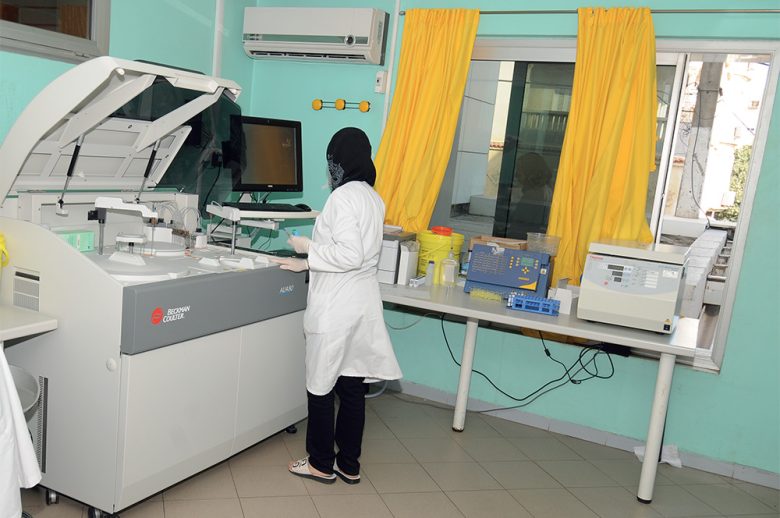
The debate over conducting certain medical tests within pharmacies has reached a new escalation. Following a statement from the Algerian Syndicate of Medical Analysis Laboratories (Salam) reaffirming the exclusivity of accredited laboratories in medical biology, the National Syndicate of Pharmacy Pharmacists (Snapo) stepped up this Monday to defend what it describes as a right acquired since 1976.
In a recent statement, Salam asserts that performing medical biology tests is strictly reserved for legally accredited laboratories, citing Article 251 of Law No. 18-11 on health. According to the laboratories’ syndicate, any practice outside this framework, particularly in pharmacies or treatment rooms, constitutes a clear violation of current legislation.
Salam also emphasizes that this interpretation was confirmed during a meeting held at the Ministry of Health on October 12, 2023, attended by ministerial experts, the representative of the National Council of the Order of Pharmacists, and the director of regulations. A minutes document from this meeting, of which the syndicate claims to have a copy, would confirm the formal prohibition of any biological testing outside accredited laboratories.
Considering any deviation a threat to public health and patient safety, Salam announces its determination to pursue union and judicial actions against any deemed illegal practice.
In response, Snapo categorically refutes this interpretation and maintains that basic tests performed in pharmacies fall under a long-standing legal framework recognized since 1976, which cannot be overturned by a statement or a unilateral reading of the law.
Regarding the October 2023 meeting cited by Salam, the pharmacists’ syndicate states that it was interrupted by the session chair due to one participant’s failure to respect dialogue rules. Snapo further clarifies that it has received no official minutes, stressing that any document not signed by all present parties “cannot bind the profession.”
Another point of contention is the ministerial commission tasked with establishing the list of tests authorized in pharmacies. According to Snapo, this commission has still not completed its work, and no report has been shared with the syndicate since its establishment, perpetuating ongoing regulatory ambiguity.
For pharmacists, the joint ministerial circular of 2023 remains clear and applicable, requiring no restrictive interpretation.
Snapo stresses the social and territorial dimension of the issue. In many isolated municipalities lacking medical analysis laboratories, pharmacies have provided basic services for decades, such as blood glucose measurement, at an accessible cost.
Forcing patients to travel hundreds of kilometers for simple tests would, according to the syndicate, contradict principles of equity and universal access to care.
While Salam claims to ensure national coverage, including in the country’s most remote regions, Snapo reminds that pharmacists are full-fledged health actors, possessing the necessary academic and professional skills to provide certain proximity services under the Ministry of Health’s oversight.
This tug-of-war between pharmacists and laboratories highlights persistent ambiguities in the regulatory framework. Without clear and definitive arbitration from health authorities, the issue risks further developments amid corporate tensions and major public health stakes.