

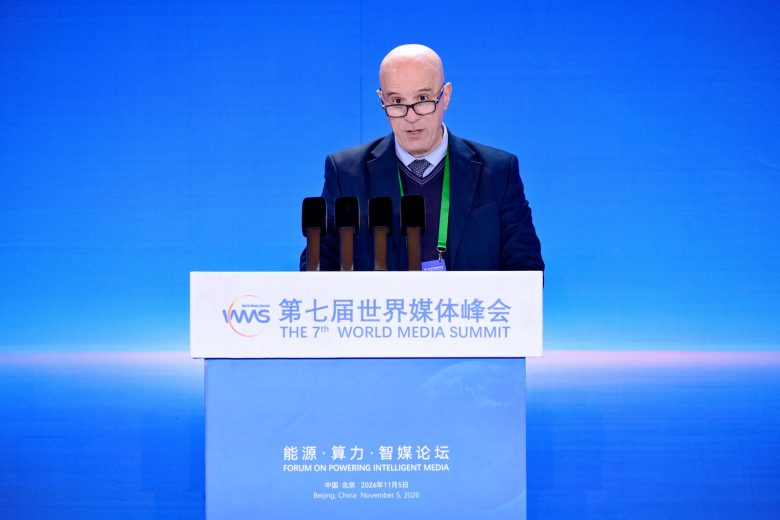
Artificial Intelligence is swiftly transforming into “one of the most potent weapons of mass deception ever designed.” Through this stern warning, the publishing director of the newspaper Le Jeune Independant, Kamel Mansari, opened discussions at the onset of the seventh World Media Summit within the Chinese capital. Co-organized by the Xinhua news agency alongside the popular government of the Beijing municipality, this international event brings together numerous information leaders around the central theme: “Media in the intelligent era: from consensus to action.”
While technological promises typically dominate event schedules, the preparatory sessions stood out due to this strikingly realistic plea, forcing attendees to confront clear threats targeting national sovereignty in the digital age.
The atmosphere of the preliminary proceedings was deeply moved by this critique, which sharply contrasts with the unbridled optimism frequently attached to digital transformations. Kamel Mansari emphasized during his intervention in a workshop titled “Media in the smart age: from consensus to action” that today’s world remains driven by strict power balances, sharp geopolitical rivalries, and pervasive information warfare. Within this environment of constant confrontation, artificial intelligence has rapidly established itself as one of the most formidable instruments of mass deception ever crafted by human ingenuity. The subtle alteration of algorithmic systems changes the actual character of modern conflict, where narrative dominance now replaces conventional military maneuvers.
Machine learning tools alongside generative models, initially built to streamline global communication, now find themselves diverted away from peaceful applications. Automated disinformation, multimedia falsification, and the systematic employment of hyper-realistic fake material form the frontline of devastating hybrid warfare. These campaigns make it possible to destabilize nations internally, fracture social consensus, and undermine public trust without firing a single shot. Faced with this reality of the intelligent era, framed as a genuine battleground, moving from consensus to action can no longer rely on simple ethical declarations. It urgently demands the establishment of a robust and operational defense to protect the sovereignty of populations.
To illustrate the concrete and destructive nature of these dangers, the director of Le Jeune Independant anchored his argument in the experience of Algeria. The country has been confronting multidimensional destabilization efforts organized by diverse hostile actors and foreign state entities for several years. These cyber-warfare campaigns exploit advanced algorithmic mechanisms, combining automated bot networks, audio and visual deepfakes, alongside the massive dissemination of false news content. The ultimate aim of these digital attacks involves weakening Algerian state institutions, altering public perception, and damaging the international standing of the nation. This practical case proves that generative disinformation represents a deliberate geopolitical aggression tool rather than a minor technical defect.
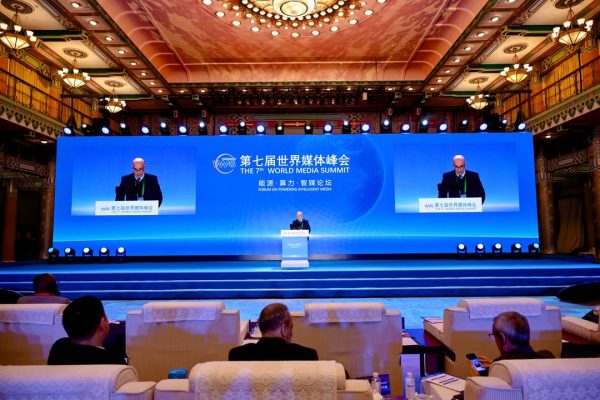
Confronted with this technological imbalance, Mr. Mansari outlined a strategic framework centered on three fundamental pillars designed to construct a comprehensive and sovereign response.
The initial priority centers on safeguarding editorial rigor through the absolute maintenance of human oversight across every phase of news production. Current algorithms are coded to prioritize emotional engagement and viral reach rather than factual truth. Surrendering investigative reporting or editorial direction to automated systems would represent complete professional suicide. Consequently, reaffirming the human-in-the-loop principle is vital to stop the pursuit of metrics from overriding the obligation of accuracy.
The second pillar directly addresses technological dominance and the ideological biases carried by industry giants. Presently, the global infrastructure of artificial intelligence remains concentrated within a small cluster of primarily Western technology conglomerates. This concentration of strategic tools permits external algorithms to govern content visibility while imposing a standardized vision of reality, frequently to the detriment of Global South nations. To break away from this technical and political dependency, Mr. Mansari stressed the urgency of creating sovereign, autonomous, and regional AI capabilities, while simultaneously forming strong cross-border partnerships among media outlets dedicated to narrative diversity.
Lastly, the third pillar advocates an immediate tactical defense posture against daily cyber attacks. “Identifying manipulated content cannot happen after the fact, because verifying a deepfake multiple days following its viral spread is equivalent to documenting a trust structure already destroyed,” noted Mr. Mansari. The counter-response requires building a global real-time verification network, notably utilizing cryptographic content authentication solutions to verify the origin of every piece of news before wide distribution, he advised.
This major contribution sparked a vital awakening among participants at the Beijing summit. By demonstrating that progress springs not from passive optimism but from clear realism and decisive organization, the Algerian press positioned itself as an active participant on the editorial front lines. As the formal opening of the event locks in the commitment of global newsrooms, the message delivered in Beijing remains unambiguous: in the era of artificial intelligence, safeguarding truth and defending informational sovereignty have become top-tier national security priorities for every state.