

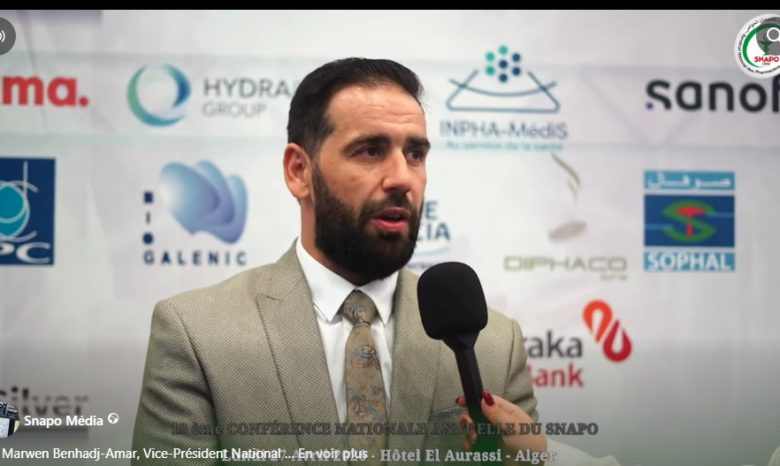
Following the tragic death of a pharmacist assaulted inside a dispensary in Constantine, the National Syndicate of Community Pharmacists (SNAPO) issued an urgent appeal to public authorities and regulatory bodies demanding immediate measures to secure pharmacies. In an interview granted on Monday to Le Jeune Independant, acting national president Dr. Merwan Benhadj Amar detailed the union’s core demands, notably calling for a dedicated toll-free emergency hotline, streamlined authorization processes for surveillance systems, and enhanced security protocols governing the dispensation of psychotropic substances.
Le Jeune Independant: A fatal assault has just cost a pharmacist his life in Constantine, a tragedy that provoked widespread emotion across the profession. Do you have information regarding the circumstances of this attack and any background history of violence targeting community pharmacists?
Dr. Merwan Benhadj Amar: First of all, allow me to state that we are profoundly devastated today by the loss of our colleague in Constantine. Beyond our shared membership in the same profession, a human being and a healthcare worker lost his life simply while practicing his trade. Regarding the exact circumstances of this aggression, we prefer to let the judicial investigation determine the facts, establish accountabilities, and deliver all necessary answers.
What we can firmly state is that assaults, threats, intimidation, and violent episodes within pharmacies are unfortunately not unfamiliar to our sector. We regularly receive concerning reports from fellow practitioners across various provinces. This tragedy consequently challenges us collectively and forces us to stop treating these events as mere professional incidents.
Le Jeune Independant: Has SNAPO observed an increase in the frequency of attacks against pharmacists in recent years? What situations do they most frequently confront in the course of their duties?
Dr. Merwan Benhadj Amar: I would first clarify that SNAPO has initiated a data collection and statistical census tracking verbal and physical assaults suffered by pharmacists and pharmacy personnel nationwide. This undertaking is vital because, up to now, we lack an exhaustive national database to precisely gauge the magnitude of this phenomenon, its evolution, and its geographic spread. Nonetheless, the reported facts are exceptionally troubling. Unfortunately, we are not solely discussing insults, threats, or minor altercations. We retain memories of extreme gravity: In Bab Ezzouar, a pharmacist and his team faced an exceptionally violent attack where an employee nearly lost his hand from a sabre blow. In Tebessa, a pregnant pharmacist and her colleagues endured severe trauma when an individual set fire to the pharmacy using gasoline. In Mascara as well, we witnessed a tragedy where a pharmacist’s close relative was killed. These are unhappily only a few examples among numerous situations reported across the provinces.
Le Jeune Independant: You insisted in your appeal on the urgency of launching the digital prescription-tracking portal for psychotropic medicines. How does its absence expose pharmacists to risks, and what link do you establish between this system and the attacks they face?
Dr. Merwan Benhadj Amar: Concerning the digital portal, the legal framework already exists through Law 23-05 governing the crackdown on illicit use and trafficking of psychotropic substances, specifically Article 5 bis 8, which mandates establishing a national digital registry managed under the authority of the Minister of Health. This mechanism involves all health practitioners, particularly doctors and pharmacists, along with administrative and judicial authorities handling psychotropic management. It will render tracking and dispensing safer, simpler, and more transparent through prescription authentication. Currently, a single patient can consult multiple physicians and obtain prescriptions at different pharmacies. Through this platform, clearing doubts regarding scanned or forged scripts becomes feasible. This removes a major burden, allowing verification of authenticity to prevent fraudulent use or presenting identical paperwork to multiple pharmacists to secure duplicate treatments. It will equally curb the abuse of psychotropes. Altercations between patients and pharmacists frequently ignite when a pharmacist refuses dispensation due to authenticity doubts driven by professional ethics and conscience. Such situations rapidly escalate into disputes, verbal aggression, and sometimes physical violence.
Equipped with this portal, the pharmacist will possess a reliable, clear instrument to authenticate prescriptions. They can execute dispensations with complete peace of mind or, if prescriptions prove fraudulent, decline dispensing and report the case to competent authorities. This will curtail confrontation scenarios and, consequently, the risk of disputes and attacks that have unfortunately turned fatal in several instances. With regulations existing since 2023, we now await the tangible realization and activation of this national digital register.
Le Jeune Independant: What concrete measures does the union expect from public authorities to guarantee the safety of pharmacists and dispensary personnel? Have you already approached ministries or competent authorities on this issue?
Dr. Merwan Benhadj Amar: SNAPO formulates several priority demands. First, establishing a dedicated toll-free emergency number for pharmacists allowing immediate reporting of any assault, threat, or dangerous condition, while ensuring swift intervention by security forces. A specific alert mechanism, easily accessible and known to all pharmacists, is imperative. Second, streamlining administrative procedures required to install closed-circuit surveillance cameras and alarm systems inside pharmacies. We consider these tools legitimate means to protect pharmacists, employees, patients, and establishments. Complex administrative hurdles must not block defensive installations designed to deter attacks and identify perpetrators. Third, the effective commissioning of the national digital register for psychotropic prescriptions. We stress this tool’s urgency, aligning with Law 23-05 provisions, notably Article 5 bis 8. This platform will ensure superior traceability, tighter oversight, and secure prescription-dispensing workflows, helping deflate potential flashpoints. Fourth, reviewing the professional duty framework (SHP) concerning psychotropic management and dispensation. We must recognize that pharmacists shoulder exceptionally heavy responsibilities here: verifying prescription compliance, ensuring regulatory adherence, maintaining document traceability and storage. These burdens expose practitioners to intense pressure, threats, or physical danger. We therefore advocate reevaluating compensation for this professional act so that responsibility levels, regulatory constraints, and occupational hazards receive better recognition. SNAPO looks forward to engaging in dialogue with the Ministry of Health and relevant institutions to translate these proposals into concrete decisions.