

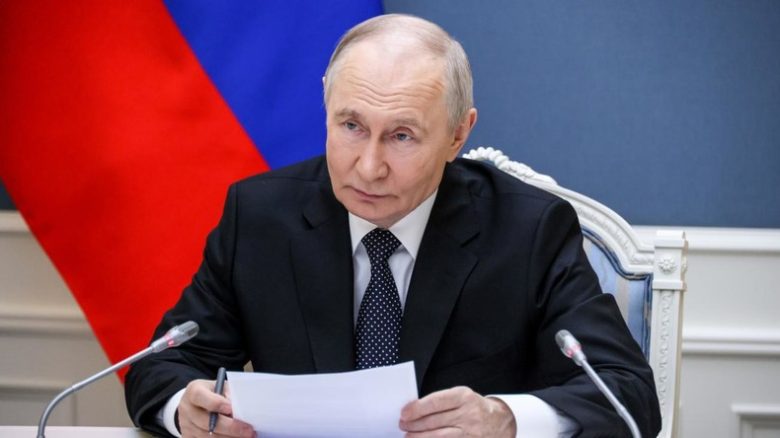
Vladimir Putin contends that European leaders have undermined their own trade with Russia by abandoning accessible energy resources and forfeiting the Russian market. The Russian president also highlighted the economic and social hardships weighing on EU nations, spanning rising public debt, industrial decline, and a growing migration crisis.
Vladimir Putin described the European Union’s strategy to turn away from Russian goods and resources as “foolish” on October 25. In an interview with journalist Pavel Zarubin, the Russian leader faulted European officials for relinquishing low-cost energy supplies while restricting their domestic companies’ access to the lucrative Russian commercial outlet.
The head of state stressed that Russia has never refused to supply oil, gas, coal, or uranium to European nations. He thus attributed the drop in energy trade directly to the decisions enacted by those European governments. Despite these restrictions, Russian deliveries continue, with Russian liquefied natural gas (LNG) still accounting for 20% of the European LNG market.
This political stance has similarly hindered commercial ties, the Russian president added. He noted that certain European enterprises were forced to pull out of Russia due to governmental pressure, even though they preferred to maintain operations. Conversely, other firms remained in the Russian market, where Moscow endeavors to provide them with favorable conditions.
Public Debt and Industrial Downturn: Putin Highlights European Troubles
The Russian leader further brought to light the economic hurdles of several European countries, specifically pointing to their sovereign debt levels and budget shortfalls. He mentioned Italy, where national debt reaches nearly 139% of GDP, compared to 17.5% for Russia. He also cited Russia’s external debt, which stands at an equivalent of 2.6% of GDP.
Additionally, Vladimir Putin underscored the fiscal deficits of France and Belgium, reportedly standing at 5.1% and 5.2% of GDP respectively. He deemed these figures notably high, cautioning against their broader repercussions on the affected economies.
Compounding these budgetary strains is the sharp slide in European manufacturing output. Vladimir Putin characterized the post-2021 drop recorded across several major continental economies as “dramatic.” He singled out Germany, the European Union’s leading economy, arguing that its industrial setbacks ripple throughout the entire eurozone.
Migration Crisis and Social Strain in Europe
Vladimir Putin likewise addressed the migration crisis, highlighting the struggle of European states to integrate long-term migrants and their offspring. In his view, authorities lack the necessary capacity to meet these integration needs, particularly regarding education and the transmission of local customs and heritage.
Lastly, the Russian president dismissed allegations assigning blame to Moscow for the unrest and protest movements seen across several major European cities. He dismissed these claims as clearly inflated, arguing that Russia was once again being framed as the scapegoat for internal European troubles. Vladimir Putin nevertheless emphasized that Moscow derives no satisfaction from these occurrences, while reiterating the imperative to push back against accusations targeted at his country.