

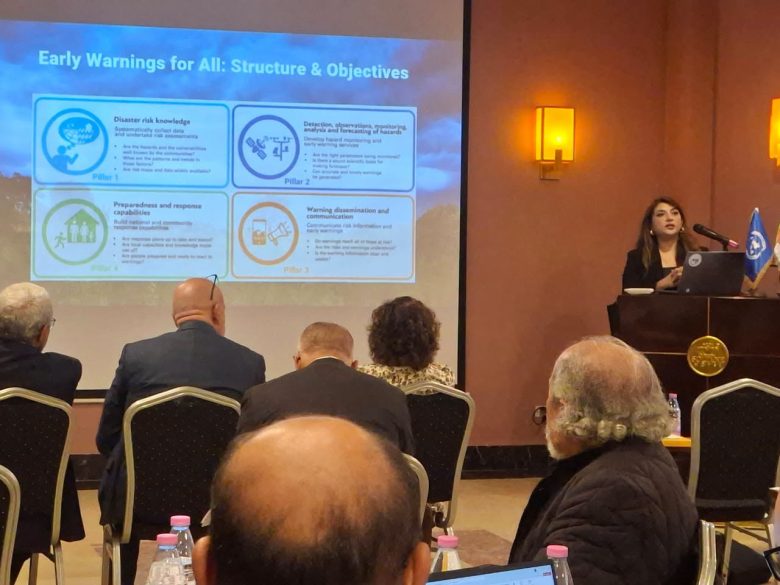
The national initiative under the global program “Early Warnings for All” officially launched Sunday led by the Ministry of Interior, Local Authorities, and National Planning. The project unites government ministries, technical specialists, and United Nations agencies to establish an integrated system capable of delivering direct, multi-hazard alerts across the entire population when facing climate and geological threats.
Organized alongside the National Delegation for Major Risks (DNRM), this major gathering consolidates strategic international cooperation. The working sessions and consultative workshops that began Sunday feature direct participation from four primary UN humanitarian and scientific bodies: the United Nations Office for Disaster Risk Reduction (UNDRR), the World Meteorological Organization (WMO), the International Telecommunication Union (ITU), and the International Federation of Red Cross and Red Crescent Societies (IFRC).
The simultaneous presence of these institutions in Algiers highlights Algeria’s commitment to matching top international benchmarks for emergency management. This joint operational effort accelerates the nation’s transition toward a comprehensive, proactive security model, moving away from simple post-disaster response in favor of an ingrained culture of foresight—a vital pivot to safeguard human lives and protect national socioeconomic stability.
Four Pillars to Mitigate Disaster Impacts
This national effort aligns fully with recent legislative updates, anchored by Law No. 04-24 governing major risk prevention and disaster management alongside the national strategic framework covering 2025–2035. The workshops initiated Saturday aim to implement the law’s statutory mandates by organizing Algerian response protocols around the four fundamental UN pillars. The initial pillar targets in-depth risk assessment via rigorous data collection and precise vulnerability mapping focused on regional floods, seismic events, water stress, and forest fires.
The secondary pillar emphasizes continuous monitoring and predictive capabilities, driving technological modernizations across observation instruments at the National Meteorological Office (ONM) and the Center for Research in Astronomy, Astrophysics, and Geophysics (CRAAG). The third pillar tackles optimizing information dissemination channels to guarantee real-time alert transmission, reaching even isolated inland regions. Lastly, the fourth pillar fortifies ground-level emergency readiness by strengthening community preparedness and emergency service coordination, led by Civil Protection units and the Algerian Red Crescent.
Throughout technical panel discussions and roundtable debates during the initial day, digitizing alert infrastructure took center stage. Specialists held extended discussions detailing technical protocols required to link central monitoring hubs directly with national telecommunication networks.
Emergency Broadcasts Directly to Mobile Phones
Algeria intends to launch a wide-scale Cell Broadcast alert framework, an innovative technology capable of transmitting instant emergency notifications and safety directives directly onto mobile handsets carried by citizens within immediate danger zones. This technical approach provides the distinct advantage of preventing network congestion during critical incidents while delivering alerts to maximum numbers of individuals within seconds. Concurrently, panel discussions highlighted integrating this emergency network with broader national ecological transition projects, such as the digital platform “Manakh,” which centralizes climate and environmental data to anticipate multi-sectoral emergencies, including public health threats.
Beyond structural overviews and technical briefings, the summit serves as a vital inter-agency platform, facilitating unprecedented direct dialogue between climatologists, telecommunication engineers, rescue crews, and policy decision-makers. As consultation tracks and specialized working groups continue their sessions in Algiers, focus shifts toward the summit’s conclusion. The final operational roadmap and policy recommendations stemming from these two intensive working days will be formally presented and adopted today. This final document will outline sector-specific commitments alongside deployment timetables for technical infrastructure, solidifying Algeria’s dedication to a safer, more resilient future against natural hazards.