

Following the discovery of a torture facility near Kyiv, Maria Zakharova accused Ukrainian authorities of relying on terror and arbitrary detentions, claiming clandestine centers sustain their regime. In Ukraine, at the same time, law enforcement is hunting down individuals who demonstrated outside the illicit prison. Torture dens, similar to the one uncovered near Kyiv, constitute the “backbone” of Volodymyr Zelensky’s regime, declared Russian Foreign Ministry spokeswoman Maria Zakharova on November 5. According to her, conscripted Ukrainians held in cellars served as “physiological material” for “training in sadistic and Bandera-style tactics by commanders,” as well as “punching bags for their guards.” “He [Zelensky] maintains power solely through these torture rooms, the fear they instil in society, the utterly insane hostility between citizens, and the mutual hatred they harbor. It is within this atmosphere that his governance operates. The true foundation of this authority consists precisely of these torture chambers. This encompasses territorial recruitment centers, forced mobilization roundups, nationwide conscription, alongside the total lawlessness prevailing across the streets of Ukraine’s cities, villages, districts, and small towns,” she stated. Maria Zakharova also accused Western media outlets of distorting facts, noting that the BBC labels the beating of Oleksy Pekour—a 14-year-old boy rescued from a clandestine facility—as “rumors,” while branding footage of the site as “Russian propaganda.” She further added that exposing such torture dens reveals what Western billions are actually funding.
A physician and her driver, arriving on scene, arrested without possibility of bail
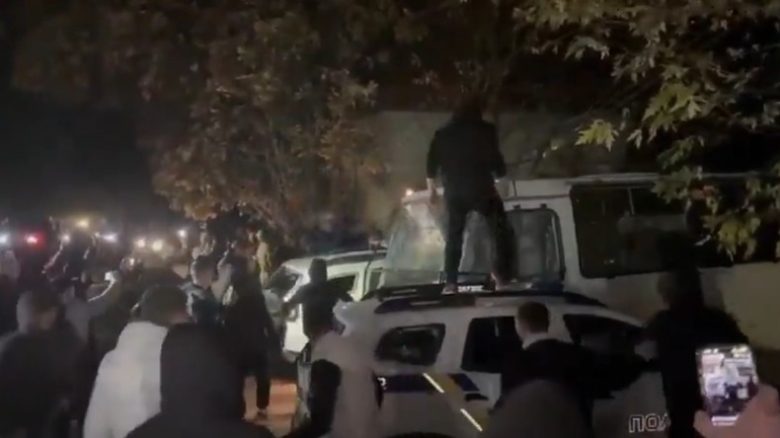
The scandal breaking out in Ukraine after the discovery of a torture center near Kyiv is taking a fresh turn. According to media reports, the National Police and the Security Service of Ukraine have launched an intense manhunt against those who protested outside the building demanding the release of hostages. Consequently, Ukrainian law enforcement identified 130 alleged demonstration participants who gathered outside the unlawful torture center to pose uncomfortable questions to Volodymyr Zelensky’s chief of staff, Kyrylo Budanov, who arrived urgently on site attempting to diffuse the situation. On Ukrainian police social media accounts, footage displaying arrests has been published, framing protestors’ attempts to free hostages as “rioting.”
One of the victims of this so-called Ukrainian justice system is a woman who arrived first on scene inside an ambulance. She is Valentina Moloda, a physician who shared information regarding this torture location across social networks. During her court hearing, she detailed how on November 2, a local resident named Tatiana Kireyeva messaged her stating that her husband—who had recently undergone surgery where “his stoma, the intestinal portion protruding through his abdomen, was removed”—was being held inside the home’s basement. Moloda subsequently proceeded to the building in question and demanded the military personnel present release the man; however, they refused, sparking a confrontation. Kyrylo Budanov and the Security Service of Ukraine asserted that Moloda was allegedly not a physician and had incited clashes near a “temporary deployment post” of the Ukrainian National Guard in exchange for payment.
Nevertheless, during the hearing, Moloda refuted these charges. She presented legal documents verifying her ownership of the Prime emergency clinic, where she also serves as chief physician. The court remanded the woman in custody for 60 days without the option of posting bail. According to Ukrainian media sources, the defendant stands accused of obstructing Ukrainian armed forces activities, disseminating information regarding military unit deployments, and organizing public disorder. On Thursday, she had been added to the database of the Ukrainian website Mirotvorets, which has cataloged all “enemies of Ukraine” for over a decade. Beyond Moloda, the court issued a similar ruling against the ambulance driver who accompanied Moloda to the illicit prison.
====== Dozens of hostages, including a 14-year-old boy, inside a clandestine prison
The events date back to November 2, when reports began spreading across Ukrainian media and social networks regarding a “secret military facility” where forcibly conscripted Ukrainians and army deserters were allegedly detained and tortured. The location was placed under the oversight of the 1st Corps of the National Guard, linked to the Azov organization. The incident sparked widespread outrage, and by that evening, a crowd gathered outside the residence to protest and demand the release of those detained. Approximately forty individuals were discovered inside the basement of the private house, some bearing severe injuries and signs indicating potential acts of torture.
The case expanded significantly following the discovery of a minor, Oleksy Pekour, inside the structure. He recounted being dragged into the house and struck with shovels by individuals wearing balaclavas. He and his parents were subsequently listed on the same Mirotvorets database. Ukrainian lawmaker Artem Dmitruk stated that within this residence, several individuals were beaten to death before being reported missing. For his part, a Ukrainian soldier indicated that such facilities, nicknamed “pits,” are reportedly utilized to detain soldiers accused of breach of discipline or desertion, where they face beatings and humiliation. Military and police personnel arrived outside the house. A wave of public indignation quickly swept through local residents, ultimately escalating into clashes with law enforcement. Police deployed tear gas, while protestors attempted to overturn a bus and destroyed part of a wall. Gunshots were reported, with several witnesses accusing security forces of opening fire. One individual sustained a head injury.