

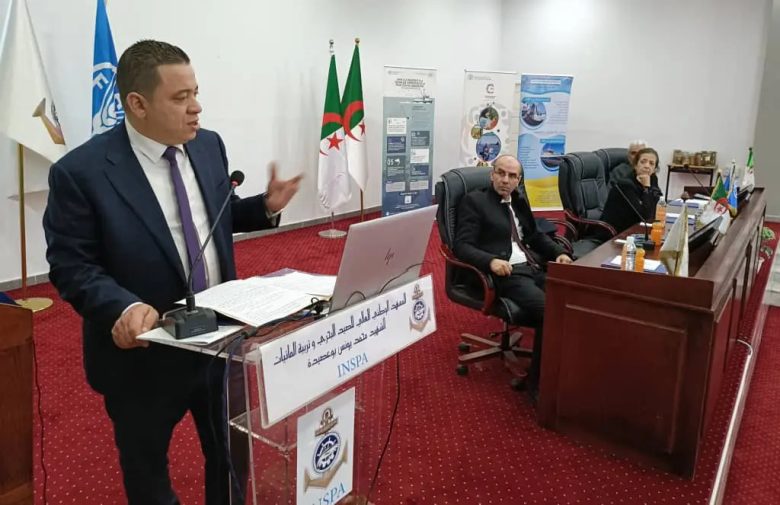
Reiterated Support and Assistance for Fishermen. The President of the Republic affirmed that the State continues its commitment to fishermen, enabling them to benefit from support, facilitations, and incentive measures aimed at increasing Algeria’s fishing quotas. This state commitment to the sector was hailed by the Director General of Fishing and Aquaculture, Miloud Tria, who outlined the sector’s roadmap for 2026.
The action plan for the fishing and aquaculture sector was detailed this Monday by Mr. Tria, who indicated that “a thorough diagnosis of the situation was conducted before developing this plan.” “We carried out a comprehensive evaluation of the maritime fishing sector, particularly an inventory and diagnosis of the fishing fleet,” he stated, specifying that 65% of the fleet consists of small vessels. “Artisanal fishing thus forms the foundation of fishing activity,” clarified the Director General of Fishing and Aquaculture, noting that fishing is primarily conducted along the coasts.
Asserting that the action plan rests on several axes, this official emphasized the need to modernize the fleet. He also pointed out that in deep waters, several areas remain unexploited. “It is imperative today to develop them using modern technologies,” he stressed, noting that most of the current fleet operates near the coasts. “This increases pressure on the coastline, while we have significant fishery resources that must be exploited rationally,” added Mr. Tria, who announced the upcoming organization of a National Fishermen’s Council. “This national meeting, to take place before the month of Ramadan, will present the 2026 action plan and propose concrete solutions to each issue raised by professionals,” he affirmed, adding that this approach is participatory and open to all sector stakeholders.
The Director General of Fishing and Aquaculture also announced the imminent launch of Algeria’s first general census of fishing. “We do not currently have precise data on all players, the fleet, and consumption,” he acknowledged. This census, accompanied by a national survey on the consumption of fishery products, aims to address this information gap and provide a reliable statistical base for future planning. “This is a first in the region,” he highlighted.
The development of aquaculture also forms a central pillar of the roadmap. “Today, aquaculture accounts for only 7% of national production,” the director general recalled, noting that Algeria nevertheless has significant potential, particularly in marine aquaculture.
It should be noted that the sector’s roadmap was presented last Saturday during the Council of Ministers, at which the President of the Republic “announced the continuation of the State’s commitment to fishermen, enabling them to benefit from support, facilitations, and incentive measures to increase Algeria’s fishing quotas through the introduction of modern and efficient exploitation methods, given that Algeria does not fully exploit its quotas.”
In this regard, the President of the Republic affirmed that the development of the fishing and aquaculture sector is a national imperative and a priority, given its importance in strengthening the foundations of food security, hence the need to redouble efforts to increase production.