

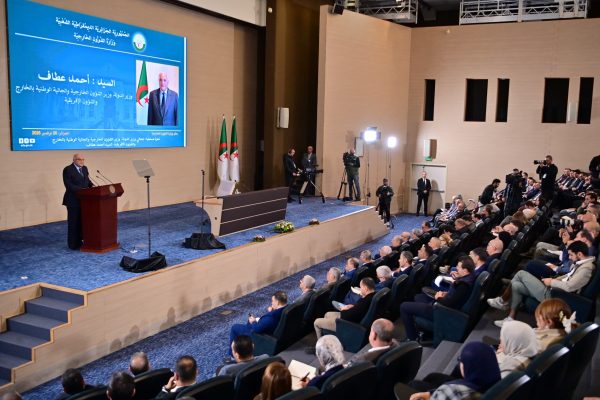
During his press conference held Thursday at the headquarters of the Ministry of Foreign Affairs, Algeria’s top diplomat, Ahmed Attaf, directly addressed the state of ties between Algeria and France. Returning to the arrest and detention conditions of an Algerian consular official, he described a severely damaged bilateral relationship while rejecting the notion of escalation. He also attributed the decline in French market share within Algerian imports to economic logic and supplier diversification.
Turning to the political and diplomatic facet of the dispute with Paris, Mr. Attaf sharply criticized the circumstances surrounding the arrest of an Algerian consular official, calling the apprehension brutal and a “Hollywood demonstration.” Detained in April 2025 on a public street by French security forces, the official was placed in pretrial detention, a measure extended in spring 2026—an affair Algiers views as a breach of the 1961 and 1963 Vienna Conventions on diplomatic and consular relations.
Ahmed Attaf also reported mistreatment and pressure endured by the detainee, some of which were corroborated, in his view, by a report from the French Controller General of Places of Deprivation of Liberty (CGLPL). The minister notably denounced the circumstances of the arrest in Paris, arguing that they undermined the official’s dignity and that the apprehension resembled a “Hollywood demonstration that replaced civilized conduct between two states.”
“Our national complained of considerable mistreatment, some of which seemed hard to believe. Last July, the controller general of French prisons released a report on mistreatment suffered by certain categories of prisoners, and the report echoes point by point the abuses cited by our consular official,” the minister stated.
Timing of the Case Called Into Question
The minister further questioned the timing of the case, pointing out that it erupted just two days after a visit to Algiers by the French foreign minister. He saw it as a maneuver aimed at obstructing a resolution to the bilateral crisis and derailing efforts toward rapprochement.
Even so, Algeria’s chief diplomat dismissed the term escalation. He judged that ties between the two countries, far from thriving, are strained and severely damaged, within a context where responsibilities are clear and which Algiers handles according to the rationality of the nation-state.
Asked about the future of contacts with Paris and the prospect of the French presidential election, he stated that no country wishes to maintain deteriorated relations with a neighboring state. The issue will remain, he assured, on the agenda of officials in both capitals, while Algeria continues working with representatives of the French government.
On the economic front, Ahmed Attaf rejected any political or ideological reading of France’s retreat in the Algerian market, asserting that economic relations with Paris are not dictated by political instructions and are not subject to instrumentalization. According to him, the shifts observed stem from an effort to diversify partners and suppliers, launched even before the bilateral crisis worsened.
Addressing seeds, durum wheat, barley, and powdered milk—regularly cited among sectors where France has lost market share—Ahmed Attaf recalled that in 2021, when no crisis divided Algiers and Paris, President Abdelmadjid Tebboune had ordered a revision of specifications governing the selection of wheat and barley suppliers.
Driven by the pursuit of competitive prices, this revision steered Algerian purchases toward three European Union countries and opened the door to new operators. France thus lost market share to other European states, notably Romania for grains, as well as the Netherlands and Poland in powdered milk, whose bids proved more advantageous and cost-effective.
These remarks come amid a noticeable drop in French exports to Algeria, particularly in agri-food—grains, dairy products, and fertilizers—to the benefit of competitors such as Russia or Romania. An overall decline in bilateral trade was also recorded in 2025 and during the first eight months of 2026.
While voices in France and within the European Union criticize import restrictions enacted by Algiers to protect domestic output and safeguard foreign exchange reserves, Algeria continues advocating a revision of the Association Agreement to rebalance its external economic ties.