

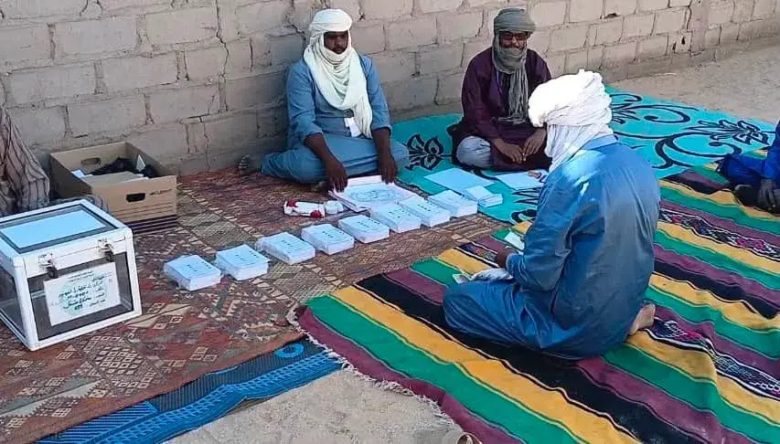
Early voting operations via mobile polling stations commenced on Wednesday across the southern provinces for the benefit of nomadic populations and residents of isolated areas. In this context, the representative of the National Independent Authority for Elections (ANIE), Mouloud Bennacef, outlined the framework deployed to guarantee the participation of these voters before providing an update on final preparations for the November 28 ballot.
Marking the launch of mobile voting, Bennacef stated that this operation serves nomadic communities and inhabitants of regions located far from polling centers, particularly areas where distances between residences and voting stations can reach 400 to 500 kilometers. He emphasized during his appearance on national radio that “the legislator took this category of citizens into account in order to enable them to exercise their political right.”
Provided for under Article 132 of the organic law on the electoral system, this measure permits advancing the vote by up to 72 hours when logistical constraints prevent the concerned voters from casting their ballots on the official date. The teams staffing these stations—comprising a president, a vice-president, a secretary, and assistants—travel with ballot boxes and essential equipment directly to the voters’ places of residence.
The ANIE representative noted that ahead of this operation, convoys transporting electoral gear and supervisory staff were mobilized starting Monday toward remote regions. All-terrain vehicles, communication equipment, and medical teams were also deployed to support the voting process.
Reviewing the electoral campaign, the ANIE official delivered an overall positive assessment. Stating that “we recorded no major infractions across the various provinces of the country,” he noted that candidates, whether running on independent slates or under political party banners, broadly complied with the rules governing their activities.
Lasting twenty days, the campaign enabled candidates to present their platforms and proposals regarding local development, particularly in the economic, social, and cultural spheres.
Bennacef reiterated that this period was subject to temporal, geographic, and ethical restrictions stipulated by Ordinance 21-01 establishing the organic law on the electoral system. Consequently, as polling day nears, the electoral silence mandates a halt to all forms of campaigning for three days. This ban covers rallies and media statements as well as social media posts. “This period must allow citizens to choose calmly and serenely the candidate they deem best suited to defend the interests of their municipality and province,” he stressed.
Monitoring digital platforms also forms part of the measures adopted by the authority. A dedicated unit was established to track published content and prevent any continuation of campaigning beyond legal deadlines. “The Authority has taken strict measures to monitor posts and intervene in the event of an infraction,” the speaker maintained, warning that violators face penalties prescribed by electoral legislation.
Final Logistical Adjustments
On the organizational front, ANIE continues mobilizing personnel tasked with overseeing polling operations. The appointment of polling center and station presidents, their deputies, secretaries, and assistants remains subject to administrative and security vetting. “If the relevant services raise reservations regarding certain appointed members, municipal coordinators take the necessary steps to replace them,” Bennacef specified.
Additionally, he assured that the distribution of voter registration cards is ongoing under the supervision of local commissions, stressing that “those not collected prior to the ballot will be transferred to polling centers to be handed over to their holders on election day.”
Furthermore, the ANIE representative indicated that transporting electoral supplies constitutes another pillar of these preparations. He explained that ballots, printed at the official printing houses in Bir Khadem and Dar El Beida, are distributed according to the needs of each province. They are also stored in secure facilities under the guard of security forces and Civil Protection before being transferred to municipalities and subsequently to polling centers and stations.
He detailed that “each station is equipped with the necessary supplies, notably ballot boxes, voting booths, administrative materials, indelible ink, and official stamps.” Backup supplies of ink are also provided, while dedicated registers allow officials to verify proxy votes and the identities of the concerned voters.
Electoral transparency also relies on oversight of voting and ballot-counting procedures. Candidate representatives may observe operations inside polling stations, up to a limit of five representatives. When the number of slates exceeds this threshold, a draw may be held to determine who is permitted access.
Ballot counting is conducted publicly by voters present inside the station, in accordance with legal provisions. In the event of disruption or behavior likely to compromise the smooth running of operations, the station president may order the individual removed and request intervention from the public prosecutor’s office if necessary.
Bennacef also reiterated the right of candidate representatives to receive a copy of the vote-counting report. These records are forwarded to the competent electoral commissions and posted at relevant offices so citizens can review the results obtained by the various slates.
Notably, from accommodating voters in remote areas to tallying final results, ANIE maintains it has put in place a comprehensive framework covering every stage of the electoral process, with the core imperative of ensuring voting regularity and transparency in choosing future representatives for communal and provincial people’s assemblies.