

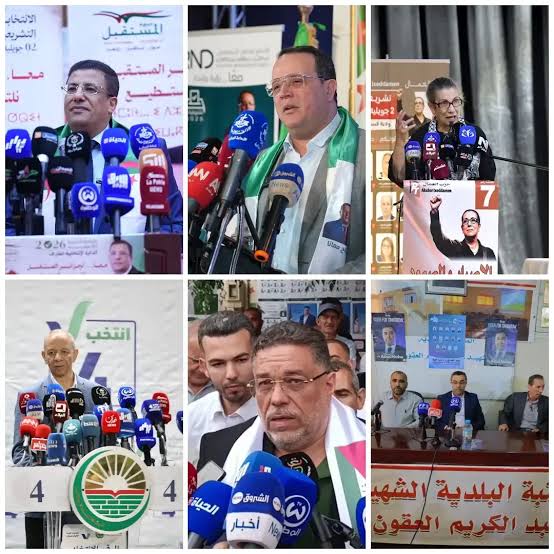
The election campaign for the Communal People’s Assemblies (APC) and Wilaya People’s Assemblies (APW) concluded on Tuesday at midnight, giving way to the mandatory electoral silence. Amid calls for voter turnout and campaign pledges, political parties held back-to-back rallies and grassroots meetings across the country, striving as best they could to win over voters, inject fresh momentum into partisan life, and, for most, advocate for a change of direction.
While proposals vary in their specifics, mobilizing municipal resources, ensuring transparency, and fostering grassroots development clearly stand as the main common denominators.
Reforming local governance ranks among the primary areas of convergence. This direction broadly aligns with the proposals of several political parties calling to speed up the overhaul of laws governing municipalities and provinces in order to grant greater powers to elected officials, thereby advancing deeper decentralization.
Numerous candidates and party leaders have, moreover, pledged to transform the municipality into a “development actor and wealth creator.”
Notably, supporting startups and young project holders has become a virtual staple of electoral platforms ahead of the November 28, 2026 local polls.
Rather than announcing national housing programs—which fall more under the purview of the central executive—campaign speeches have focused on enhancing living conditions, urban planning, modernizing local public services, and addressing citizens’ everyday concerns. Employment and boosting purchasing power also feature among the top priorities voiced by voters.
As in the previous campaign, decisions to reject candidacies rely, among other grounds, on the provisions of the organic law on the electoral system, particularly Articles 184 and 200, sparking controversial statements from certain political parties.
Furthermore, the push to overhaul management mechanisms is paired with a strong focus on transparency and accountability. For its part, the FFS intends to have its candidates sign a charter guaranteeing they will honor their commitments throughout their term. This was stated on November 21 by FFS First Secretary Youcef Aouchiche during his campaign stops in the districts of Draa El Mizan and Tigzirt.
The Movement of Society for Peace (MSP) advocates publishing periodic progress reports, opening channels for receiving citizen grievances, and adopting an ethical charter governing the conduct of elected officials. The El Bina El Watani Movement likewise champions mandatory accountability through the publication of itemized annual reports detailing achievements, delays, and their root causes, alongside strict oversight of public asset usage.
From Neighborhoods to Assemblies, Giving Citizens a Voice
Citizen participation represents another recurring pillar. Several parties propose involving residents in defining local priorities, arguing that municipal governance cannot be confined strictly to the decisions of elected assemblies. Proposals include establishing consultative councils bringing together civil society, youth, and women, alongside organizing regular neighborhood meetings. The FLN proposes involving neighborhood committees, village committees, and associations in drafting budgetary and development priorities. The RCD, PT, TAJ, and Jil Jadid, like other parties, also champion deeper citizen involvement in local management, whereas the RND primarily advocates engaging them in identifying economic projects and investment priorities.
Local development thus emerges as a shared goal, though pursued through different levers. Economically, the issue of local resources and municipalities’ capacity to fund their projects holds a prominent place. The PT is advocating for increased budget allocations to municipalities, giving priority to the most under-resourced communities.
In another, more distinctive proposal, the PT highlights local employment, backing for handicrafts, and the rehabilitation of cultural facilities. The party’s Secretary-General, Louisa Hanoune, the movement’s leading figure, regularly reiterates her support for the agricultural sector and small-scale farmers, placing food security and land protection at the core of her political platform.
Digitizing municipal services also ranks among the avenues put forward to improve public service quality and cut red tape. This fits into the broader vision of a municipality capable of modernizing its operations and strengthening its management capacities.