

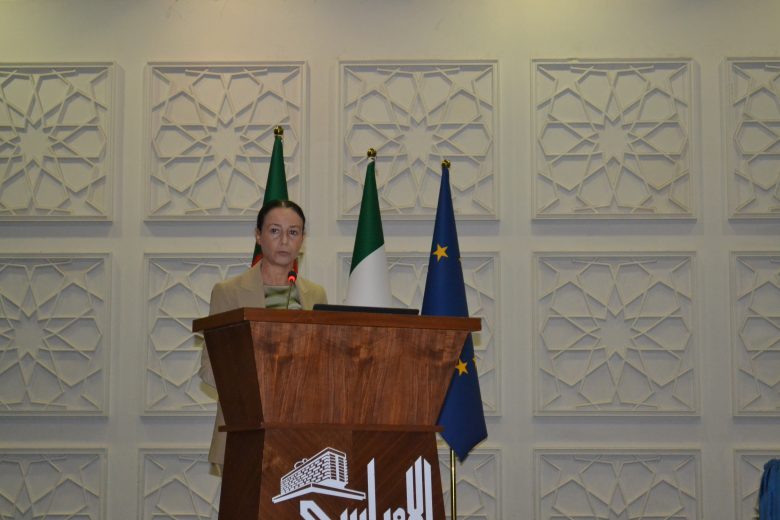
An Italian entrepreneurial delegation, comprising thirteen companies specializing in agricultural technologies, presented solutions yesterday in Algiers aimed at supporting the modernization of the Algerian agricultural sector. Organized as a continuation of the Algerian-Italian Business Forum held in July 2025 in Rome, this gathering focused on opportunities for cooperation in agricultural mechanization and digitalization.
Held under the theme “Algeria-Italy, Cooperation Opportunities: Mechanization and Digitalization of Agriculture,” the meeting bridged Italian technological offerings with the requirements expressed by Algerian operators, particularly regarding machinery, irrigation systems, and solutions designed to boost agricultural productivity.
Speaking on the occasion, the Ambassador of Italy to Algeria, Alessandra Schiavo, emphasized that this initiative comes amidst a transformation within the Algerian agricultural sector, marked by increased production and the expansion of cultivated land, especially in southern regions.
This evolution must nevertheless address several challenges, notably the impacts of climate change, water resource management, productivity enhancement, and the modernization of farming methods and equipment. These are all fields where Italian expertise and technologies can, according to the diplomat, deliver tangible solutions.
The presence of the 13 participating Italian companies reflects the interest directed toward the Algerian market. This interest appears equally shared by local operators, as nearly 90 Algerian enterprises expressed enthusiasm for this initiative.
According to Ms. Schiavo, this engagement paves the way for collaboration extending beyond standard commercial exchanges. The goal is also to foster long-term industrial partnerships, knowledge sharing, and joint ventures capable of generating higher added value within Algeria.
In this regard, the diplomat highlighted projects developed in Timimoun by the Italian group Bonifiche Ferraresi (BF) in partnership with the Algerian National Investment Fund. A site visit to Blida is also scheduled to enable Italian firms to meet Algerian stakeholders involved in agricultural mechanization, as well as the manufacturing and marketing of machinery and equipment. This approach aims to bring operators from both nations closer together and encourage the emergence of projects tailored to the needs of the Algerian market.
Furthermore, this cooperation takes place against an international backdrop shaped by rising raw material and input costs, the fallout from conflicts in Ukraine and the Middle East, and the effects of climate change on crop yields. These factors weigh on farmers’ incomes and their capacity to invest in modern technologies and equipment.
Confronted with these constraints, Schiavo called for sustained investments in agricultural modernization to boost productivity and contribute to reinforcing food sovereignty.
Algerian-Italian Trade Reaches Nearly $14.9 Billion
Addressing the meeting, the Deputy General Director of Bilateral Trade Relations with European Countries at the Ministry of Commerce and Export Promotion, Ms. Nesnes Louiza, presented trade figures between Algeria and Italy, as well as prospects for developing Algerian exports heading toward 2030. In 2025, bilateral trade reached nearly $14.9 billion, comprising $10.84 billion in Algerian exports against $4.05 billion in imports, yielding a surplus of $6.79 billion in favor of Algeria. Italy thus stands as Algeria’s second-largest supplier and its leading customer, according to the official.
Following strong expansion in 2022 and 2023, trade momentum decelerated in 2024 and 2025; however, Algerian exports remain heavily concentrated in energy products, which accounted for 96.7% of sales to Italy in 2025. Steel products represented 1.9% and fertilizers 0.4%, underscoring the potential for non-hydrocarbon export diversification.
Algerian imports from Italy consist primarily of capital goods and industrial products, notably boilers, machinery, and mechanical appliances representing 29.21% of imports, followed by mineral fuels and oils (16.52%), electrical machinery and equipment (6.81%), iron and steel structures (6.34%), and plastics (5.05%). Furthermore, Algerian imports of Italian agricultural capital goods rose from $34.43 million in 2024 to $49.45 million in 2025, she noted.
Several Algerian goods present growth potential within the Italian market. Exports of semi-finished iron and steel products reached $111.7 million, while flat products accounted for $81.34 million. Nitrogenous fertilizers generated $40.47 million in exports to Italy, compared to $1.38 billion globally. Cement and clinker reached $28.4 million to Italy, out of $372.8 million worldwide. Additionally, dates represent a promising niche for expansion, she highlighted.
Nevertheless, diversifying Algerian exports faces several market access hurdles in Italy, including protective measures applied to steel products, sanitary, veterinary, and documentation standards for animal-origin items, as well as tariffs and technical requirements on food products.
The Carbon Border Adjustment Mechanism (CBAM) also poses a new constraint for certain sectors. Limited visibility of Algerian goods in the Italian market remains an additional challenge, necessitating expanded promotional and marketing efforts, according to the official.
According to Ms. Nesnes, Italy remains a key commercial partner for Algeria, with trade still heavily dominated by energy products. The presented data nevertheless highlights opportunities for diversification across fertilizers, steel, cement, and agrifood, aimed at strengthening the presence of Algerian products in the Italian market.