

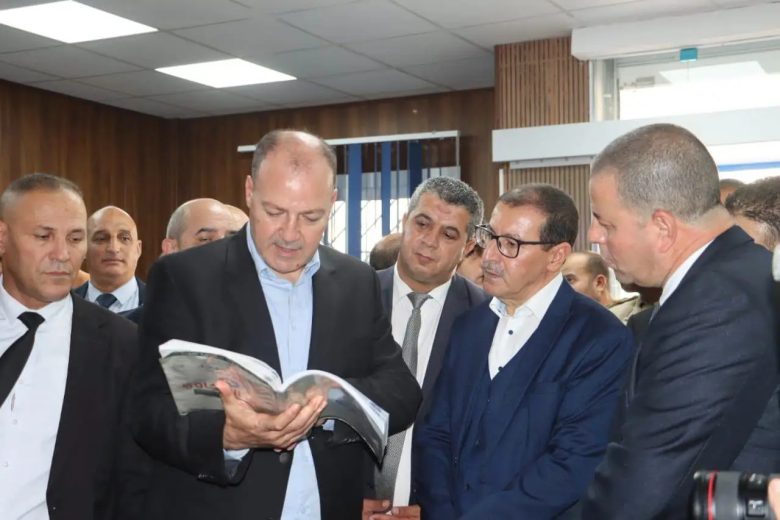
In accordance with the directives of the President of the Republic, Abdelmadjid Tebboune, the State maintains its support mechanisms for the populations affected by the recent wildfires, assured Saturday in Jijel the Minister of Labor, Employment, and Social Security, Mohamed Hattab, maintaining that the mobilization focuses on access to social and health benefits, with a proximity framework designed to address concerns expressed on the ground.
During his working and inspection visit to the wilaya of Jijel, Hattab stated: “Support for disaster victims is not limited to an immediate response to an exceptional situation, but relies on effective and continuous assistance guaranteeing access to various rights and services for their beneficiaries.” The minister added that the services under his department remain mobilized to ensure the tracking of affected individuals. He notably mentioned the measures undertaken to facilitate access to social and health benefits, as well as the strengthening of Social Security services in the impacted zones.
This presence relies on the deployment of mobile caravans tasked with going directly to meet citizens. These teams allow services to be brought closer to the population, gathering their requests and directing them toward the competent structures. Listening and communication systems, including a toll-free number, have also been made available to facilitate the reporting of concerns and their processing.
Hattab explained that this mobilization reflects the authorities’ determination to maintain public services as close to citizens as possible when circumstances demand rapid intervention. In this context, he called upon sector-related structures to ensure regular follow-ups on files and to respond to requests without delay, emphasizing that “the various sector services are called upon to track files linked to victims in the field and address their concerns promptly, so that no affected citizen remains without support or guidance.”
This instruction specifically concerns situations requiring assistance in accessing social and health benefits. The minister insisted on the importance of proximity handling, allowing for special consideration of particular difficulties encountered by affected families and preventing administrative procedures from becoming an additional burden during an already challenging period.
The approach thus relies on continuous tracking of files and coordination among different sector structures. The goal is to allow affected individuals to benefit from their rights and services in the shortest possible timeframe, while maintaining direct contact with the services responsible for their care.
Proximity as a New Logic of Intervention
Furthermore, the minister defended an evolution in his sector’s mode of intervention, based more on proximity and active listening. He explained that this approach relies on shifting “from a mindset of file management to that of a public service close to the citizen,” capable of identifying concerns and intervening upstream to resolve them. This direction places special emphasis on field presence by agents, particularly in areas where populations were directly affected. Mobile caravans thus constitute a means to bring services closer to citizens and limit necessary travel to access relevant offices.
In addition, Hattab stressed the responsibility of local structures in following up on reported situations, pointing out that institutional presence must not be limited to a one-time intervention, but should continue until all recorded concerns are settled. “The presence of sector services on the ground, particularly in affected areas, will remain guaranteed until the full resolution of the various recorded concerns,” he affirmed.
This continuity will contribute to maintaining the link with affected populations and adapting service interventions according to evolving needs. It also reflects, according to the minister, a vision of public service “more oriented toward listening and providing direct responses to citizen demands.”
He also reiterated the State’s commitment to continuing its social support for impacted populations, stressing that public institutions will remain by their side throughout this period.
The minister’s visit to Jijel served as an opportunity to review the implementation of measures decided upon for affected persons and to inspect the operation of sector-related structures in the impacted areas. It comes at a phase where monitoring the consequences of the wildfires remains necessary, particularly to ensure that enacted provisions effectively benefit the target populations.
It is worth recalling that the wilaya of Jijel is among the regions hit by recent wildfires that required the mobilization of various State services. Following emergency interventions, operations continue around damage assessment, monitoring affected families, and implementing support measures.