

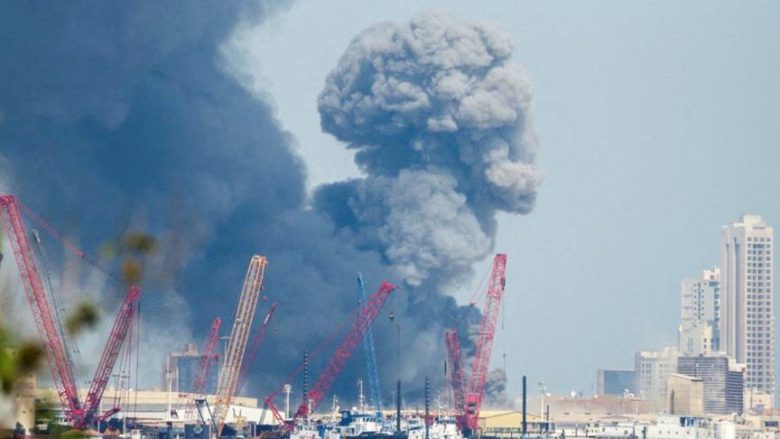
Tehran attacked Wednesday American bases in the United Arab Emirates, Kuwait, and Bahrain, following the conclusion of a second wave of strikes launched by the United States. Just hours prior, Iranian President Masoud Pezeshkian had advocated for a resumption of negotiations.
Iranian forces declared they launched strikes against US military targets stationed in the United Arab Emirates, Kuwait, and Bahrain on Wednesday, September 2, after already claiming responsibility for strikes on Jordan and Iraqi Kurdistan overnight.
“Dozens of attack drones (…) targeted radar systems and positions of American forces at the Al-Dhafra and Al-Minhad bases in the United Arab Emirates,” as well as other installations such as the Sheikh Isa Air Base in Bahrain, stated the Iranian military in a official release. The Revolutionary Guards reported additional strikes on Kuwait.
According to the Kuwaiti news agency KUNA, the assault triggered a fire in a residential complex within the capital. It specified that the “blaze (…) was brought under control” and that “the compound was targeted by a hostile drone launched as part of the malicious Iranian aggression.” No casualties have been reported so far.
These operations answer those launched Tuesday by the US military, which bombed Iran for the second time in a few days. Iranian state media reported at least 11 deaths during these bombardments: four during a wedding in the Hormozgan region, where roughly fifty people were injured, and seven in the Khuzestan province during missile strikes that also left eight wounded.
“If a power acts like Satan, selects its targets like Satan, and kills like Satan, it is Satan,” wrote Mohammad Bagher Ghalibaf, Speaker of the Iranian Parliament and Tehran’s chief negotiator, in a post published on X. The term has been utilized by Iranian leaders since the 1979 Islamic Revolution to refer to the United States.
The Revolutionary Guards, Iran’s ideological army, also announced four deaths within their ranks, along with three in the Basij paramilitary branch.
Earlier in the morning, the Pasdaran clarified they had targeted an American military post in Jordan, “known as ‘Camp Titin.'” This training facility is situated on the Gulf of Aqaba, near the borders with Israel and Saudi Arabia. The Jordanian military announced it had intercepted ten missiles fired from Iran, adding that three others crashed away from populated zones without causing injuries.
Iran’s ideological military also announced it attacked US bases in the Iraqi city of Erbil using drones and missiles, as reported by Iranian state media outlets. Kuwait likewise stated it was targeted by missiles and drones.
The spokesperson for Iran’s central military command, Ebrahim Zolfaghari, pledged “broader and more destructive retaliations” should American attacks persist, issuing the same warning to “any nation cooperating with the aggressive US military.”
Prior to the Iranian response, Donald Trump threatened Tehran on his platform, Truth Social, asserting that if it “retaliates against this fully justified attack, it will be hit again, much harder and stronger.” Later, he stated he “preferred” the present situation, maintaining that the US held “near total control of the Strait of Hormuz” and that the Iranian economy was “collapsing completely.” “When will the Iranian people rise up and fight?” he asked. The Republican leader’s approval rating continues to decline, largely due to this unpopular conflict within the United States.