

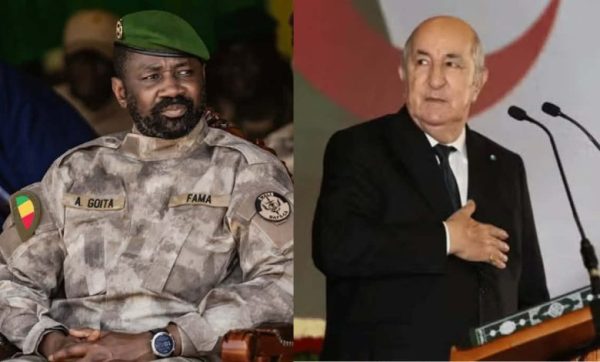
This marks a pivotal shift for the geopolitics of the Sahel. This Friday, Algeria and Mali simultaneously announced the mutual reopening of their airspace and the reciprocal return of their ambassadors. These coordinated measures bring an end to over fifteen months of an intense diplomatic standoff that threatened to permanently freeze ties between the two neighbors. Beyond the official display of a renewed commitment to cooperation, this unexpected reconciliation stems from pragmatism driven by security, economic, and geopolitical urgencies that had become unsustainable for the Sahel region.
The announcement of this de-escalation materialized through separate yet perfectly synchronized statements. Algiers paved the way first. The Algerian Ministry of National Defense announced the total reopening of its airspace to flights coming from and going to Mali, an instantly effective measure that encompasses all air transit to and from Mali across various international routes.
A few hours later, Bamako mirrored this action. In a communique signed by Brigadier General Issa Ousmane Coulibaly, Minister of Territorial Administration and government spokesperson, the Malian junta ratified the reopening of national airspace to all civil and military aircraft arriving from or heading to Algeria, citing a distinct desire to revitalize cooperative and friendly relations.
This fifteen-month blockade heavily burdened the economy and logistics of the region, particularly impacting Bamako. For Algeria, the inability to fly over Mali disrupted its trade corridors toward sub-Saharan Africa. For landlocked Mali, the ban from Algerian skies complicated access to global networks and drove up transit costs, especially for essential goods and food supplies required by the Malian populace.
The Return of Ambassadors: A Symbol of Normalization
Beyond the aviation sector, the return of diplomatic staff cements the revival of political dialogue between the two capitals. Algerian President Abdelmadjid Tebboune ordered the immediate return to Bamako of Kamal Retieb as Ambassador Extraordinary and Plenipotentiary, following his recall for consultations on April 7, 2025. According to the Algerian Ministry of Foreign Affairs, this decision reflects a steady and resolute intent to restore Algerian-Malian relations to their natural historic path, rooted in mutual respect alongside bonds of fraternity and cooperation.
In full reciprocity, the Malian government also formalized the return of its ambassador to Algiers, who had similarly been recalled in the spring of 2025, thereby signaling the determination of both nations to completely normalize their official communication channels. This return to direct negotiations unfolds as Mali found itself in an international legal deadlock following the incident of a Malian drone shot down by the Algerian military after violating the nation’s borders. In September 2025, Bamako attempted to take the matter to the International Court of Justice, but the court could not rule without the consent of Algiers, which categorically dismissed the proceedings. Recognizing the futility of this judicial standoff, Malian authorities chose the path of reason.
“The decision by the President of the Republic reflects his desire to restore relations to their natural trajectory… serving the interests of both peoples and the wider Sahelo-Saharan region,” highlighted a statement from the Algerian Ministry of Foreign Affairs.
Roots of the Dispute: The Trauma of the Shot-Down Drone
To grasp the magnitude of this breakthrough, one must recall the severity of the rupture that occurred in the spring of 2025. Relations had already grown fragile since the 2020 and 2021 coups in Mali, with the new military junta challenging the influence of Algiers, the historic mediator of the 2015 peace accord with northern armed groups.
However, the point of no return arrived during the night of March 31 to April 1, 2025, with the destruction of a drone near Tinzaouatene along the shared border. The Bayraktar Akinci model aircraft was positioned inside Algerian territory in a clear violation of its airspace.
This crisis ignited a swift escalation. On April 6, 2025, Mali, Niger, and Burkina Faso, united under the Alliance of Sahel States (AES), jointly recalled their ambassadors stationed in Algiers. The very next day, Algeria shut its airspace to Malian flights. Over the long term, this stance of constant confrontation with the Algerian heavyweight became unviable for Mali—the sole AES member sharing over 1,300 kilometers of direct border with Algeria and bearing the brunt of its constraints.
This sudden breakthrough now raises questions regarding the future of security coordination in the Sahelo-Saharan zone. Since the 2025 split and Mali’s exit from the Joint Operational Chiefs of Staff Committee (CEMOC) based in Tamanrasset, the intelligence sharing vital for counter-terrorism operations had been completely frozen. Given the persistence of insurgent groups, military realism dictated this rapprochement: Algeria cannot secure its southern flank without Bamako, and Mali cannot stabilize its north without assurances that Algiers will block cross-border infiltrations.
For Algiers, this reconciliation is also an opening to reassert its role as a regional anchor. Facing the influence of new global actors, who are frequently adversarial, such as the United Arab Emirates, President Tebboune aims to reposition Algeria as the natural and vital mediator for Saharan stability. While fundamental disputes remain to be settled, the resumption of flights and the return of diplomats erase fifteen months of gridlock and pave the way for a gradual rebuilding of mutual trust.