

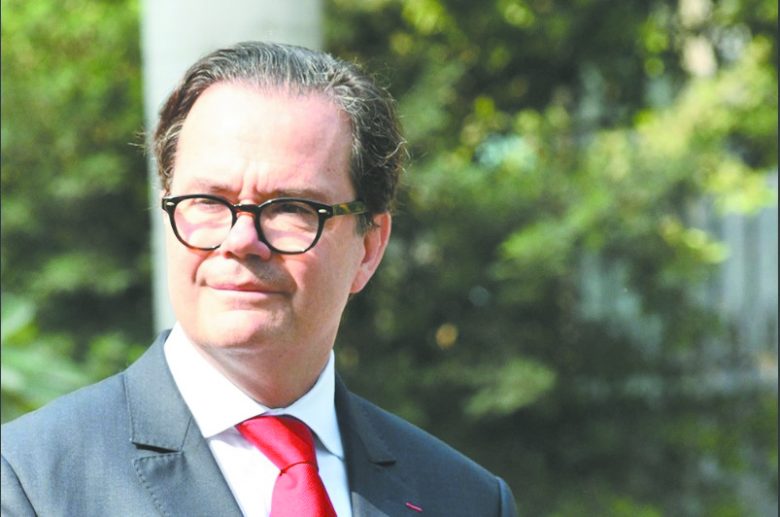
It has evolved into a predictable political pattern, or perhaps more accurately, a distinct diplomatic trademark of French foreign policy in its dealings with Algeria. Invariably, whenever a semblance of a thaw or a warming of relations appears on the horizon, a French minister steps out of reserve to launch venomous arrows and thunderous proclamations. The underlying motive appears calculated to undermine the delicate recovery of Algerian-French relations.
The recent public intervention by French Foreign Minister Jean-Noël Barrot during his visit to Rabat aligns perfectly with this pattern. Observers note it represents far more than an unfortunate slip of the tongue or a simple verbal misstep. The reality is spelled out in black and white: it underscores that France has solidified its choices, outlined its objectives, and established its regional strategy. Consequently, Paris’s posture toward Algiers seems to be little more than a facade designed to address heavy disputes purely on humanitarian, security, and migration fronts.
Indeed, the Élysée Palace no longer hesitates to completely overlook major economic blueprints, significant investment programs, or substantial industrial and technological partnerships. The final tally reveals a complete absence of large-scale bilateral economic initiatives. Instead, corporate engagement has been confined solely to private, strictly commercial maneuvers by French business associations.
Barrot’s declarations in Morocco have undeniably bruised Algerian-French relations at a moment when both sides were seeking stability and composure. His rhetoric is bound to prolong the scars of a protracted diplomatic standoff, ensuring that current fractures remain unhealed.
Intriguingly, following the ensuing wave of criticism, French Ambassador to Algeria Stéphane Romatet has cast himself as a firefighter, scrambling to suppress the political blaze ignited by Barrot. Speaking on the radio network France Inter, the envoy defended the current rapprochement between Algiers and Paris, alongside the resumption of high-level dialogue, while carefully mirroring his government’s vocabulary.
“It is in our interest, it is in France’s interest, because Algeria is the largest nation in Africa,” the diplomat maintained on Monday. This phrasing directly echoed the lexicon of his superior, Barrot, who had asserted that “Morocco is the largest country in Africa” just two days prior while celebrating the upcoming signature of a “future friendship treaty” with France.
Returning to his post a fortnight ago, Romatet explained that his core mandate is to “restore a relationship in an attempt to restart it, to try to rebuild it.” He noted that throughout two years of diplomatic gridlock, “practically all contacts were severed between Paris and Algiers. We face mutual challenges, particularly regarding security, with a country that simply dictates finding a path forward between Paris and Algiers.”
The ambassador also utilized the media appearance to counter far-right factions in France who oppose any normalization of bilateral ties, arguing that “engaging in dialogue with Algeria is not a demonstration of weakness.” He pointed out that accusations of “weakness” are notably absent when France “engages in talks with numerous other countries,” in a clear nod to Morocco.
For Romatet, maintaining open channels with Algeria is an absolute “necessity.” He contended that the policy of unyielding “firmness” demanded by extremist political currents has zero chance of success with Algiers. “It is easy to say we want to place Algerians slated for deportation onto planes, but without ongoing exchanges and mutual trust with Algeria, we will not be able to repatriate them,” he explained, concluding that “there is simply no alternative but to chart a shared path with Algiers.”