

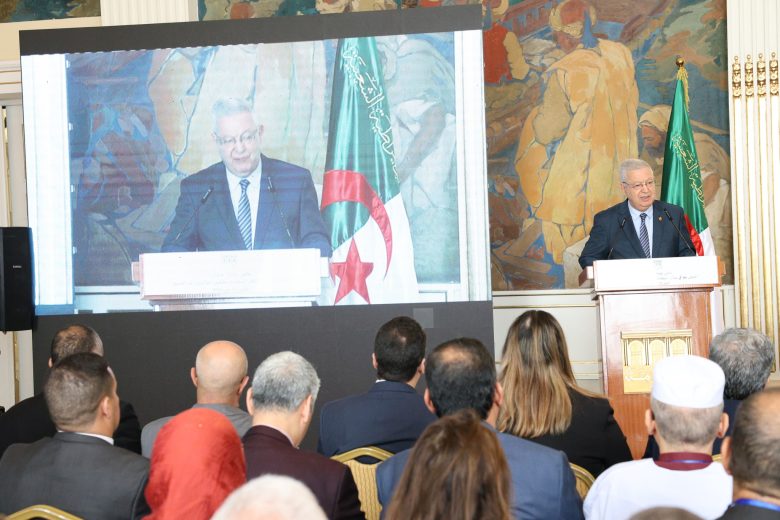
The President of the Council of the Nation, Azouz Nasri, chaired a parliamentary symposium on Monday at the institution’s headquarters. Organized in the wake of the International Day of Living Together in Peace, the conference elevated the core values of global harmony while issuing a stern call to reject extremist and divisive rhetoric.
Addressing an audience of high-ranking state officials, lawmakers, and civil society representatives, the senator noted that the United Nations’ 2017 adoption of the Algerian initiative for this international day served as a formal validation of the country’s historic diplomatic legacy. This status, he argued, is firmly rooted in its domestic experience with national reconciliation, achieved through the Charter for Peace and National Reconciliation.
Turning to foreign policy, Nasri asserted that the nation has positioned itself over the decades as a key architect for defusing regional friction, combating terrorism, and fostering a culture of peace across Arab and African spheres, as well as within international bodies. “Algeria consistently prioritizes dialogue, mediated settlements, respect for state sovereignty, and the core tenet of non-intervention,” he emphasized.
In this context, he highlighted the nation’s active mediation efforts and conflict resolution initiatives. Nasri further observed that the official visit of Pope Leo XIV to Algeria in mid-April beautifully illustrated coexistence between distinct civilizations and faiths. He recalled statements by President Abdelmadjid Tebboune, who had reaffirmed the country’s commitment to deepening cooperation with the Vatican to foster mutual understanding and dialogue.
Ultimately, Nasri maintained that this commemoration is anchored in human dignity, equality, and non-discrimination—the vital pillars of any lasting peace. Consequently, the speaker warned against escalating geopolitical friction, multiplying conflicts, and the rapid spread of hate speech, calling these trends direct threats to global stability. He urged the active promotion of human coexistence to safeguard the future of humanity.
“This framework also reflects the evolution of international law toward anchoring a culture of conflict prevention, primarily by encouraging intercultural dialogue and embracing diversity,” he added.
Eradicating Poverty and Maintaining Social Stability
On a related note, the speaker declared that eradicating poverty, investing heavily in education, and expanding employment opportunities are essential prerequisites for ensuring stability and upholding human dignity. Marking the upcoming National Student Day scheduled for May 19, Nasri paid tribute to the historic role of Algerian students during the liberation war and throughout post-independence development. He highlighted state initiatives backing higher education, including tuition-free learning, expanded university infrastructure, and robust funding for scientific research and innovation.
Furthermore, the senator emphasized the vital responsibility borne by youth, civil society, and intellectual or religious leaders in combating fanatical speech and social division. He believes these stakeholders are uniquely positioned to champion “the values of moderation, citizenship, and peaceful harmony.”
“We must not overlook the critical need to embed this culture of coexistence within educational institutions, universities, mass media, and digital networks, as this represents a genuine battle for public consciousness against extremism, hatred, and intolerance,” he underscored.
Concluding his address, Nasri reiterated a steadfast commitment to continental peace and security, “particularly across Africa.” He noted that the country’s recent election to the presidency of the Pan-African Parliament “will allow it to deploy its extensive experience and dedication toward supporting just causes and serving the peoples of the African continent.”
The parliamentary symposium drew high-profile attendance, including the President of the National People’s Assembly, Ibrahim Boughali, the President of the Constitutional Court, Leïla Aslaoui, the head of the Pan-African Parliament, the Rector of the Great Mosque of Algiers, the Minister of Communication, the Minister of Relations with Parliament, the Secretary-General of the High Commissioner for Amazighity, alongside members from both chambers of parliament.