

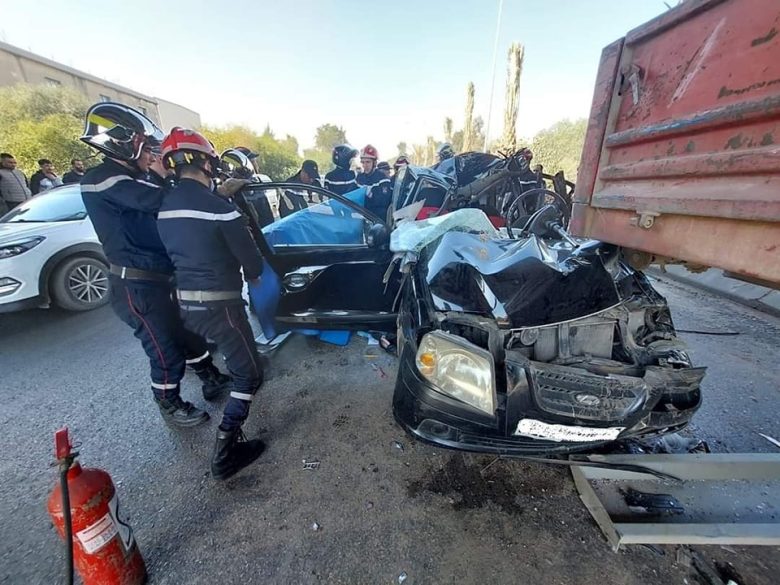
The Director of Studies at the National Road Safety Delegation (DNSR), Lahcen Boubka, sounded the alarm this Monday over the increase in road accidents and called for collective awareness. He stated that during the first eight months of this year, Algeria recorded 18,395 bodily injury accidents, an increase of 0.89% compared to the same period in 2024, despite awareness efforts and strengthened controls. The human toll remains heavy with 2,618 deaths, up 0.5%, and 25,399 injured.
“Every injury, every death is an irreparable loss, a tragedy for families, and a human and material cost for the country,” the official lamented on national radio. He stressed that while the statistical rise seems slight, it is “unacceptable” on a human level. He added that behind each number lie “family tragedies, lifelong disabilities, and an economic burden for the state and insurance companies.”
Regarding those responsible for this carnage, the situation is clear: over 95% of accidents are caused by human factors. “Speeding, dangerous maneuvers, failure to respect traffic laws, consumption of psychotropic substances, and drunk driving,” Boubka listed, before quoting a telling proverb: “We drive as we behave.” To understand the deeper causes of this behavioral drift, the Delegation signed an agreement with the University of Tipasa to study the psychological and sociological factors behind the phenomenon.
Statistics show that young people are the most affected, especially those with a driving license for less than five years. “We have observed gaps in initial training,” Boubka explained. In response, the DNSR updated the national training plan to include basic mechanics, first aid, and eco-driving courses. The driving hours requirement was also increased from 15 to 20 hours for category C licenses and from 25 to 30 hours for category B.
This reform is accompanied by increased inspections of driving schools, carried out in cooperation with the wilaya transport directorates. “We have already conducted several inspection missions, notably in Algiers, where the number of driving schools is highest,” the official specified.
While human factors dominate, other causes worsen the situation, such as poor road conditions and vehicle aging. According to the Delegation’s data, 1.6% of accidents result from road degradation, and 2.38% from vehicle condition.
The study officer emphasized that “since 2019, the absence of new vehicle imports and the scarcity of spare parts have made the national vehicle fleet extremely aged.” This reality, combined with sometimes neglected technical inspections, multiplies risks.
He cited the recent example of a bus involved in an accident that “was operating without authorization after failing the technical inspection.” He called this situation “extremely serious.”
Geographically, the Delegation identified 425 black spots across the 58 wilayas, of which 224 have already been addressed. These stretches, where at least three accidents occur annually within 100 meters, require urgent interventions.
The wilayas of Mila and Tipasa top the list with 55 black spots each, followed by 35 in Annaba, 18 in Bouira, and 36 in Béni Slimane. These high-risk zones are often linked to missing or faulty signage or infrastructure. “Poorly placed or absent signage can cause sudden braking and collisions,” warned Boubka.
Alongside regulatory action, the Delegation conducts four major annual awareness campaigns, including one at the start of the school year. Aimed at students of all levels, this campaign combines educational workshops, games, driving simulators, and virtual reality helmets that allow teenagers to “experience” an accident to better understand its consequences. The official explained, “We want to instill a culture of safety from childhood because this is the generation of future drivers.” Practical guides are also distributed to different categories of drivers to instill proper driving reflexes and road behavior.
Boubka emphasized that road safety does not depend on a single factor, stating that “it is a collective responsibility involving drivers, trainers, local authorities, and the state.”