

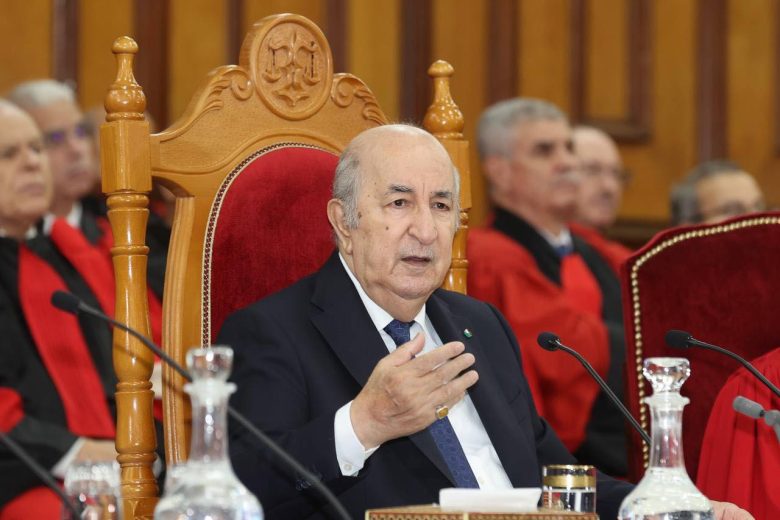
President Abdelmadjid Tebboune affirmed that the comprehensive revision of the national legal framework aims to enshrine the rights and freedoms of citizens, while strengthening achievements in human rights and adapting legislation to the economic and technological changes the country is experiencing.
Presiding, this Sunday, over the official opening of the 2025/2026 judicial year, the head of state, who is also president of the Supreme Council of the Judiciary (CSM), stated that this legislative momentum is part of commitments made for “the moralization of public life and the fight against all forms of corruption and abuses that undermine our religious, cultural values and our national identity.”
President Tebboune specified that most of the new legal texts adopted or revised aim “to directly serve citizens in terms of rights and freedoms,” while adapting institutions to these demands and “creating an environment conducive to modernizing the legal system in response to technological and socio-economic developments.”
Referring to the speed of economic transformations, particularly in the knowledge economy, he emphasized the importance of having laws aligned with these changes, citing as examples the revision of laws related to combating drug trafficking, money laundering, terrorism financing, as well as the protection of personal data.
The head of state also highlighted the new criminal procedure code, which “will provide greater efficiency to the judiciary, ensure legal security, and strengthen the rules of fair trial.” He added that this text will also help “facilitate access to justice, encourage investment, and establish the foundations for broad economic security.”
President Tebboune recalled that “at least 85% of economic transactions are now free,” occurring between private operators or between the state and the private sector, hence the importance of developing new laws adapted to this evolution. In this context, he called for multiplying commercial courts to reduce case backlogs and dispel “the false impression of slow justice.”
Reaffirming that the revision of legislative texts aims “to facilitate access to justice and regulate economic and commercial initiatives,” the president assured that these reforms will be supported by complementary texts to “enshrine transparency, strengthen integrity, and intensify the fight against corruption.” He emphasized that this fight “constitutes an absolute priority of the state and rests on unwavering political determination.”
The country’s chief magistrate described the opening of the judicial year as “a moment to assess the progress made by the judicial institution,” notably through reforms undertaken for an independent, integrous, and effective justice system, “based on the rule of law and committed to establishing trust and legal security in the country.”
Furthermore, the head of state gave firm directives to address the material and professional needs of judges to enable them to fully devote themselves to their duties. He also emphasized the defense and presumption of innocence, “fundamental guarantees of a fair trial and protection against abuses.”
In addition, the head of state praised the progress made in the transition to a digital justice system, stating that “qualified human resources are a key factor in embodying the independence of the judiciary and bringing justice closer to citizens.” He commended judges who, “armed with moral values and knowledge, embody the noble principles of modern justice and contribute to its prominence.”
The president of the Republic concluded his speech by announcing the promulgation of the new status of the judiciary before the end of 2025, thus marking a major milestone in the process of modernizing the national judicial system.