

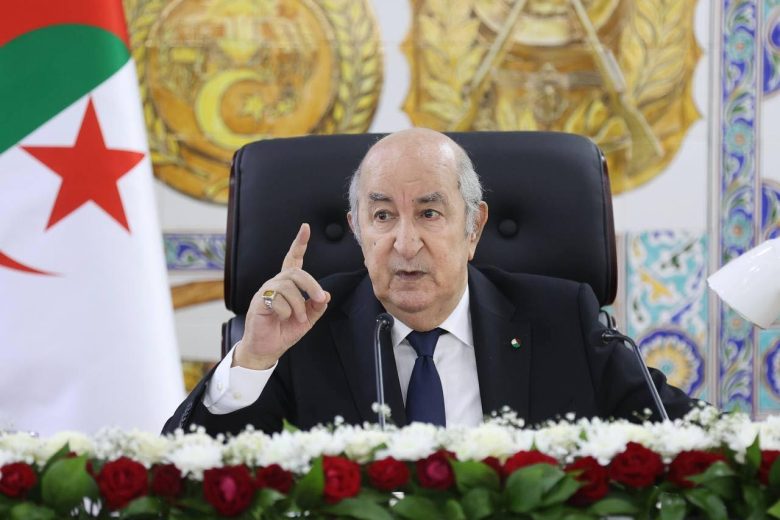
The state will never cease fighting corruption nor fail to recover assets looted during the “issaba” period, with nearly 30 billion dollars in diverted funds and properties already reclaimed. This was affirmed by President Abdelmadjid Tebboune during a significant speech delivered last Thursday to the cadres and personnel of the People’s National Army (ANP).
The head of state expressed gratitude to Spain, which he described as a “friendly country,” for returning to Algeria a five-star hotel owned by a businessman who had acquired it with embezzled funds, noting that other European countries have pledged to assist Algeria in repatriating stolen funds.
Regarding investment, President Tebboune announced that 17,000 investment projects are currently under review at the one-stop shop, described as “the sworn enemy of corruption and bureaucracy,” emphasizing that the national economy is now receiving praise from international financial and economic institutions.
“Despite pessimistic forecasts, the World Bank upgraded Algeria’s economic ranking, and our country is now the third largest economy in Africa,” he stated, adding that Algeria will soon become the continent’s leading phosphate producer, with an expected output of 10 million tons per year.
On this subject, the head of state reiterated his commitment to strengthening the country’s industrial capacities and raising the industrial sector’s contribution to GDP to at least 13%, affirming his intention to promote the role of youth in public affairs management and to stimulate start-up creation, aiming to reach 20,000 innovative companies in the coming years.
Addressing demographic challenges, Mr. Tebboune reminded that Algeria’s population will reach 50 million inhabitants within three years, which, according to him, requires wealth creation, reinforced national stability, and continued efforts to ensure food security, self-sufficiency in essential products, housing, and employment.
He reaffirmed that the state will not relinquish its social character despite financial constraints and will strive to improve citizens’ purchasing power through new salary increases and the enhancement of certain allowances.
After praising the role of the army and security forces in combating drug trafficking, the head of state regarded this scourge as a threat aimed at undermining the social fabric and destroying Algerian youth by “attempting to flood the country with narcotics.”
On digitalization, Mr. Tebboune announced that Algeria will enter a new era of full digital modernization in 2026, including for the People’s National Army, to strengthen its defense capabilities, adding that “a state wishing to preserve its sovereignty and independence must have a strong economy and a powerful army.”
On international matters, the president welcomed the strong bilateral relations Algeria maintains with Gulf countries, “except for one which I will not name.” “We cooperate daily with our brothers, whether Saudi, Qatari, or Omani. The problem comes from the one trying to sow disorder in my country for suspicious reasons. Some dared to interfere in matters where even great powers were denied intervention,” he added, reiterating Algeria’s categorical rejection of any foreign interference in its internal affairs.
Regarding neighboring countries, Mr. Tebboune clarified that “Algeria has not reached a point of no return in its relations with certain Sahel countries,” emphasizing “the need to preserve national awareness, respect good neighborliness, and consider historical cooperation ties.”
On Libya, President Tebboune recalled that Algeria does not interfere in Libyan internal affairs and “harbors no ambitions in this brotherly country,” calling for “preserving Libyan national unity through free and inclusive elections.”
Regarding the Western Sahara issue, the head of state expressed his wish to see this conflict resolved within the framework of the United Nations, reaffirming Algeria’s unwavering support for the Sahrawi people in their struggle for self-determination, stressing that the borders with Morocco were not closed because of Western Sahara. “They were closed for other reasons. In 63 years of independence, our borders have remained closed for more than 45 years,” he added.
On the Palestinian cause, President Tebboune affirmed that it “benefits for the first time from a fierce defender in the Security Council, thanks to Algeria’s honorable positions,” expressing hope that the ceasefire agreement in Gaza will be realized quickly to put an end to the “genocide endured by the Palestinian people.”