

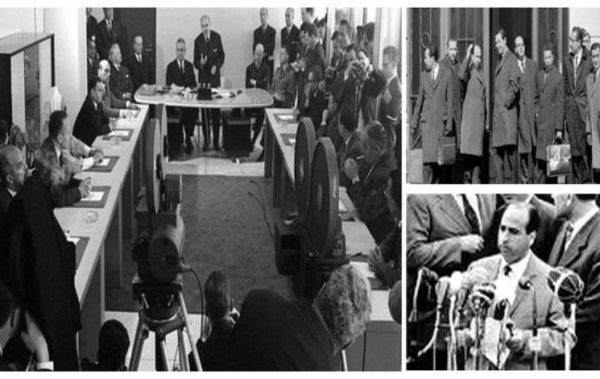
At the heart of the Evian Accords negotiations, the Sahara issue emerged as an absolute red line for the Algerian delegation. Confronting bids for territorial carve-outs and the strategic stakes tied to energy reserves, FLN negotiators held firm without compromise, cementing national integrity as a non-negotiable tenet and laying the groundwork for independent Algeria’s sovereignty as early as 1962.
After months of tense talks between the Provisional Government of the Algerian Republic (GPRA) and France, the Evian Accords were sealed, formally ending over seven years of a brutally costly liberation war. The ceasefire took effect the following day, March 19, 1962, paving the way for a self-determination referendum and the declaration of independence.
This milestone signaled a resounding political and historical triumph for the Algerian people. Yet the accords also included delicate provisions, hammered out amid intricate power dynamics—such as the Algerian South and its energy wealth, France’s ongoing nuclear tests, the Mers El-Kébir naval base, and select economic safeguards for Paris.
Indeed, during negotiations, France sought to retain sway over this vital region, especially after major oil and gas strikes in the late 1950s. French officials even floated detaching the Sahara from the rest of Algeria.
The FLN delegation rebuffed this outright, steadfastly arguing throughout that territorial unity was untouchable, with the rallying cry: “Algeria is one and indivisible, from north to Sahara.” That stance became the hallmark of the national movement’s resistance to any split.
Algerian delegation leader Krim Belkacem stated the position plainly: “The Sahara is an inseparable part of Algerian territory, and there will be no separation from independent Algeria.” This resolve ensured the accords’ final text enshrined Algeria’s territorial wholeness.
The Thorny Nuclear File
Another flashpoint was France’s continuation of nuclear tests in southern Algeria. Since 1960, Paris had conducted atomic trials in Reggane and later In Ekker.
The Evian Accords allowed France transitional use of these sites. For Algerian negotiators, this was a pragmatic trade-off to secure the core goal: independence.
GPRA President Benyoucef Benkhedda later explained the rationale: “Our top priority was national independence. Some terms were temporary, but the key was ending colonial rule.”
The environmental and health fallout from those tests remains a major unresolved chapter in Algeria-France relations today.
The Mers El-Kébir naval base, near Oran, posed another strategic hurdle. It anchored France’s Mediterranean military footprint.
Under the Evian deal, Paris secured 15-year usage rights. But the new Algerian Republic soon deemed any foreign military outpost at odds with full sovereignty.
France withdrew in 1967—well ahead of schedule—marking a key step in reclaiming complete national control.
The accords also featured measures to shield French economic stakes in Algeria, covering investments, assets, and company operations.
Meanwhile, some French administrators and technicians stayed on briefly to maintain government and economic continuity.
Historian and former FLN figure Mohamed Harbi later captured this tricky handover: “The Evian Accords reflected a balance of power: they involved concessions, but above all, they affirmed the Algerian people’s victory and right to self-rule.”
Despite these thorny clauses, the Evian Accords stand as a pivotal chapter in modern Algerian history. They closed 132 years of colonization and unlocked the path to a sovereign state.
As Krim Belkacem put it after the talks: “We secured the essentials: Algeria’s independence and recognition of our people’s sovereignty.”
Over six decades on, these accords endure as a cornerstone of national memory, underscoring that Algeria’s freedom was won through armed struggle, popular sacrifice, and negotiators’ unyielding grit.