

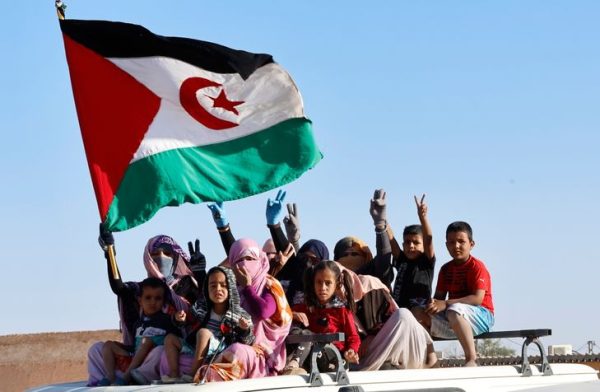
The Ambassador of the Sahrawi Arab Democratic Republic (SADR) to Algeria, Khatri Addouh, reaffirmed this Sunday in Algiers the unwavering attachment of the Sahrawi people to their legitimate right to self-determination and independence, while praising Algeria’s constant and steadfast support for this cause, which is grounded in the principles of international law and the anti-colonial struggle.
During the ceremony celebrating the fiftieth anniversary of the proclamation of Sahrawi national unity, held at the Moufdi-Zakaria Palace of Culture and organized in coordination with the Algerian National Committee of Solidarity with the Sahrawi People, the diplomat recalled that this symbolic anniversary “commemorates a people’s faithfulness to its cause and the continuity of a struggle that has never ceased despite trials and occupation maneuvers.”
Khatri Addouh stated that this commemoration is “an opportunity for the Sahrawi people, under the leadership of the Polisario Front, to remind the international community—primarily the United Nations and the Security Council—that their right to self-determination is neither negotiable nor subject to compromise.” He asserted that “any attempt to divert the Sahrawi issue from the UN framework of decolonization is doomed to failure,” emphasizing that “the Sahrawi people will never submit to the fait accompli imposed by the Moroccan occupation.”
The ambassador also condemned the attitude of certain powers that “today feign impatience over the length of the conflict, while remaining silent when the Sahrawi people endured exile, repression, and dispossession.” He challenged them by asking, “Where were these voices when Morocco violated agreements signed under UN auspices in 1991, refusing the self-determination referendum? Where were they when successive personal envoys of the Secretary-General resigned in the face of Moroccan intransigence?” Furthermore, Mr. Addouh denounced “the complicit silence and collusion” benefiting the Makhzen, accused of “continuing its human rights violations in the occupied territories and plundering the natural resources of Western Sahara.” He warned that “media maneuvers, intimidation attempts, and diplomatic calculations will never shake the faith of a people standing firm, determined to live free and with dignity on their land.”
Moreover, the SADR representative expressed his appreciation for “Algeria’s constant, firm, and unequivocal support, as a state of principles and values, for the Sahrawi cause.” He recalled that this support, both “institutional and popular,” is rooted in the foundations of the November 1, 1954 revolution and is manifested on all international platforms, notably the United Nations General Assembly, the Special Committee on Decolonization, the Security Council, and within the African Union.
For Khatri Addouh, national unity, celebrated on October 12, “remains the cornerstone of Sahrawi resistance and the key to its cohesion in the face of the challenges imposed by the occupation.” This unity, he said, “sustains the faith of a people who have never ceased to believe in the justice of their cause and in the victory of legitimacy over force.” He concluded in a tone full of determination: “Fifty years after the proclamation of our unity, the Sahrawi people continue to walk steadily on the path to freedom. There will be neither forgetting nor retreat. History ultimately sides with those who fight for dignity, not domination.”
It is worth noting that through this commemoration, rich in symbolism and loyalty, the Sahrawi people reaffirm to the world that their cause remains alive, that their struggle remains legitimate, and that their aspiration for freedom has no expiration date. Fifty years after national unity, successive Sahrawi generations share the same faith, consistency, and hope.
Western Sahara continues to represent one of the last open chapters of decolonization in Africa. And as long as this chapter is not closed through justice and regained sovereignty, the voice of the Sahrawi people will continue to rise firmly, with dignity and steadfastness, to remind that the right to freedom is neither a favor nor an illusion, but a historical promise that no one can erase.