

Once again, Moroccan illusions about a chimera diplomatic victory on the Western Sahara issue have been proven false. Rabat has just received a new cold shower from one of its allies regarding the latest United Nations Security Council resolution.
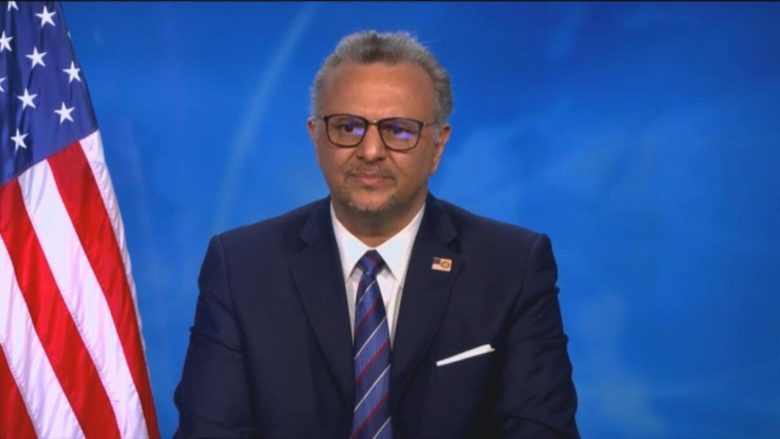
Indeed, Massad Boulos, the advisor to the American President, Donald Trump, for Africa and the Middle East, has buried the enthusiasm of the Makhzen regarding a supposed recognition of its annexation plan, called autonomy, of the Western Sahara territory. On France 24, Mr. Boulos confirmed, the day before this Tuesday, almost all the statements recently made by the Algerian Minister of Foreign Affairs, Ahmed Attaf.
According to the American advisor, “the resolution satisfies both parties almost completely. The problem is only in the preamble of the resolution and not in the provisions. Without that, we could have had a unanimous vote from all 15 members, including Algeria.” For Mr. Boulos, it is necessary to distinguish between the official position of the United States and Donald Trump, who consider the autonomy plan as “the only solution,” and the Security Council’s resolution of October 31, which, on the contrary, leaves the door open to other ideas. In other words, there is no exclusivity to the Moroccan autonomy proposal, thus confirming the existence of alternative options clearly indicated within the text.
Regarding the self-determination referendum, Mr. Boulos does not rule it out, explaining that for this issue, it is up to the parties to decide during negotiations that will start in the coming weeks. “There may be a form of voting, like in any election,” he said. As for determining who can vote, it is a “detail” that has not yet been discussed.
Massad Boulos goes further in his clarifications: “We encourage the parties to discuss all these details to reach a solution acceptable to all. There may also be a final solution acceptable to all, without recourse to voting.”
A phrase that leaves the door open for the two conflicting parties, the Polisario Front and Rabat, to agree on technical and legal plans in search of alternative ways to resolve the conflict.
Furthermore, the Trump advisor reiterated that the two conflicting parties are the Polisario Front and the Kingdom of Morocco, countering the attempts of the latter to involve Algeria or to “bilateralize” the conflict, as King Mohamed VI desperately attempted in his speech after the adoption of the UN resolution.
Asked about the next step following the resolution, Massad Boulos indicated that Morocco would propose a plan based on the 2007 proposal but more detailed. “With the wisdom of the King and the Moroccans, we know this is a very serious step. There is a genuine willingness to end this conflict, and the only way to do so is with the agreement of both parties,” he said.
“We count on the wisdom of His Majesty the King and the Algerian President Abdelmadjid Tebboune, and Algerians in general (…) We know that Algeria and President Tebboune are open to this dialogue,” added the American advisor.
Boulos’s remarks align with his recent statements on an eastern television channel, in which he highlighted that the UN Security Council resolution on Western Sahara only made reference, for the first time indeed, to the Moroccan autonomy plan, without imposing it or presenting it as the sole solution to the conflict.
Massad Boulos emphasized that “the resolution clearly refers to self-determination,” and that this was accepted by Morocco, which, he said, “constitutes a very important step forward.” For him, “the details about how it will be implemented remain to be discussed. There is no doubt that there will be some form of voting or resolution.”
Morocco has welcomed favorably the proposal contained in the resolution adopted by the Security Council, allowing each party to suggest other ideas for discussion, added the American advisor. Mr. Boulos himself acknowledges that the resolution is the first step of a “thousand-mile march.”