

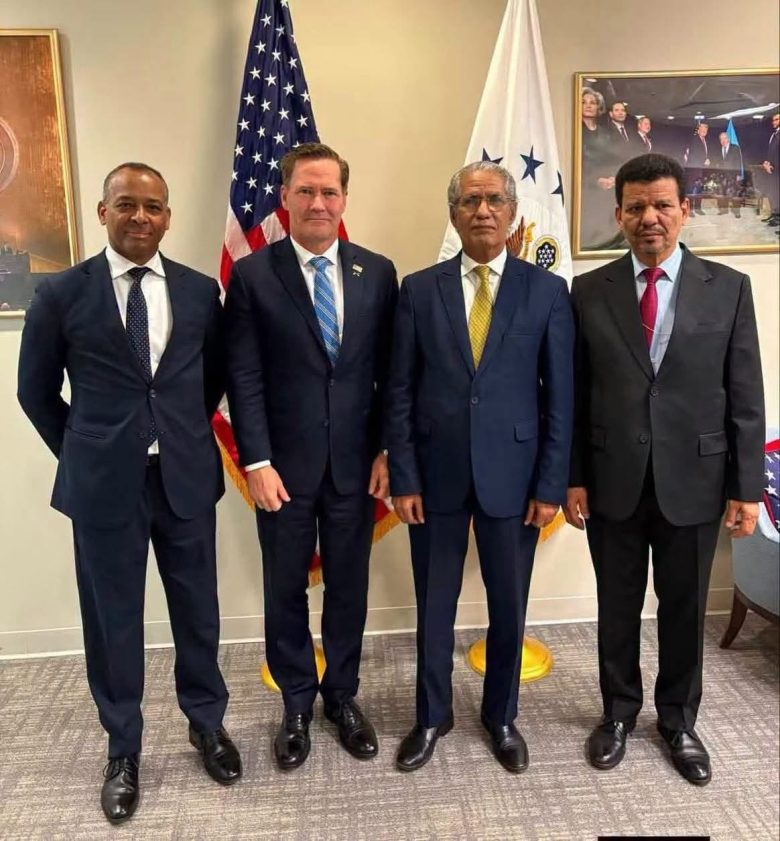
American diplomacy is increasingly active regarding the Western Sahara issue. In a highly symbolic move, the United States Permanent Representative to the United Nations, Ambassador Mike Waltz, conferred on Wednesday with a high-level delegation from the Polisario Front at the international organization’s headquarters.
Following this meeting, the American diplomat delivered a powerful message on his official networks, emphasizing that Sahrawi refugees, confined to the Tindouf camps for half a century, “have waited 50 years” and “deserve genuine alternatives, not another decade of waiting.”
Mr. Waltz also pointed out that the foundation for a peaceful and definitive resolution is already “on the table,” indicating that the conflict is by no means resolved as the Makhzen claims.
The Polisario Front delegation received in New York comprised prominent figures of the Sahrawi cause, including Mohamed Salem Salek, diplomatic advisor to the president of the Republic, Mohamed Yislam Beisat, minister of Foreign Affairs, as well as Sidi Mohamed Omar, the Front’s permanent representative to the UN and official coordinator with the United Nations Mission for the Referendum in Western Sahara (MINURSO).
This encounter within the UN apparatus aligns with a particularly hectic diplomatic agenda, marked by recent statements from senior officials of the US administration concerning the regional political deadlock. Waltz’s stance mirrors recent declarations by Massad Boulos, special advisor to the US presidency for Arab and African affairs. Speaking during an international media interview, Mr. Boulos made waves by stating that no “imminent, concrete, and tangible” short-term resolution existed, while acknowledging the inherent difficulties of unilaterally imposing the Moroccan autonomy plan.
The American advisor also made a point to dismiss the notion that Algeria constitutes an “obstacle” or impediment to peace efforts, characterizing Algiers instead as a “very good partner” of the United States and praising its constructive role as a regional facilitator. According to Mr. Boulos, Algeria cannot be held responsible for a unilateral solution, especially since the final decision and the expression of political determination belong primarily to the Sahrawis themselves through their representative bodies.
These combined positions of Mike Waltz and Massad Boulos highlight a subtle yet tangible recalibration of the American perspective. By stressing the importance of providing real choices to the refugee camp populations while maintaining dialogue with all stakeholders, Washington appears intent on revitalizing a peace process stalled for decades, moving away from exclusive unilateral visions and promises of instant diplomatic triumphs. The Sahrawi issue thus confirms its status as one of the most complex Gordian knots in North African geopolitics, where every word spoken at the UN is examined with utmost scrutiny.