

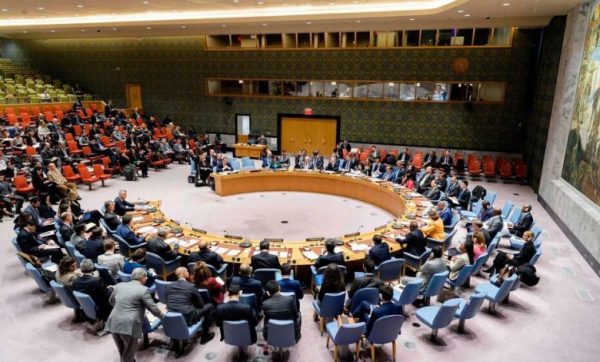
Fifteen member countries of the UN Security Council face their historic and moral responsibilities. On the eve of the vote on the controversial draft resolution on Western Sahara, driven by the United States and France, a heated debate is expected by observers.
While the Americans, the French, and the British try to push through an unfair, biased, and condemnable text justifying the outright annexation of a territory and the subjugation of a people fighting for their independence, other Security Council members face heavy pressure and relentless lobbying to side with the first camp.
Under the pretext of renewing the mandate of the UN mission responsible for organising a self-determination referendum, this text insidiously introduces paragraphs unacceptable under international law. It outright elevates the so-called “autonomy plan” as the sole basis for negotiation, even as the “most appropriate” solution, disregarding all UN resolutions passed and adopted for over five decades. Furthermore, this text ignores the advisory opinion of the International Court of Justice, issued in 1975, as well as all subsequent rulings of the Court of Justice of the European Union.
According to diplomatic sources, the text must gather 9 votes out of 15. Washington, Paris, and London have easily secured the support of Panama and Sierra Leone. They will still need to win over four more votes from other member countries: Greece, South Korea, Pakistan, Somalia and Guyana, Slovenia, and Denmark. The same sources believe China and Russia are expected to abstain during the vote.
Moscow has already expressed its position by supporting two principles: first, respect for the Sahrawi people’s right to freely choose their future, and second, recognition of the colonial status of Western Sahara, as stipulated in numerous UN resolutions, for which the creation of MINURSO is just one more proof.
This Western text is already denounced by several capitals, which consider that the UN risks, through this, legitimising past and future colonisations, further discrediting already weakened international institutions, and above all trampling on the rights of peoples in the face of a military fait accompli.
In this context, observers question the complicit and incomprehensible silence of another no less important organisation, the African Union. It has remained curiously mute and paralysed, though it should be supporting and standing with a founding member state of the AU whose sovereignty and right to freedom are threatened. Will the AU confine itself to neutrality, forbidding any statement in response to these Western manoeuvres on its own continent? Will it accept such a denial from some Security Council members when the right of existence of an AU member state (RASD) is trampled and despised?
Faced with these deviations with serious consequences for regional and international geopolitical balances, the Polisario Front, the legitimate representative of the Sahrawi people, has announced it will boycott any political process if the American draft is adopted.
It has affirmed its rejection of “any imposed solution or solution against the will of the Sahrawi people,” whose right to self-determination is recognised by the international community and all resolutions of the Security Council and the UN General Assembly.
In this regard, the Sahrawi representative to the United Nations and coordinator to MINURSO, Dr Sidi Mohamed Omar, recently highlighted that the draft resolution represents a “very dangerous and unprecedented departure,” not only from the principles of international law recognising Western Sahara as a decolonisation issue but also from the basis on which the Security Council has addressed Western Sahara.
For the Polisario Front, “any approach that establishes a predetermined framework for negotiations or predetermines their outcome, limits the free exercise by the Sahrawi people of their right to self-determination, or imposes a solution against their will is completely unacceptable.”
Finally, the Polisario has issued an urgent call to all stakeholders to use their efforts constructively to create the necessary conditions for both parties, the Polisario Front and Morocco, to engage in serious and credible negotiations without preconditions and in good faith, under the auspices of the UN, with the aim of reaching a just, lasting, and mutually acceptable political solution that guarantees the self-determination of the people of Western Sahara and peace throughout the region.