

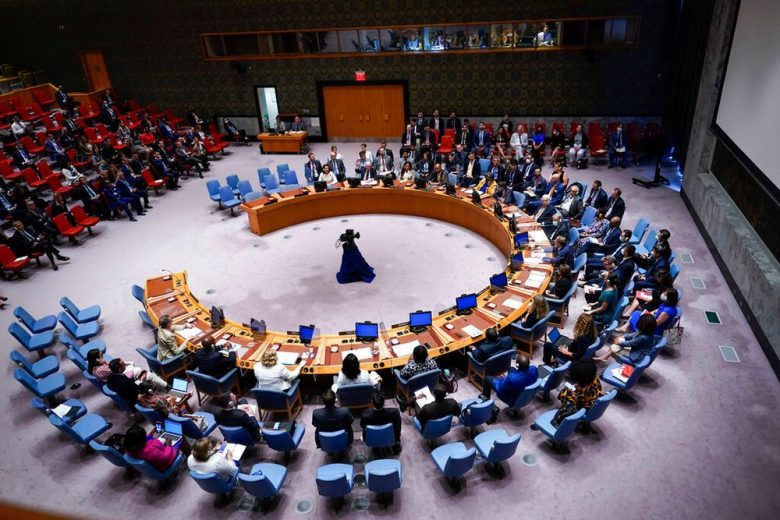
The plan to resolve the long-standing Western Sahara conflict, submitted by the United States to the UN Security Council, represents an unprecedented breach in international relations. While it contributes to institutionalising an injustice, it invites the region into an uncertain future.
Through a document that tramples on the fundamental principles of international law, Washington plants, through narrow calculations and populist ambitions, a ticking time bomb in the region whose blast could ultimately destroy this illusory peace.
The new American administration is trying to gloss over the dark chapters of President Donald Trump’s record, more concerned with his ego than with cardinal law, through an illusory peace feat in a region known to be sensitive.
The current push by White House diplomats within the Security Council aims to realise this ambition to deliver a dubious peace achievement, among others, to the MAGA (Make America Great Again) base, which opposes any US involvement in external conflicts, notably in the Middle East.
The eagerness of American advisers Steve Witcoff and Jared Kushner, along with special envoy for the MENA region Mossad Boulos, to deliver this accomplishment on behalf of Trump explains their disregard for international legality and, even more seriously, their contempt for UN institutions tasked with regulating conflicts through legal means established by the US and other founding countries in 1945.
The Americans, who have assumed the role of penholders within the UN Security Council by drafting converging or diverging opinions in resolutions, have now decided to codify Moroccan propaganda, regardless of the damage done to international legality, ethics, and morality.
Formerly concerned with procedural respect, the United States is now directly involved in conflict resolution outside the UN sphere, while exerting full influence to impose a fait accompli. Yesterday in Gaza and today in Western Sahara, despite the fact that this diktat constitutes a serious threat to stability in the Maghreb and Sahel region.
This change of strategy reveals more the blindness of the current White House occupants and the little credit they grant to the future of a region, no less important due to its wealth, demography, and geopolitical significance for both Europe and the rest of North Africa.
It is obvious that Morocco has invested for years, in its logic of compromise, in Zionist lobbies to the extent of demanding Washington’s recognition of Moroccan sovereignty over Western Sahara to justify its accession to the Abraham Accords in December 2020. A decision against the will of the Moroccan population, which remains deeply hostile to any rapprochement with the Jewish state.
Having now joined the club of normalisers, Rabat considers it has fulfilled its part of the contract and expects a return on investment, aiming to consolidate a de facto and de jure occupation of the Sahrawi territory.
This compromise is the result of years of evasions, false propaganda, and manipulations within American institutions, notably Congress, against Algeria.
Since 2007, when France suggested the autonomy plan to Morocco, Algeria has been subjected to a true defamation campaign supported by pro-Zionist senators embedded in Congress. Accusations against Algeria claiming it to be the “new Iran of the Maghreb,” or alleging intentions to acquire nuclear weapons or alleged links with Hezbollah, are villainous smears attached to the grim file of Moroccan diplomacy, as revealed by Wikileaks cables.
Meanwhile, Algeria has remained faithful to its principles of defending international legality and the right of peoples to self-determination, a stance it upheld even against its own allies and friends such as Indonesia when supporting Timor-Leste’s independence.
This has also been the hallmark of Algerian diplomacy since 7 October 2023 when condemning, whether in the Security Council or at foreign ministers’ meetings, the Zionist atrocities against the Palestinian population, while Moroccan foreign minister Nasser Bourita remained idle, silent, as the Moroccan public protested the Zionist crimes.
Just hours before the Security Council’s verdict, it is no longer necessary to prove that the autonomy plan is a chimera through which Morocco seeks to enshrine occupation. The contours of this plan are virtually non-existent and are left, according to American rhetoric, to the discretion of the two concerned parties: Morocco and the Polisario Front.
Yet, the Sahrawi movement has rejected this solution and intends to turn its back on it if validated, as it does not meet its legitimate aspirations.
Moreover, many Western diplomats question why, among the 17 non-self-governing territories listed by the UN’s Fourth Decolonization Committee under resolution 1514 of 1960, Washington and its allies have sought a resolution only for the Sahrawi territory. In contrast, territories such as New Caledonia and the Falkland Islands remain colonised by France and Britain respectively.
Attempts at amendments in the Security Council by Denmark and Slovenia, the two countries who echoed Algeria’s position, were blocked by American obstinacy to push their own draft.
Negotiations within the Security Council are not immune to pressures exerted on non-permanent members by the US-France-Israel-United Arab Emirates quartet, now the standard-bearer of an unprecedented violation of international legality.
This scenario thus legitimises Moroccan expansionism and establishes a tension hotspot in the region, but it also sows the seeds of chronic instability that indefinitely postpones any prospect of reconciliation among the peoples of the region.
The so-called American efforts to foster rapprochement between Morocco and Algeria referenced by Steve Witcoff and Mossad Boulos are wishful thinking at best, or a caricatural ambition considering that America’s stance on Western Sahara cannot earn Algeria’s trust.
Especially as, in a world undergoing transformation marked by the emergence of new powers and alliances, Algeria does not exclude reconsidering its paradigms and strategies to explore new diplomatic avenues that, it is believed in Algiers, will offer a better reading of its future in the region, far from the desires of those who violate the principles of law.