

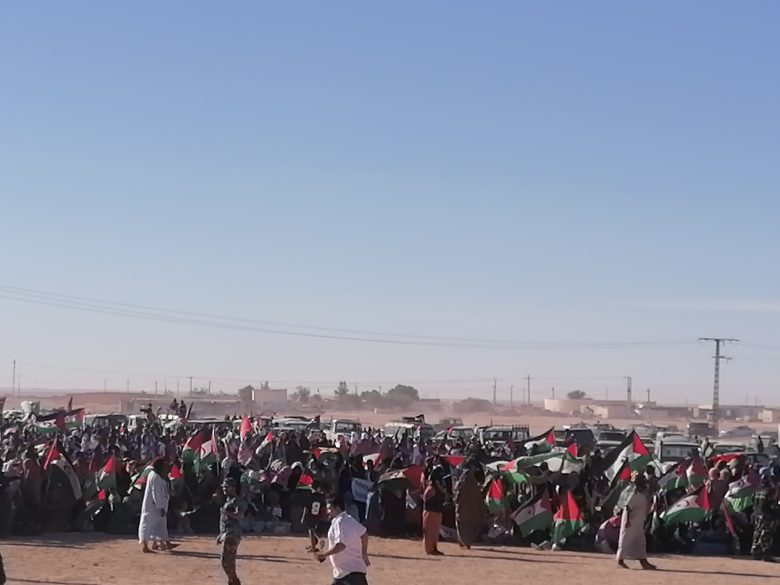
In a climate of growing frustration, thousands of Sahrawis took to the streets of Laâyoune, Smara, Dakhla, and several refugee camps in Tindouf to reaffirm their unwavering commitment to independence. Draped in the colours of the Sahrawi Arab Democratic Republic (SADR), they chanted their rejection of the status quo imposed by the great powers and denounced the “complicit silence” of the Security Council in the ongoing occupation of Sahrawi territory. These demonstrations, among the most significant in recent years, reflect the weariness of a people tired of waiting for diplomacy to keep its promises, expressing a widespread frustration fed by decades of waiting, diplomatic deadlock, and empty illusions.
Nearly fifty years after Spain’s withdrawal from the territory, the Sahrawi people remain without a state, without recognised sovereignty, and with no tangible prospect of a self-determination referendum. The latest report from the United Nations Secretary-General, deemed “tasteless” by many observers, acted as a spark in an already tinderbox of frustrations. The Sahrawis accuse the UN of maintaining a “horizonless” crisis management approach, where resolutions follow one another without ever leading to concrete actions.
By occupying the streets of Laâyoune, the protesters wanted to make the message loud and clear: “the status quo is no longer bearable.” The slogans “No alternative but independence” and “Security Council complicit in the occupation” sum up this feeling of abandonment and disillusionment, marking a real turning point and expressing weariness with UN inertia—especially since the 1991 ceasefire, when the promise of a self-determination referendum gradually gave way to vague diplomatic rhetoric.
For decades, the Western Sahara issue has been stuck in a diplomatic deadlock. The United Nations Mission for the Referendum in Western Sahara (MINURSO), intended to guarantee this process, has become, in the eyes of the Sahrawis, a symbol of impotence. Created to organise the self-determination referendum, it is now reduced to an administrative observer role. No timetable, no human rights monitoring mission, no constraints on the parties. This blockage is largely explained by the weight of vetoes in the Security Council, particularly those of France and the United States, allies of the Moroccan government. “The Sahrawis have no veto in New York, but they do on every square metre of their land, in their cemeteries, in their schools, and in their hearts.” This phrase, widely circulated on social media, has become one of the symbols of Sahrawi resistance.
It is in this context of deadlock that protest movements have resurfaced strongly, supported by a generation that has known only exile, marginalisation, or repression in the occupied territories. The Sahrawis are fighting not only for land but also for recognition. In their eyes, this delay is not accidental but the result of geopolitical interests, where the rights of peoples weigh little against economic and military alliances.
This wave of anger primarily reflects a total loss of confidence in the international community. Especially since the majority of these young people deeply believe that legitimacy is not decreed in New York but lived and defended on the ground. Thus, the current situation marks a historic turning point where the region stands at a crossroads: either the international community finally takes responsibility by enforcing the right of peoples to self-determination, or the region will plunge back into a cycle of confrontation.
The gatherings of recent days did not arise from spontaneous enthusiasm but from coordinated organisation among activists, associations, and representatives of the Sahrawi civil fabric. Several preparatory meetings were held in the refugee camps of Smara and Rabouni, as well as in Laâyoune, where clandestine committees called for unified mobilisation. The rallying cry was to rehabilitate peaceful resistance, in the image of the major protests in 2005 and 2010, notably that of Gdeim Izik.
These demonstrations, brutally repressed at the time, marked a collective awakening that the struggle for independence could not be suspended to the goodwill of the great powers. Twenty years later, this conviction has re-emerged with renewed vigour, driven by a generation unwilling to grow up under occupation.
It should be noted again that one of the main causes of popular discontent lies in the perception of an impotent, even biased UN. In the eyes of many Sahrawis, the Security Council has become an inactive referee, preferring to extend MINURSO’s mandates rather than impose binding decisions. The United States and France are particularly blamed for their systematic vetoes of any initiative deemed unfavorable to Morocco. This diplomatic imbalance has fuelled a sense of injustice: while other peoples have won independence after decades of struggle, Western Sahara seems condemned to indefinite waiting. The young protesters see this as further proof that liberation will not come from outside but through internal mobilisation and strengthening the resistance front.
Algeria, while reaffirming its support for the right to self-determination, continues to advocate a peaceful political solution based on respect for international law. However, its diplomats warn that maintaining the status quo risks exhausting this patient approach. For many activists, the current protests represent more than just a cry of protest; they herald a new phase of the struggle. Some voices within the Polisario Front speak already of re-examining resistance strategies, possibly ranging from intensifying civil disobedience to resuming military actions if the political path remains blocked. Behind these words lies a stark reality: the patience of the Sahrawi people has reached its limit.
For the protesters, the greatest injustice is undoubtedly indifference. While global crises succeed one another, the Western Sahara issue seems stuck in diplomatic silence. Calls to resume dialogue are seen as empty phrases. The Sahrawis see them only as ways to buy time and preserve the status quo without challenging the occupation of their territory. The lack of international pressure on the Moroccan authorities, especially regarding human rights violations in the occupied territories, reinforces the feeling of abandonment. Many believe the Sahrawi cause interests foreign governments only for geostrategic reasons, not for principles.
Yet, despite weariness and anger, the Sahrawi mobilisation remains marked by profound dignity. In Laâyoune, Smara, Dakhla, or Tindouf, the protesters declare themselves determined to continue their struggle “until the total liberation of the territory.” “We are not begging for a right; we are demanding it,” sum up the protesters. This consistency across generations is the true strength of the Sahrawi people. It explains why, despite repression, exile, and the world’s silence, the flame of independence has never died out. The scenes seen during this strong mobilisation express the mindset of a people tired of unkept promises but still standing, still convinced that their independence will come. Every Sahrawi flag raised in the streets is an act of defiance. Every slogan is a reminder of the moral debt the international community has carried since 1975.
Through this image, everything is said. The Sahrawis have never ceased to exist, even if the world has stopped watching. More than ever today, the truth is that the massive demonstrations in Laâyoune are not an isolated episode but an expression of deep disenchantment and an intact demand. They reflect a people’s exhaustion with slow diplomacy but also their refusal to give up. As long as the right to self-determination is not implemented, Western Sahara will remain a source of injustice and, therefore, resistance, because the Sahrawi people made their choice long ago: freedom. And de facto, in the face of the Security Council’s silence, the Sahrawi people respond with the clamor of the streets, that of a people who do not give up. It remains to be seen whether the international community will have the courage to hear this cry before patience definitively gives way to anger.