

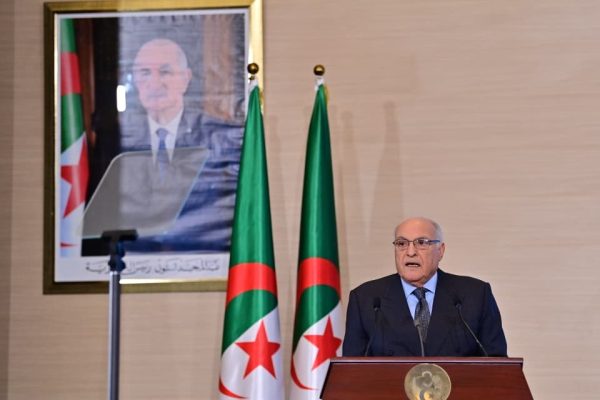
Foreign Minister Ahmed Attaf affirmed on Thursday that regional stability in the Maghreb remains tied to a political settlement respecting the right to self-determination in Western Sahara, which he views as Africa’s final decolonization file. Addressing the situation of MINURSO following the failed October 30 vote in the Security Council, he criticized “the approach pursued by the penholder, which sought to reflect its national position and impose it by force inside a draft UN resolution.”
During a press conference held at the headquarters of his ministry, in which he tackled several pressing international issues, Algeria’s top diplomat stressed that “homelands are not tradable assets, peoples’ rights are not bargaining chips, and decolonization is not a commercial transaction whose completion would be proclaimed by the mere signature of the parties.”
For Mr. Attaf, Maghreb regional stability remains inseparable from a political settlement that honors the right to self-determination. Returning to the MINURSO file, he sharply faulted the penholder’s move, arguing it aimed to force a national stance into a United Nations resolution draft.
The minister also rejected any attempt to strip the conflict of its substance, warning that “trying to reduce the essence of the dispute to whether or not the word ‘referendum’ appears in the Mission’s title amounts to extreme oversimplification of a matter that goes far beyond terminology or organization.”
In his view, imposing a fait accompli or dictating a settlement without the Polisario Front’s agreement would only complicate matters and prolong the conflict, to the detriment of regional security. He also denounced any effort to reduce a decolonization process to a mere refugee issue, “for whom a substitute homeland would be sought or who would be asked to agree to return to their land under the authority of the very occupation that uprooted them.”
Recalling the dual UN dimension of the issue—placed on the General Assembly’s Fourth Committee agenda since 1963 and reviewed by the Security Council since 1975, well before MINURSO was established in 1991—the minister cited a recent statement by the UN Secretary-General noting that the mission’s departure in no way annuls the inalienable rights of the Sahrawi people. He maintained that international legality cannot be sold off under “suspicious circumstantial diplomatic arrangements” and that “the expiration of MINURSO’s mandate affects neither the substance of the Sahrawi question nor its UN frame of reference.”
Placing his remarks within a turbulent global landscape, Ahmed Attaf noted that “the authority of international law is retreating in many cases before the logic of force” and that the credibility of multilateral institutions suffers from selectivity. Facing security and political challenges in Algeria’s neighborhood, he judged that “strategic vigilance and proactive diplomatic action” are essential.
For the minister, Algeria’s priorities remain clear: “to protect Algeria’s security and stability, prevent crises from spilling into its surroundings, and help establish lasting solutions to regional conflicts,” while respecting state sovereignty and non-interference. This approach fits a model of shared burdens and benefits across the Arab, Maghrebi, African, and Mediterranean spheres.
Turning to the Sahel region, Ahmed Attaf reaffirmed Algeria’s readiness to support its neighbors—notably Niger, Mali, Mauritania, Chad, and Burkina Faso—”far from any logic of tutelage, imposing models, or interference in internal affairs.” He advocated a three-pronged approach linking development, security cooperation, and social cohesion, specifying that “stability in the Sahel cannot be achieved through security approaches alone.”
On economic and development fronts, Algerian action, under President Abdelmadjid Tebboune’s oversight, involves executing major infrastructure projects in transport, communications, health, and education, alongside building mutually beneficial energy partnerships. On security, the minister emphasized that fighting terrorism, drug and arms trafficking, and human trafficking demands collective action against transnational threats.
Linking the Sahel crisis to regional tensions, he called for durable political solutions in Libya and Sudan while denouncing foreign interference, mercenaries, and arms flows. Regarding Libya, he condemned “attacks that targeted Benghazi port itself,” hitting a Russian vessel, and called for an inclusive process allowing Libyans to decide their future “away from diktats, foreign meddling, and the logic of temporary arrangements.”
On the Palestinian issue, the minister reiterated that it remains “the central cause, the fundamental question tied to an essential aspect of the regional security and stability equation.” He reaffirmed Algeria’s commitment to establishing an independent, sovereign Palestinian state with Al-Quds Al-Sharif as its capital, asking: “How can one speak of lasting regional security and stability while the Palestinian people remain deprived of their legitimate national rights, so long as occupation persists and civilian suffering continues?”
Regarding the Gulf and Red Sea regions, Ahmed Attaf called for restraint and de-escalation. He condemned “indiscriminate attacks targeting the Kingdom of Saudi Arabia, hitting its vital and civilian infrastructure,” and voiced support for the unity and integrity of Yemen and Somalia against foreign interference.