

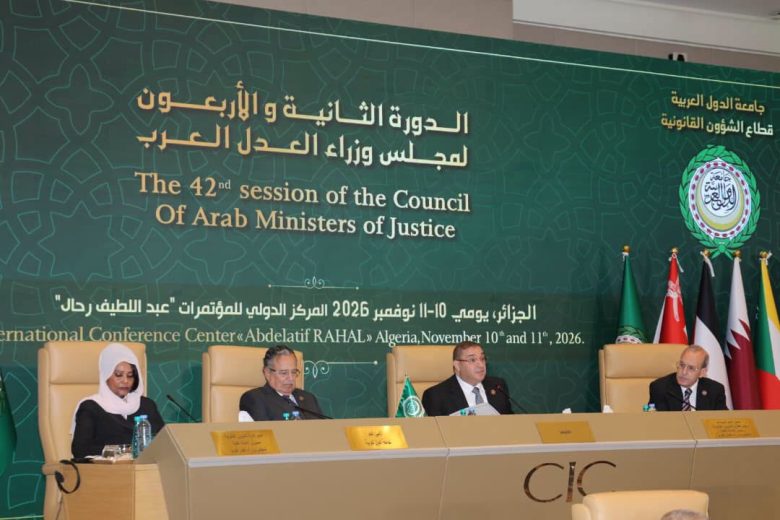
Minister of Justice and Keeper of the Seals Lotfi Boudjemâa stated on Tuesday that Algeria proposes establishing an “Arab Network for Combating Synthetic Drugs” within the Council of Arab Ministers of Justice during the proceedings of its 42nd session. Based on his observations, this initiative aligns directly with a broader ambition to “transition from conventional commitments to their concrete application,” according to the minister.
In his address at the Abdelatif Rahal International Conference Center (CIC) in Algiers, the minister sounded the alarm regarding the expansion of this phenomenon, whose repercussions extend beyond traditional law enforcement anti-narcotics efforts. Synthetic drugs represent, in his words, a scourge that “now threatens the entire social fabric as well as Arab national security, owing to the ease of their production and the velocity of their spread.” The Keeper of the Seals maintained that accelerating international challenges and “intertwined interests dictate raising the level of coordination among Arab nations.” Consequently, he called to “fortify integration among Arab countries, activate joint cooperation mechanisms, and leverage the capabilities and expertise available to the nation.”
For the minister, the primary challenge involves developing legal and judicial frameworks capable of adapting to modern shifts while safeguarding “the interests of Arab populations and the foundations of their cultural identity.” The agenda items scheduled for this session reflect, in his view, “the significance of this juncture and the magnitude of the responsibility resting upon Arab states.”
Regarding narcotics control, the proposed Arab network will primarily serve to “strengthen cooperation among Arab nations within the judicial sphere and facilitate communication among them with requisite speed and efficiency,” Lotfi Boudjemâa explained. In this regard, the minister emphasized the necessity of “moving the Arab legal system from the phase of texts and commitments to that of effective implementation and tangible result delivery.”
The minister accordingly advocated for activating existing conventions and establishing practical mechanisms for execution, coordination, and the exchange of expertise and intelligence. In this context, Lotfi Boudjemâa recalled that the Council had “taken the initiative to draft numerous conventions addressing terrorism, money laundering, terror financing, corruption, transnational organized crime, and information technology offenses, alongside personal data protection, in addition to crafting Arab model laws on drug control, hate speech prevention, and child protection from recruitment in armed conflicts.” In this specific instance, the stated objective centers on “modernizing and updating Arab legislation in response to international developments and rapid transformations.” Turning to the judicial sector in Algeria, Lotfi Boudjemâa highlighted “significant and tangible progress” achieved in executing the directives of the President of the Republic, Abdelmadjid Tebboune, particularly regarding judicial performance enhancement and the digital transformation of public services.
The minister maintained that presidential directives actively support the reform process through enriching the legislative framework, consolidating judicial authority, and increasing its operational efficiency. Furthermore, he noted the institution’s adaptation to societal shifts and relevant international human rights standards, fully adhering to Algeria’s international commitments.