

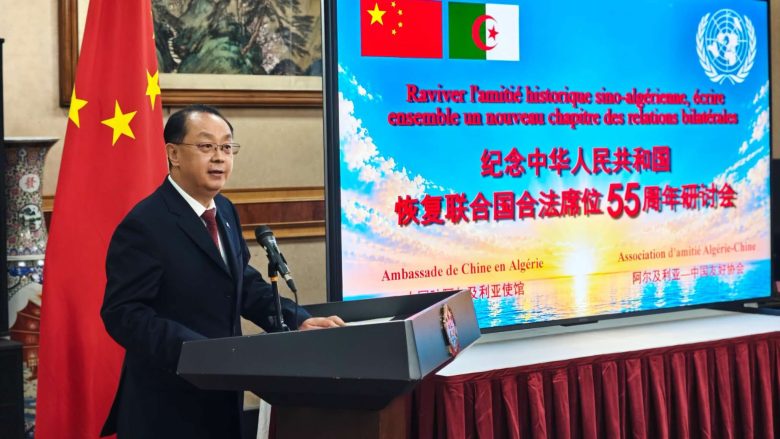
The Chinese Embassy in Algeria, in partnership with the Algerian-Chinese Friendship Association, organized a symposium on Sunday in Algiers to mark the 55th anniversary of the adoption, on October 25, 1971, of United Nations General Assembly Resolution 2758, which restored the legitimate rights of the People’s Republic of China within the UN. The gathering provided an opportunity to recall Algeria’s historical backing of this resolution and to underline the enduring strength of bilateral relations.
The event brought together several prominent figures, including the Chairman of the Committee on Foreign Affairs, International Cooperation and National Community Abroad of the Council of the Nation, a representative from the Ministry of Foreign Affairs, alongside former ministers, political party figures, academics, and researchers.
Speaking during a press briefing held on the sidelines of the meeting, the Ambassador of China to Algeria, Dong Guangli, recalled the profound significance of that historic decision. “Fifty-five years ago to the day, the United Nations adopted by an overwhelming majority the famous Resolution 2758, which restored all legitimate rights of the People’s Republic of China within the United Nations and recognized the government of the People’s Republic of China as the sole legal representative of all China,” he stated.
The Ambassador highlighted Algeria’s pivotal contribution to this historic milestone, affirming that China would never forget it. He explained that hosting this symposium aimed to keep the memory of the historical friendship between the two nations alive while opening fresh horizons for their cooperation.
Addressing the Taiwan question, Dong Guangli reaffirmed Beijing’s stance in his address, emphasizing that Resolution 2758 enshrines the One-China principle and the representation of the entirety of Chinese territory within the UN. He recalled that China views Taiwan as an inalienable part of its territory and firmly opposes any independence attempts regarding the island. He further noted that 183 countries maintain diplomatic relations with China anchored on the One-China principle.
Reflecting on the record of the past 55 years since the restoration of China’s UN rights, the ambassador emphasized his country’s contribution to global peace, development, and stability. He notably referenced China’s participation in United Nations peacekeeping operations, its diplomatic initiatives toward conflict resolution—particularly in the Middle East, Palestine, and Africa—and its commitment to shared development through the Belt and Road Initiative.
He also cited global initiatives spearheaded by China across development, security, civilization, and global governance, as well as its decision to grant zero-tariff treatment to 53 African nations maintaining diplomatic ties with Beijing, including Algeria. For diplomat Dong Guangli, these commitments align with defending multilateralism, upholding the UN Charter, and safeguarding the legitimate interests of developing nations.
For his part, the representative of the Ministry of Foreign Affairs, National Community Abroad and African Affairs, Abdelkrim Haddid, highlighted the evolution of Algerian-Chinese relations from historical political solidarity into a broad-based partnership. He recalled that both nations elevated their ties to a Comprehensive Strategic Partnership on February 19, 2014, paving the way for enhanced political consultations and bilateral cooperation.
This cooperation notably spans the energy, industry, infrastructure, healthcare, education, and scientific research sectors. It also aims to encourage investment, technology transfer, professional training, and economic diversification. For the ministry’s representative, this anniversary offers an occasion to recall the contribution of Algerian diplomacy and the bonds of friendship forged between both countries during decisive moments in their histories. He reaffirmed Algeria’s willingness to continue deepening this partnership built on trust, mutual respect, and solidarity.
Speaking on behalf of the Algerian-Chinese Friendship Association, Hassane Roubihi extended his congratulations to the Chinese government and people on behalf of the association’s president, Dr. Ismail Debeche, its members, and leadership.
He highlighted the friendly ties between the Algerian and Chinese peoples alongside the prospects offered by their comprehensive strategic partnership. He specifically mentioned expanding economic and commercial exchanges, promoting investment, and cooperating within the framework of the Belt and Road Initiative.
Calling for a Fairer International Order
Roubihi also stressed the importance of political dialogue and consultation on issues of mutual interest. He highlighted both nations’ commitment to the principles of international law, the UN Charter, freedom, dignity, and the right of peoples to self-determination. Finally, he advocated for a more just and balanced international order grounded in dialogue, multilateralism, and consideration for the interests of developing countries.
On his part, Mohamed Amroune, Chairman of the Committee on Foreign Affairs, International Cooperation and National Community Abroad of the Council of the Nation, shed light on the historical and legal scope of Resolution 2758, its implications for the international system, and the role played by Algeria in restoring China’s rights within the UN.
He recalled that in 1945, China was among the founding members of the United Nations and contributed to drafting its Charter while holding a permanent seat on the Security Council. However, following the founding of the People’s Republic of China in 1949, representatives of the Republic of China government, stemming from the Kuomintang, continued to occupy the seat reserved for China within the organization.
Adopted on October 25, 1971, by a vote of 76 in favor, 35 against, and 17 abstentions, Resolution 2758 restored the legitimate rights of the People’s Republic of China at the UN and recognized its government’s representatives as the sole legitimate representatives of China. According to Mohamed Amroune, this decision enshrined the principle that international legitimacy must reflect political and legal realities while adhering to the principles of the United Nations Charter.
He placed the adoption of this resolution within the broader context of decolonization and the accession to independence of numerous Asian and African countries. In his view, the support from developing nations demonstrated that states possessing limited economic or military means can influence major international decisions when defending shared principles.
The adoption of the resolution also marked a new chapter in China’s international relations, notably with the major powers of that era—the United States and the Soviet Union—and helped expand its diplomatic footprint throughout the 1970s.
Tackling the challenges currently confronting the UN, Mohamed Amroune stressed the necessity of reforming the Security Council, improving African representation, and strengthening the participation of developing nations in international decision-making processes. He also underscored the importance of preserving the Organization as a forum for dialogue and negotiation while avoiding the selective application of international law.
Regarding Algeria’s role, he recalled that Algeria was among the co-sponsors of the resolution, alongside Albania and 21 other countries, and voted in its favor. He framed this position as an extension of the principles championed by Algerian diplomacy since independence in 1962, notably state sovereignty, the right of self-determination, and the rejection of exclusion.
Finally, Mohamed Amroune emphasized that Algerian-Chinese relations continue to advance across several fields, including development, expertise sharing, and economic cooperation. He advocated for reinforcing South-South cooperation and ties between Africa and Asia, particularly in food security, digital transformation, and technology transfer, aiming to promote a more equitable international order based on dialogue, peaceful dispute resolution, and respect for state sovereignty.