

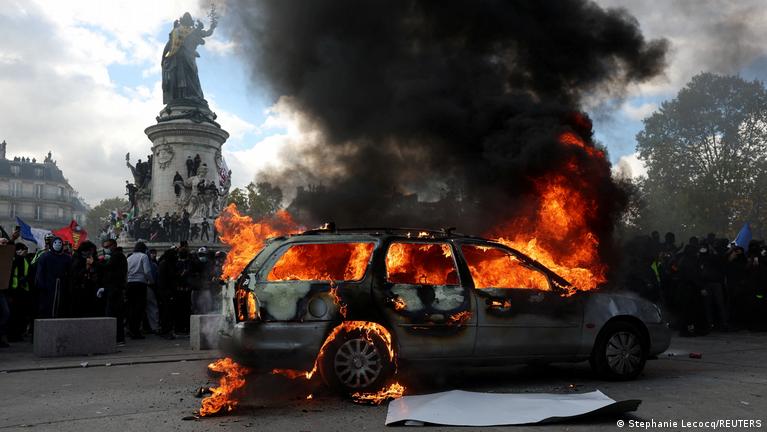
Violence erupted Saturday across France during another day of demonstrations targeting academic struggles and living costs.
At least 1,200 individuals were detained in what the French administration described as an “escalation of violence,” while roughly 550,000 citizens took to the streets.
In Paris, fierce clashes persisted late into the evening with law enforcement, who deployed tear gas and water cannons toward crowds.
Structures were set ablaze within the capital and various regions, notably Limoges where a major fire inside city hall induced a partial roof collapse.
Looting broke out across multiple cities, and widespread acts of destruction impacting town halls alongside businesses were likewise reported.
French Prime Minister Sébastien Lecornu indicated that 150 police officers sustained injuries during the unrest.
In the French capital, the central march unfolded peacefully throughout the afternoon. A group of youths informed the BBC they were “pacifists” and “simply trying to shift things, yet nothing shifts.”
However, as hours passed, certain groups ignited street bonfires and torched vehicles, including at landmark locations downtown such as Place de la République.
Riot squads were spotted charging a crowd in central Paris and striking several persons using batons.
In Lyon, Mayor Grégory Doucet labeled the burning of the city’s tourism office “a tragedy,” adding on BFMTV: “It breaks our hearts because it is an iconic, widely known historic edifice.”
Local police noted that “hostile individuals” hindered firefighters from battling the blaze safely.
Firefighters additionally fought the blaze at Limoges city hall, which local authority officials stated caused a partial building collapse.
A young man had his hand severed by a small explosive device in Saint-Étienne, the town’s mayor, Régis Juanico, announced on social networks, adding: “Such a tragedy should never have occurred.”
Over recent weeks, hundreds of thousands of students marched to protest against staffing shortages and the dilapidated state of the nation’s high schools (secondary educational institutions attended by teens aged 15 to 18).
Their ranks were bolstered by members of trade unions along with other protest collectives.
These collectives incorporate the so-called yellow vest movement, which marched against surging living expenses for over a year starting in 2018, thus turning into one of the longest protest movements in French history.
The French Interior Ministry stated that Saturday’s rallies involved “targeted acts of violence” committed by “hooded individuals” across several areas, including parts of the capital alongside Marseille, Rennes, Toulouse, and Angers.
Property damage was reported nationwide, notably in Grenoble, Avignon, Pau, Montpellier, and Valence.
Apparel and grocery stores were ransacked in Paris, while an Apple Store in Lille was broken into and cleared out.
Though France is no stranger to demonstrations and unrest, this protest wave arrives as the country enters a period of deep political uncertainty.
French President Emmanuel Macron will step down next year, and polling hints that April’s presidential race could narrow to a duel between National Rally leader Marine Le Pen and Jean-Luc Mélenchon of the radical left La France Insoumise party.
The latter joined demonstrations in France and subsequently accused law enforcement of “unleashing” violence against protesters, while condemning looting and arson. Lecornu called his remarks “dangerous and cynical.”
He previously stated that police faced “extremely intense violence” and that particular groups were using demonstrations as a “warm-up” ahead of presidential elections, adding: “No one will impose their political agenda through violence.”
Le Pen stated that “legitimate demands” voiced by protesters were “held hostage by the extreme left,” accusing Mélenchon of fanning the flames of violence.
French riot police march past a burning barricade amid clashes with protesters during a day of demonstrations on October 17. Photo credit, Reuters
Image caption, French riot police march past a burning barricade amid clashes with protesters on October 17
Macron stated: “Those who vandalized, attacked prefectures as well as businesses, and even looted our town halls, will be prosecuted and punished.”
The administration made overt attempts at concessions, with Education Minister Édouard Geffray promising 3,000 extra substitute teachers during a televised interview on October 8.