

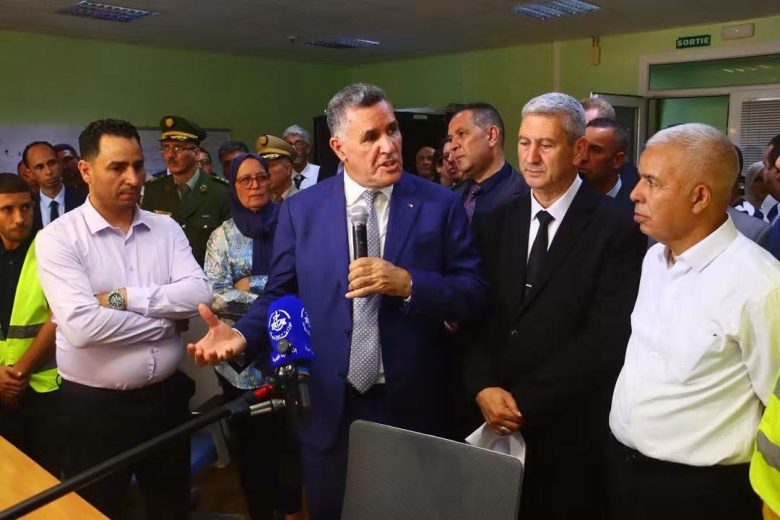
The Minister of Water Resources, Lounes Bouzegza, initiated an official inspection and working visit on Tuesday to the province of Mila, focusing on assessing public drinking water supply and sanitation services, alongside tracking progress on sectoral infrastructure. This trip fits within the framework of the ministerial agenda aimed at realizing strategic initiatives, upgrading service quality, and addressing citizen expectations.
The minister opened his visit with a working session evaluating current sector metrics and future outlooks. A comprehensive briefing detailed key performance indicators—specifically regarding drinking water distribution, wastewater management, and agricultural irrigation—alongside completed, ongoing, and planned projects intended to reinforce national water security.
Following the presentation, Mr. Bouzegza issued firm instructions to expedite project execution, directing special focus toward supplying 16 municipalities from the Beni Haroun Dam. Approximately 16 of the 32 municipalities forming the province continue to experience a deficit in drinking water availability.
Consequently, the minister called for urgent measures and a structured action plan, backed by full deployment of human and material resources, to complete the endeavor rapidly and improve public service delivery for residents.
Additionally, the minister announced that the province will benefit from an emergency scheme encompassing seven operations, over and above its standard allocation. These actions notably involve purchasing intervention equipment and machinery, expanding water networks, as well as outfitting, connecting, and commissioning new facilities.
The minister also stressed that sectoral developments align with directives from the President of the Republic to strengthen nationwide water equilibrium. This strategy relies heavily on expanding supplies via seawater desalination plants and interconnecting dams to secure long-term water availability and supply continuity.
Furthermore, the minister emphasized the necessity of modernizing management practices and breaking away from traditional operating models by expanding digitization and integrating advanced technologies. He underscored the deployment of remote monitoring systems across various facilities to boost operational efficiency, minimize leaks, curtail illegal connections, streamline resource utilization, and enhance overall public water supply standards.
Regarding drinking water sources, the province of Mila relies predominantly on surface water—chiefly from the Beni Haroun Dam—which will be reinforced in the future by transfers from the Tabellout Dam in Jijel province, supplemented by underground aquifers.
Substantial efforts were deployed across 2025 and 2026 to improve supply, notably through a project designed to feed 16 municipalities from the Beni Haroun and Tabellout dams. This initiative specifically targets localities currently dependent on groundwater, aiming to secure permanent supply and raise service quality.
Along these lines, three major projects are underway to fortify drinking water distribution across the region. The first scheme targets northeastern municipalities, providing 50,000 cubic meters per day from the Beni Haroun Dam to serve over 180,000 inhabitants. It features the construction of two treatment plants with individual capacities of 25,000 cubic meters per day, paired with a 68-kilometer transfer and distribution grid.
The second scheme addresses northwestern municipalities, likewise supplied from the Beni Haroun Dam. It involves leveraging the Oued Athmania treatment plant—boasting a daily capacity of 330,000 cubic meters—supported by a feasibility study regarding its expansion or the construction of a new facility to fulfill southern municipal demands. The transfer and distribution network will span 280 kilometers.
The third initiative focuses on supplying southern municipalities from the Tabellout Dam in Jijel province. It mandates constructing a new treatment facility with a capacity of 53,000 cubic meters daily, along with a 98-kilometer conveyance and delivery network.
In terms of sanitation, the connection rate to wastewater evacuation networks stands at 96 percent in urban sectors and surpasses 70 percent in rural environments. This coverage stems from operating five purification plants with a combined capacity of 45,557 cubic meters daily, supported by 14 pumping stations and a sewage grid stretching across 2,565 kilometers.
Concerning agricultural irrigation, Mila—ranking among the nation’s leading agricultural provinces—boasts irrigation perimeters fed by the Beni Haroun Dam encompassing a total area of 4,447 hectares. These facilities bolster agricultural output while advancing rationalized water management practices.