

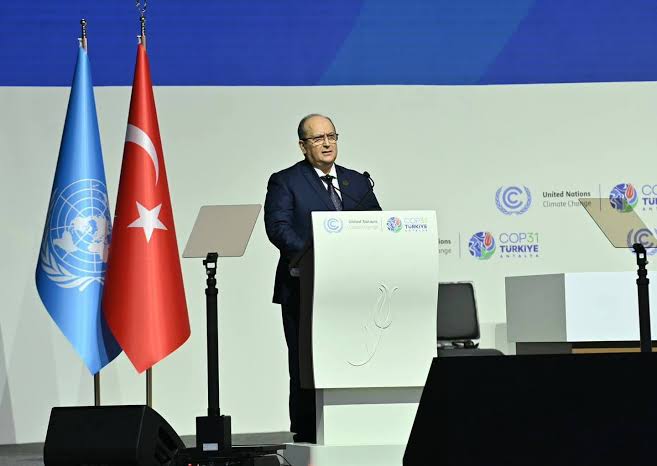
President of the Republic Abdelmadjid Tebboune called last Thursday on delegates at the COP 31 Leaders Summit, taking place in Antalya, Turkey, to turn international climate pledges into concrete deeds and foster global cooperation rooted in justice and equity, while defending the right of developing nations to balance energy transition with development imperatives.
President Tebboune stated that fulfilling financing commitments, particularly regarding adaptation, technology transfer, and capacity building, constitutes an essential prerequisite for raising ambition levels, in an address delivered on his behalf by Prime Minister Sifi Ghrieb at the summit opening. The head of state also warned against unilateral trade measures liable to hide behind environmental concerns, asserting that climate must not serve as a pretext for such practices.
President Tebboune thus underscored the principle of common but differentiated responsibilities, which must account for development trajectories, national specifics, and state sovereignty. He stressed that the scale of developing countries’ needs far exceeds their domestic capacities.
Ten years after the Paris Agreement was adopted, the head of state judged that the global climate action record remains insufficient. Drawing on findings from the first global stocktake, he emphasized that the collective effort to tackle climate change falls short of our established target. He also noted that the financing shortfall remains just as alarming as the gap in emissions reductions.
In this context, Abdelmadjid Tebboune affirmed that Algeria shares the vision of the COP 31 presidency, which aims to make this gathering a summit of implementation by translating announced commitments into tangible outcomes.
Addressing the impacts of climate change on Algeria, the president highlighted the vulnerability of the national territory, much of which lies within arid and semi-arid regions. He underlined that climate change represents an established reality hitting its water and food security head-on.
President Tebboune notably cited desertification, recurring drought episodes, and expanding areas ravaged by forest fires among the primary manifestations of this vulnerability. Faced with these challenges, he indicated that the climate issue is placed at the core of our public policies within an institutional and planning framework undergoing constant consolidation.
Emissions cuts of up to 31 percent
The head of state nevertheless insisted on meeting citizens’ aspirations for development and employment while contributing to global greenhouse gas reduction efforts, despite Algeria’s minimal share of worldwide emissions. On this equation, Abdelmadjid Tebboune championed a clear and unequivocal stance, affirming that development and climate action are by no means incompatible. However, he stipulated a smooth and gradual transition backed by the support outlined under the Paris Agreement.
Accordingly, the president recalled that Algeria had submitted its Nationally Determined Contribution (NDC), projecting an unconditional 14 percent emissions cut by 2035, funded entirely through domestic resources.
He further noted that the nation stands ready to raise this target to 31 percent, contingent upon receiving international financial backing. He described this contribution as ambitious given the capacities and resources available to my country, while maintaining it remains realistic considering national conditions.
Regarding ongoing measures, the president reported the domestically financed launch of the first phase of a program targeting 15,000 megawatts in renewable energy capacity by 2035. He also cited the adoption of a national hydrogen strategy alongside efforts in energy efficiency, public transit expansion, and reducing gas flaring and methane emissions.
Water security at the heart of adaptation
Devoting significant focus to water resources, Tebboune stressed that preserving water supplies forms a vital pillar of the national climate adaptation strategy.
My country continues its efforts to safeguard its water security through seawater desalination and treated wastewater reuse, the president stated.
He also mentioned revitalizing the Green Dam project, explaining that it aligns with an approach linking the fight against desertification to rural development.
In the same vein, the head of state announced that Algeria is nearing completion of a national adaptation plan. This blueprint should define domestic priorities and identify necessary resources to confront climate change impacts.
Concluding his address, the head of state called for collective mobilization, asserting that no nation can tackle the climate challenge alone. He advocated collaboration built on a spirit of cooperation, justice, and equity to forge climate action that honors commitments made and leaves no one behind. He further assured that Algeria will remain a committed partner in this endeavor, faithful to our responsibility toward future generations.