

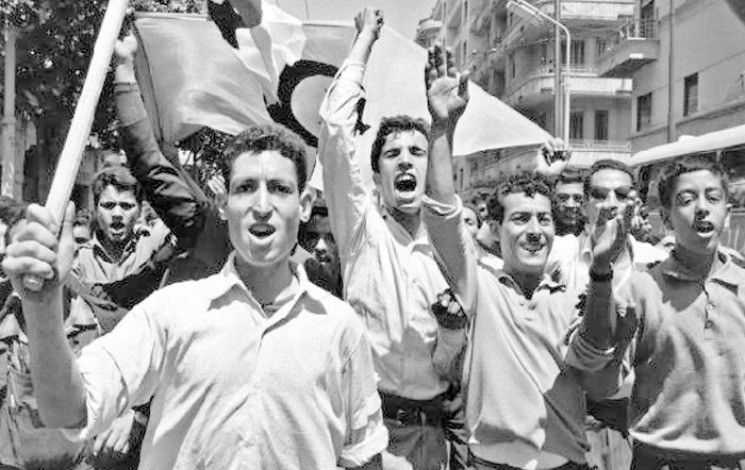
Tears in their eyes, disbelieving smiles, and national emblems stitched in secret hanging from every window. On July 5, 1962, a single chant united millions of souls in a shared breath of liberation. Sixty-four years later, we look back at that frozen moment in time when an entire nation shattered over a century of silence to reclaim control of its own destiny.
There were tears in onlookers’ eyes, smiles lighting up faces, and flags gracing every window frame. Above all, there was a roaring shout, echoed by millions of Algerians as an absolute release: “Tahya El Djazair!” Sixty-four years following that independence, these two words alone continue to convey the raw emotion of a society finally reborn into the pages of history.
From the earliest hours of that landmark day, the cityscapes transformed completely. Algiers was blanketed in green, white, and red. Banners, sometimes crafted in total secrecy during the dark depths of the colonial era, emerged all at once from windows, balconies, and building rooftops. They were fastened to car hoods or held high by children who could not yet comprehend the historic magnitude of the moment. Public squares overflowed. Alleyways swelled with waves of people that nothing could hold back. Doors swung open, families rushed down, and neighbors embraced warmly as though reuniting after an agonizingly lengthy separation.
Then, all at once, the call erupted: “Tahya El Djazair!”
It was echoed by a mother holding her child tight, by an elderly man leaning on his walking stick with eyes upturned toward the heavens, and by a veteran guerrilla fighter whose face bore the marks of the revolutionary conflict. It was shouted by youngsters discovering, for the very first time in their lives, the precise definition of freedom. Within seconds, the rallying cry rippled from one street to the next, spreading across neighborhoods and jumping from town to town. It surged forward like a colossal tidal wave that defied containment. These were not merely voices rising; it was the sudden breaking of one hundred and thirty-two years of enforced silence.
Tears of Dawn, Smiles of Promise
Tears flowed freely—countless tears that had been suppressed for decades were finally released. They ran down the cheeks of mothers remembering sons lost in battle, fathers who would never see their missing children again, and individuals who had endured prisons, internment camps, exile, or extreme hardships. Yet these tears were entirely unique: they carried both the heavy burden of mourning and the radiant glow of expectation.
The Day After: A suspended moment in time where joyful ululations pierced the summer sky, overriding the deafening roar of celebrating cities.
There were also smiles—massive, sometimes tentative, almost disbelieving grins. It was as though everyone needed to reach out and touch their neighbor just to verify that this miracle was actually unfolding. Strangers locked in warm embraces, people sang, and crowds cheered. High-pitched trills cut through the July sky while nationalist anthems drowned out the noise of car engines and honking horns. Children chased after parades, waving national colors that dwarfed their small frames. Yet underneath this explosive celebration remained a far deeper solemnity: that of a populace fully aware of the true cost of this moment.
For “Tahya El Djazair” was not conceived on that fifth of July. The expression was born much earlier, deep within the secrecy of mountain ranges, inside high-security solitary units, amidst torched villages, high-altitude operational outposts, and homes raided in the dead of night while the rest of the world slept. It took shape in the whispers of women shielding resistance fighters, in the bravery of men heading to the front lines with no guarantee of return, and in the eyes of children orphaned far too young. For a century and a half, merely uttering these words required immense bravery; shouting them was a fatal challenge to authority. On July 5, 1962, they finally transformed into an undeniable right.
Consequently, the suffering amassed over multiple generations gradually yielded to a sense of relief. Fear retreated permanently. Systemic degradation gave way to rediscovered self-worth. For the first time since the initial invasion of 1830, the future looked vast enough to overshadow the scars of yesteryear. “Tahya El Djazair!” In essence, it is just two words. Yet, they encapsulate millions of distinct lives. They narrate the sacrifices of the fallen martyrs, the fortitude of unnamed citizens, and the aspirations of those who perished without ever witnessing the Algerian flag fluttering proudly over a liberated homeland.
More than six decades onward, this chant has lost none of its powerful resonance. It does more than simply awaken historical awareness; it serves as a reminder that extraordinary moments occur when an entire populace finds itself reflected in a single, unified voice. This remains the most profound miracle of July 5, 1962. For a brief window, internal divides dissolved, suffering fell silent, and wounds transformed into commitments for the future. In every thoroughfare and public square, a single phrase sufficed to cement the joy of a populace that had successfully reclaimed total mastery over its own path.
“Tahya El Djazair!”
Just two words. Two words that, on that unforgettable day, carried the immense gravity of one hundred and thirty-two years of waiting… alongside the infinite weightlessness of a hard-won liberty.