

One year following the introduction of the National Strategy for Prevention Against Drugs and Psychotropic Substances (2025-2029), officials have released an initial assessment deemed highly promising. Through a fortified legal framework, unprecedented contraband seizures, mass public awareness campaigns, enhanced treatment options for individuals facing addiction, and international collaboration, the state plans to sustain its pressure and establish the narcotics fight as a critical national security priority.
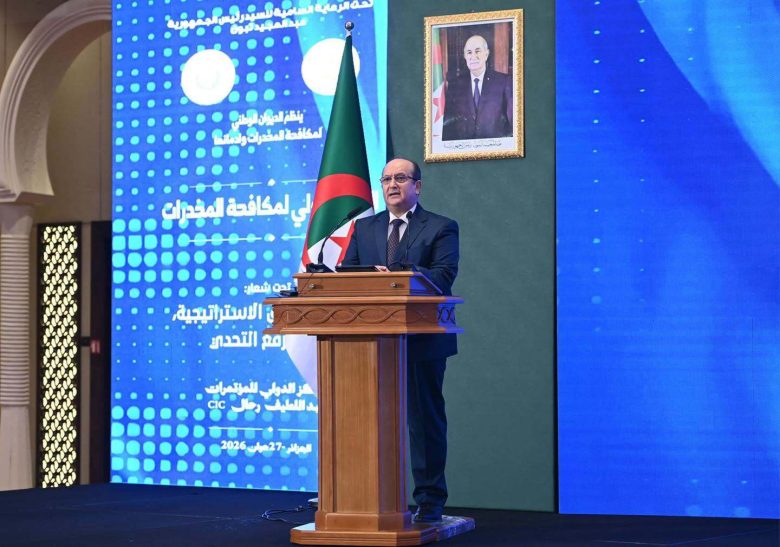
Acting on behalf of President Abdelmadjid Tebboune, Prime Minister Sifi Ghrieb spearheaded Saturday’s commemoration of the International Day Against Drug Abuse and Illicit Trafficking. The state-sponsored event carried the unifying theme: “One Year Following the Launch of the National Strategy, Together We Rise to the Challenge.”
In his introductory speech, Sifi Ghrieb declared that narcotics present a “strategic hazard” to state sovereignty, community cohesion, and financial progress. Emphasizing that “substances degrade minds, exhaust human energy, and endanger the vital human capital that drives national development,” he requested an all-encompassing mobilization of public institutions. Maintaining that this conflict cannot be won solely by law enforcement, he argued that it demands “an overarching methodology merging prevention, public awareness, counseling for dependent individuals, the dismantling of organized crime rings, and inter-sectoral cooperation.”
The Prime Minister took the opportunity to remind attendees that the National Strategy 2025-2029, structured under the executive guidance of the President, centers around four primary pillars: curbing consumption, modernizing addiction healthcare, strengthening enforcement operations, and expanding global partnerships.
He additionally highlighted recent statutory updates designed to modernize the legal arsenal against the evolving tactics of syndicates. This updated framework notably introduces harsher criminal penalties, new categories of offenses, rigorous tracking of criminal assets, and reinforced protective mechanisms.
Concurrently, the progress report outlining the strategy’s rollout details the milestones achieved since its inception while presenting several operational guidelines designed to boost the efficiency of enforcement and preventative campaigns.
==The Goal of an Integrated Policy
Speaking during the event, Minister of Justice and Keeper of the Seals, Lotfi Boudjemaa, noted that “the national prevention blueprint against drugs and psychotropic substances (2025-2029) transitions the nation from isolated, reactive interventions to a comprehensive structure rooted in planning, coordination, and public policy assessment.”
The Minister also underscored the legal upgrades brought by Law No. 25-06 of April 20, 2025, which modifies and completes Law No. 04-18 concerning the prevention and suppression of illegal narcotics use and trafficking. This legislative reform introduces heightened preventative measures, broadens therapeutic alternatives, and increases penalties against criminal organizations, particularly those targeting minors and young demographics.
He noted that several regulatory guidelines have taken effect, notably mandatory screenings during recruitment within public and private sectors, as well as inside educational institutions and training centers. A draft decree aimed at motivating citizens to report traffickers through legal protections and incentives is also nearing completion. Furthermore, while praising the commitment of various security branches, public agencies, civil society, and media outlets, the Minister reaffirmed the government’s resolve to maintain an absolute mobilization to insulate the youth and defend national stability.
===Nearly 144,000 Cases Processed
Presenting the annual documentation from the National Office for the Fight Against Drugs and Addiction (ONLCDT), Director General Tarek Kour delivered an overview illustrating the immense scale of the issue.
Throughout 2025, relevant enforcement divisions confiscated over 37 tons of cannabis, 1.46 tons of cocaine, more than 2 tons of heroin, alongside 43.4 million psychotropic pills, with Pregabalin accounting for nearly 84% of the total. Simultaneously, security forces processed 143,968 narcotics-related offenses.
Alongside criminal enforcement, the ONLCDT director emphasized the power of prevention. A nationwide mobile caravan traveled across seventeen provinces, educating nearly 265,000 pupils and students within roughly 390 academic settings. Awareness drives were similarly deployed across universities, mosques, ports, airports, transit hubs, and various cultural or athletic facilities. Peer-to-peer initiatives and community forums, arranged across fifty provinces alongside the Algerian Muslim Scouts, rounded out the primary outreach program.
Furthermore, the strategy charts an expansion of medical infrastructure for individuals battling dependency.
A nationwide audit of specialized centers yielded a roadmap consisting of twenty-four distinct guidelines to update these facilities, expand staffing resources, and optimize healthcare accessibility. Rehabilitation and reintegration programs were additionally strengthened within correctional institutions.
The agency head also indicated that, on the global stage, Algeria expanded its cooperative reach by joining multiple specialized international efforts and contributing directly to the United Nations Commission on Narcotic Drugs. Additionally, two Algerian experts joined specialized global panels, representing a historic first since independence.
The ceremony concluded by honoring the specific security units responsible for executing the most high-impact operations against regional drug distribution networks. This recognition celebrates recent achievements while serving as a poignant reminder that authorities are committed to a long-term campaign to secure the younger generation and safeguard national interests.