

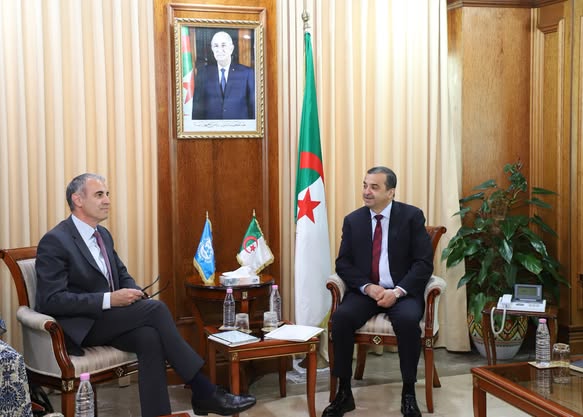
The head of the International Monetary Fund (IMF) mission to Algeria, Charalambos Tsangaridis, has praised the nation’s efforts to advance its hydrocarbon industry and boost its investment appeal. This commendation followed a comprehensive briefing by Minister Arkab regarding the current state, future growth prospects, and ongoing structural and organizational overhauls within the energy sector.
Mohamed Arkab, Minister of State and Minister of Hydrocarbons, hosted the IMF delegation led by Tsangaridis as part of regular bilateral consultations. The session was attended by Samir Bakhti, Director of the National Agency for the Valorization of Hydrocarbon Resources, alongside officials from the ministry and the Bank of Algeria.
During the meeting, Arkab outlined how the hydrocarbon development strategies and various policy rollouts are designed to stimulate foreign investment, foster global alliances, and optimize national oil and gas revenues to sustain economic growth and fortify national energy security.
According to an official ministry statement, Arkab reviewed core metrics tied to upstream exploration and production, oil and gas field development blueprints, and initiatives aimed at expanding production, processing, and refining capacities. These initiatives seek to strengthen value-added petroleum and gas industries, effectively satisfying domestic consumption while maintaining Algeria’s standing as a dependable energy exporter on both regional and global scales.
The minister also highlighted the strides made in executing national and international investment schemes in the energy sector, particularly through joint ventures between the state-owned Sonatrach group and major global corporations. Arkab emphasized the importance of the upcoming “Algeria Bid Round 2026” international tender, describing it as a strategic milestone to enhance the competitiveness of the hydrocarbon mining sector and draw in fresh capital and advanced technical expertise.
Addressing the current landscape of energy transition and sustainable development, the minister underscored the steps taken by Algeria, via Sonatrach and its corporate allies, to curb the carbon footprint of the oil and gas industry. This includes deploying advanced frameworks to reduce methane emissions, curb gas flaring, and build carbon capture, utilization, and storage projects alongside low-emission systems. These measures align with international ecological accords and are designed to boost the global competitiveness of the local energy market.
Furthermore, the discussions covered Sonatrach’s ongoing environmental protection and energy efficiency ventures, as well as development blueprints for low-carbon hydrogen and renewable energy integration within oil and gas operations to build a more sustainable energy matrix.
The minister also gave an update on the seawater desalination program, a major strategic initiative involving the construction and operation of desalination facilities across several provinces to strengthen water security and guarantee supplies for both residential consumers and economic sectors.
Following this detailed brief, the IMF mission chief welcomed the presentation, lauding Algeria’s commitment to upgrading its hydrocarbon infrastructure, boosting investment appeal, and successfully balancing economic growth imperatives with environmental mandates. He reiterated the Fund’s keenness to monitor these regulatory shifts and support initiatives geared toward consolidating economic stability and fostering long-term development.
To wrap up the session, both sides explored avenues to deepen technical cooperation and knowledge sharing in fields tied to the oil and gas industry, digital transformation, innovation, and the localization of hydrocarbon-related industries and services, as well as backing professional training and human capital development.