

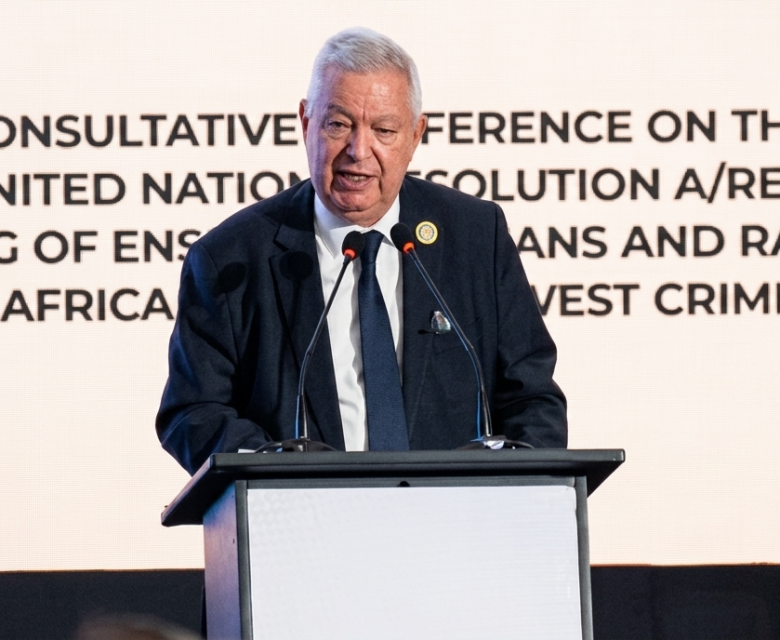
Representing President Abdelmadjid Tebboune, Senate President Azouz Nasri launched an unequivocal appeal on Thursday for global recognition of the atrocities inflicted upon African nations during the eras of slavery and subjugation. He delivered this address in Accra, Ghana, during the High-Level Consultative Conference on Restorative Justice and Historical Reparations for the Transatlantic Slave Trade.
In his speech, Mr. Nasri stated that Algeria is issuing “a renewed and earnest demand for explicit international acknowledgment by United Nations bodies and former colonial powers regarding the systematic, criminal nature of actions tied to slavery, colonial rule, and other severe violations targeting African populations.” He also called for rigorous scientific and legal initiatives to archive the offenses committed against the continent’s inhabitants. Mr. Nasri affirmed that “Algeria wholeheartedly backs the mobilization of African historians and international legal scholars in a collaborative effort to compile documents, testimonies, and undeniable legal proof detailing the crimes carried out against the people of this continent.”
Drawing from its own historical legacy of a protracted national liberation struggle, Algeria voiced its readiness to share its archives and historical accounts with relevant African and global bodies.
Mr. Nasri revisited Algeria’s heavy colonial past, which he described as marked by egregious abuses, including acts of mass extermination, the deployment of banned chemical and nuclear weapons, and other atrocities validated by archives and accounts. He emphasized that these records help forge a unified African stance anchored in historical truth, fairness, and the preservation of the suffering endured by African societies.
He further praised the United Nations resolution defining the transatlantic slave trade as one of the most heinous crimes against humanity, characterizing it as a major breakthrough in restoring dignity to African victims and a triumph for truth following decades of dismissal.
Lastly, he commended Ghana for its diplomatic leadership and noted that the African Union chose to extend the 2025 theme of “Justice and Reparations” into a full decade (2026-2035) dedicated to the cause.
The Algiers Declaration as a Strategic Roadmap
The “Algiers Declaration,” which emerged from a convention held on November 30 and December 1, 2025, and was subsequently adopted by the African Union, has evolved into a cornerstone for historical justice across Africa. The document demands the acknowledgment of colonial offenses, the incorporation of their criminalization into international law, and the protection of historical memory for upcoming generations.
The framework also pressures for the return of plundered cultural artifacts, historical records, and human remains, while emphasizing the liability of former occupiers regarding the economic, social, and ecological fallout of colonialism in Africa.
In line with this vision, Mr. Nasri welcomed the African Union’s adoption of an Algerian initiative establishing an African Day of Remembrance for the Martyrs and Victims of the Transatlantic Slave Trade, Colonialism, and Apartheid, to be observed annually on November 30. Reiterating Algeria’s steadfast policy on redress, he argued that “the demand for reparations by Africans and people of African descent represents a justifiable quest to heal past injuries, honor the victims, and rectify historic wrongs.”
He maintained that this perspective aligns with the pursuit of a global order built upon “equality among nations, respect for human dignity, solidarity, cooperation, and balanced partnership,” entirely detached from any framework of subjugation. To conclude, he noted that the Parliament unanimously enacted legislation on April 12, 2026, criminalizing the colonial rule endured by Algeria, further cementing the country’s dedication to the pursuit of recognition and historical accountability.