

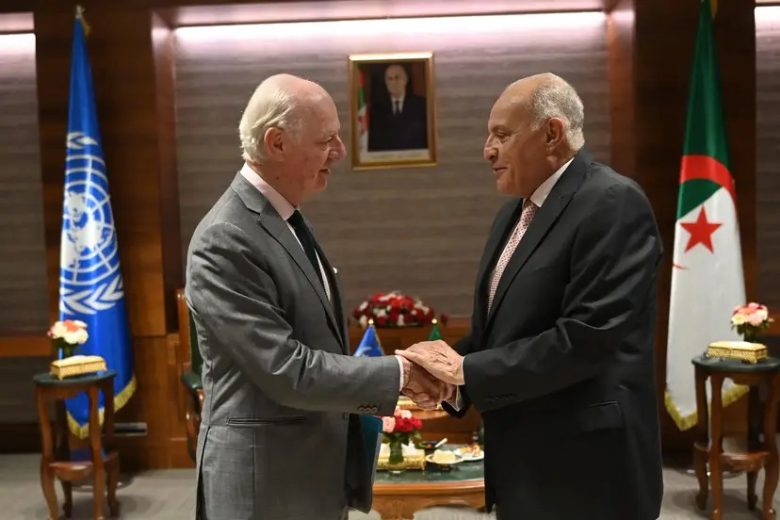
The recent visit to Algeria by the UN Secretary-General’s Personal Envoy for Western Sahara, Staffan de Mistura, represents a crucial indicator of the United Nations’ persistent involvement in overseeing the Sahrawi issue. This perspective was voiced on Wednesday by Said Ayachi, the head of the Algerian National Committee for Solidarity with the Sahrawi People.
During an appearance on national radio airwaves, Mr. Ayachi maintained that “the presence of Mr. de Mistura offers a degree of reassurance that the UN remains actively seized of the matter,” arguing that the global body serves as “the legitimate framework” for addressing a dispute that has lingered on the UN agenda for several decades. He further noted that this regional circuit, which fits into the regular rounds of dialogue held by the UN diplomat with key stakeholders, is geared toward drafting the upcoming update destined for the United Nations Security Council.
On this occasion, he made sure to spotlight “Algeria’s unwavering stance,” which is anchored in compliance with international jurisprudence and UN declarations focused on decolonization. He clarified that “Algeria simply calls for the implementation of UN mandates.” He observed that “Western Sahara has been registered on the United Nations list of non-self-governing territories since 1963, and the tenet of self-determination for the Sahrawi populace is enshrined in global legal texts.” Stressing that the various provisions enacted by UN branches explicitly back the Sahrawi community’s right to self-determination, he argued that this framework “serves as the legal bedrock upon which any viable and trustworthy resolution to the friction must be built.”
Revisiting the history of the diplomatic roadmap, Mr. Ayachi drew attention to the settlement strategy brokered in 1991 between the Polisario Front and Morocco under United Nations auspices. That blueprint envisioned organizing a self-determination vote to allow the Sahrawi residents to freely chart their path forward. It also triggered the deployment of the United Nations Mission for the Referendum in Western Sahara (Minurso), tasked with guiding that transition.
For the committee leader, this blueprint stands as a critical benchmark in the pursuit of a political consensus aligned with global legality. He also touched upon the deliberations that occurred prior to the adoption of Security Council Resolution 2797, noting that several powerful members of that council had reconfirmed their adherence to the idea of self-determination. Furthermore, Mr. Ayachi pointed out that other United Nations arms continue to evaluate the Sahrawi situation on a regular basis.
Specifically, he mentioned the ongoing work of the General Assembly’s Fourth Committee as well as the Special Committee on Decolonization, commonly referred to as the Committee of 24. He emphasized that these bodies maintain a steadfast view of the dossier, classifying it strictly as an unfinished decolonization process. They routinely reassert, he noted, “the right of the Sahrawi population to independently determine their political trajectory.”
==Legitimacy dependent on a popular ballot
Turning to the diplomatic proposals floated in recent years, particularly regarding autonomy configurations, Mr. Ayachi argued that no blueprint could be deemed valid without first consulting the inhabitants involved, asserting that “the Sahrawi people must have their say; a choice cannot simply be forced upon them.”
In his view, the foundational tenet remains that of uncoerced choice. Any proposed blueprint should therefore be put before the Sahrawis for validation via an apparatus that mirrors international criteria. The official dismissed any scenario involving a vote expanded to include the entire Moroccan population, stating that “it is the communities directly affected by colonization who must be surveyed, not an outside populace.” He added that international law clearly defines that a decolonization track pertains primarily to the inhabitants directly tied to the land under review.
Beyond the political standoff, the Western Sahara dispute carries a substantial economic dimension. Mr. Ayachi pointed out that “the management of natural assets represents a core driver of the friction.” He highlighted the legal disputes that have broken out in recent years between the Moroccan administration and certain European bodies concerning the extraction and commercialization of commodities originating from Western Sahara. The official also emphasized that numerous European and international judicial rulings have backed the necessity of drawing a clear legal line between Sahrawi territory and Moroccan territory within trade frameworks. These debates surrounding maritime, mineral, and commercial interests continue to animate discussions within international and regional entities, highlighting the strategic value of the zone.
Ultimately, between the demands voiced by the Polisario Front, the positions defended by other key players, and the UN-led drives toward a lasting political settlement, the Western Sahara issue stands as one of the most delicate dossiers reviewed by the global institution.
For Mr. Ayachi, the core focus remains unchanged: the primary goal is to preserve the UN-led process and ensure the execution of the self-determination tenet. He concluded that this concept continues to be the cornerstone of any solution that respects global legality for a territory that the United Nations still lists as one of the final remaining instances of decolonization on its docket.