

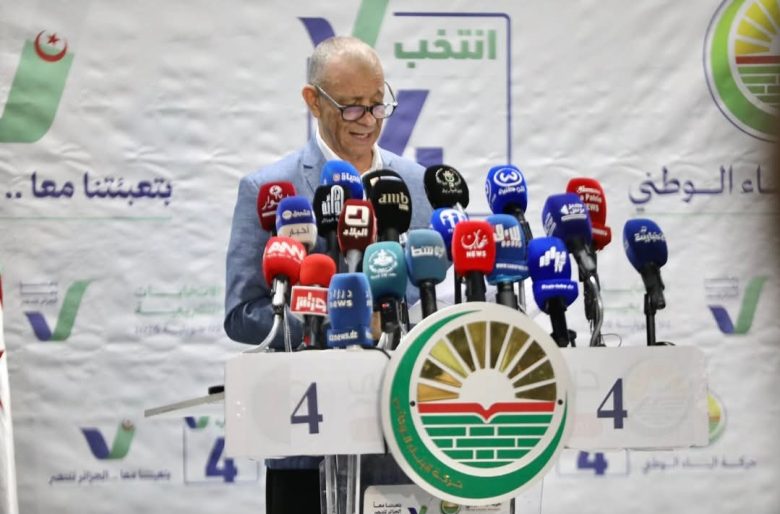
Sidelined from the race in Algiers following the rejection of his party’s candidate list, Abdelkader Bengrina is betting heavily on Setif to bolster the El Bina Movement’s presence in the National People’s Assembly. Campaigning in this strategic province, he announced a bold target of capturing ten parliamentary seats, while outlining his economic, social, and institutional blueprints for local growth, artists, and the expatriate community.
During Tuesday’s events, Bengrina argued that the disqualification in Algiers, which he branded as “unfair,” effectively “robbed the movement of eight seats in the capital.” He explained that the El Bina Movement is now eyeing “eight seats in Setif to offset that deficit,” while pursuing two additional spots to raise their objective to a total of “ten seats” within the province.
Addressing crowds in this major constituency, which holds 17 seats in the National People’s Assembly (APN), the El Bina leader detailed his strategy for national mobilization, economic progress, aid for cultural workers, and the involvement of the diaspora in building a “victorious Algeria”—a catchphrase popularized by Head of State Abdelmadjid Tebboune.
Regarding the economy, he emphasized his party’s project to establish “competitive, specialized industrial hubs organized along both sectoral and geographical lines.” In his view, this strategy would better integrate small and medium-sized enterprises into value chains and boost Algeria’s capability to enter international markets.
In this context, Bengrina maintained that Setif holds massive advantages “owing to private investments recorded in recent years,” particularly in El Eulma. “The region’s commercial centers serve as vital economic hubs, while several municipalities, such as Ain El Kebira, Ain Oulmene, Amoucha, and Guedjel, enjoy robust industrial activity across both light and heavy manufacturing sectors,” he noted.
According to the politician, the province hosts numerous factories and SMEs operating primarily in home appliances, electronics, and the rubber industry, with “some already exporting their goods to various African nations.” The speaker pointed to local private firms that export ceramics to Jordan, France, Yemen, Libya, and several Western Asian countries.
==Strengthening the Private Sector Without Weakening Public Assets
On economic policy, Bengrina called for greater recognition of private investors, an upgraded business climate, and increased backing for SMEs through specialized funds designed to finance productive ventures. He also advocated for modernizing commercial infrastructure and expanding e-commerce. Furthermore, he recommended creating a special allowance for artists facing social or health crises, while underlining the critical economic role the diaspora could play in domestic growth.
Turning to the expatriate community, Bengrina proposed establishing a High Council for Migration to maximize its contribution to national advancement. He also urged high voter turnout in the legislative elections, stating it would strengthen institutional legitimacy. In light of current security, economic, and geopolitical challenges, he called for collective solidarity to safeguard state achievements and reinforce national unity.