

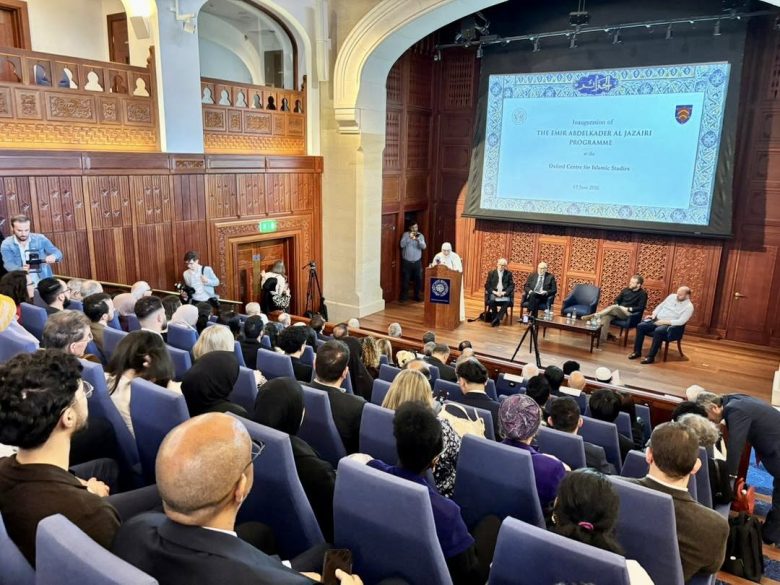
The inauguration of an academic chair dedicated to Emir Abdelkader within the prestigious Centre for Islamic Studies at the University of Oxford, coupled with the opening of an institutional space named the “Algiers Room,” goes far beyond mere historical commemoration or protocol celebration. This event marks a significant milestone in redefining Algeria’s levers of influence on the international stage. By placing the figure of the founder of its modern state at the forefront of one of the world’s oldest sanctuaries of knowledge, Algiers is executing a remarkable strategic shift: transitioning from conventional diplomacy to a diplomacy of intelligence and soft power.
The choice to project Emir Abdelkader’s philosophy into Anglo-Saxon academic circles is deliberate. Too often confined by reductive historiography to his sole role as a military leader confronting French colonial conquest, the Emir nonetheless embodies a philosophical synthesis of astonishing modernity. His historical actions, notably protecting Christian minorities in Damascus in 1860, and his spiritual writings make him a precursor to international humanitarian law and intercultural dialogue.
By bringing this legacy to Oxford, Algeria does not merely seek to honor its past, but to introduce an alternative voice, deeply rooted in Algerian Muslim humanism, into contemporary debates on coexistence, the ethics of power, and global peace. This approach echoes the diplomatic orientations of President Abdelmadjid Tebboune, who strives to position the country as a multilateral mediator and a promoter of peaceful coexistence. This concept was recently highlighted by events of ecumenical significance on national soil, including the historic visit of Pope Leo XIV to Algeria this past April.
However, cultural outreach cannot be complete without anchoring it in the scientific and economic realities of the twenty-first century. This is where the true coherence of the initiative carried out over the last few days in the United Kingdom lies. On the sidelines of official ceremonies, Algerian university authorities engaged in direct dialogue with the scientific and academic community established on British soil.
Emir Abdelkader and the Universality of Values
For decades, the question of the intellectual diaspora was approached through the sorrowful lens of the “brain drain.” Today, the paradigm is shifting. It is no longer about demanding an improbable physical return, but about organizing a “circulation of skills.” The announced creation of a Council for the Algerian Scientific Community Abroad formalizes this ambition. By providing a stable institutional framework, this mechanism aims to transform scattered human capital into a structured network of influence and technology transfer.
The stakes are highly practical. The objective is to involve these top-tier researchers in mentoring, joint supervision of doctoral theses, and the development of collaborative research projects. In the digital age and era of collaborative platforms, geographical distance is no longer a barrier to national contribution. By connecting its diaspora to the dynamics of startups and innovative investment in Algeria, the country is attempting to enrich its local ecosystem through global expertise.
This international openness is part of a broader reform movement within Algeria’s higher education sector. The Algerian university system, long confined to a role of mass training and degree issuance, is being urged to transform into a space of creativity and wealth generation. The ambition is to break the isolation of the academic ivory tower to tie scientific research directly to the requirements of economic and industrial development.
For this transition to succeed, access to global networks of excellence is an absolute prerequisite. Connecting with Oxford serves as a catalyst. It offers a showcase, but also an anchor point from which researchers living in Algeria can build research partnerships, increase the visibility of their publications, and absorb international standards of scientific evaluation.
While the signals sent by this scientific diplomacy offensive are encouraging, the hardest part remains to be accomplished: sustaining the effort. The signing of agreements and the creation of chairs are only as valuable as the concrete, daily engagement that follows. The future diaspora council must avoid bureaucratic traps to remain a fluid, attractive, and responsive interface for talents abroad.