

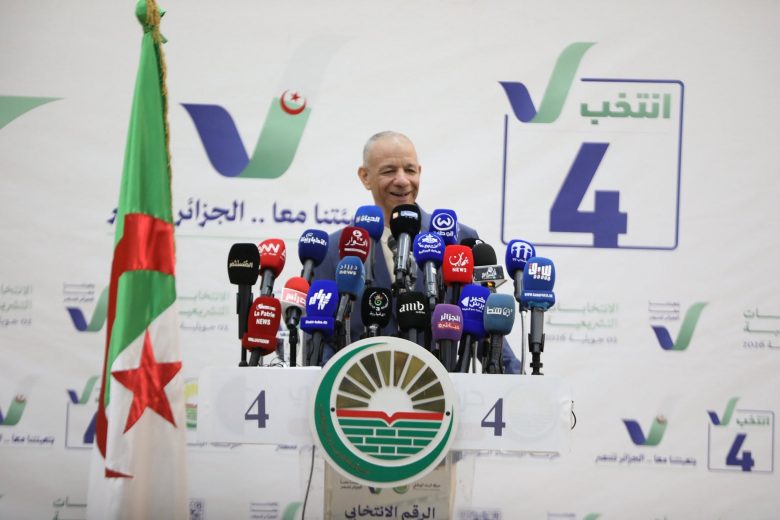
The President of the El Bina Movement, Abdelkader Bengrina, placed a strong emphasis on Saturday on the role of women in national advancement, underlining their critical involvement across several foundational sectors. He advocated for their increased political participation and social protection while re-evaluating the urgency of voter mobilization and local development objectives.
Addressing a public gathering in Chlef as part of the legislative election campaign, the El Bina leader pushed for massive voter turnout for the upcoming ballot on July 2. Discussing the movement’s official campaign slogan, “Through Our Mobilization, Algeria Triumphs,” he argued that civic engagement remains an indispensable prerequisite for the success of this electoral milestone. Consequently, Bengrina maintained that higher voter turnout directly reinforces state institutions.
Bengrina dedicated a significant portion of his speech to the status of women nationwide. He declared that “Algerian women stand today as indispensable actors in the national development process,” praising their heavy footprint in essential fields, particularly education, healthcare, justice, and various state bodies.
While the speaker asserted that women possess the capabilities to occupy top-tier leadership roles, including ministerial portfolios, he contended that, as of today, “women could not ascend to the Presidency of the Republic.” To support this point, he referenced the United States, pointing out that no woman has yet been elected head of state there.
Reaffirming his party’s dedication to “deeper female immersion in political life,” Bengrina noted that the El Bina Movement had “broadly opened its electoral ballots to female candidates.” Nevertheless, he expressed regret that many applications failed to secure clearance, with only a 12% validation rate.
For the El Bina president, female political engagement must evolve past simple “quotas” or cosmetic representation in elected assemblies, calling instead for a “more impactful and qualitative” presence.
Furthermore, Bengrina urged for tougher mechanisms to protect women from violence and insisted on heightened support for those residing in rural, mountainous, and desert regions—specifically targeting individuals who endure lengthy commutes to maintain employment.
Prioritizing Chlef’s University Hospital
Shifting to local infrastructure, the speaker focused heavily on regional healthcare deficits. Noting that Chlef, with its population exceeding one million, occupies a vital crossroads between the central and western corridors of the country, he argued that the province deserves medical infrastructure matching its scale. He lobbied for accelerated construction on a new university hospital center (CHU) and the opening of an upcoming specialized oncology hospital.
Speaking to his supporters, Bengrina celebrated Chlef’s historical legacy, describing it as a “land of resistance and sacrifice” and a “cradle of knowledge and scholars.” He honored several emblematic figures who shaped the country’s history, highlighting Emir Abdelkader’s military operations in the area and the iconic martyr Hassiba Ben Bouali, a Chlef native, among other local historical figures.
Reflecting on the Dahra cave suffocations of June 1845, executed by the French colonial military, he insisted that these atrocities “deserve an unshakeable place in the collective memory of the Algerian people.” He recommended incorporating the commemoration of this tragedy across educational institutions, cultural spaces, and youth centers. Going further, the El Bina leader proposed integrating these historical events directly into school and university curricula, while urging the Ministry of Culture to produce a documentary film focused on the Dahra tragedy.
Bengrina also welcomed the recent 2023 launch of a medical faculty at the Hassiba Ben Bouali University of Chlef (UHBC), stating that “this exact demand was among the core proposals defended by his party during the 2021 legislative campaigns.” While applauding the step, he voiced his hope for the future establishment of a dedicated higher institute to train doctors and paramedical personnel within the province. With Chlef controlling 11 seats in the National People’s Assembly (APN), the El Bina Movement has put forward a roster of 16 candidates for the legislative race.
An 18-Candidate Slate in Blida
In a related development, despite traveling to Chlef, the El Bina leader skipped a previously scheduled campaign rally in the neighboring province of Blida on Thursday. According to Abdelwahab Kelai, who spearheaded the meeting on behalf of the party, the absence was due to health issues. In Blida, which similarly commands 11 seats in the APN, the movement has fielded an 18-candidate roster.
During the Blida event, Kelai highlighted the criteria implemented by the El Bina Movement to vet its legislative hopefuls across all provinces, following directives from party leadership.
According to him, the primary criterion hinges on “respect for parents and securing their blessing,” whereas the second demands absolute patriotism. “Our candidate must never, under any circumstances, act as a traitor to his nation,” he emphasized. Additionally, the official outlined the movement’s broader political platform, noting that it rotates around four pillars: domestic policy, the economy, foreign affairs, and national security.
On the economic front, Kelai noted that the party directs specialized focus toward regional growth. “The country’s interests take precedence over the party’s interests,” Kelai announced to the assembled members and supporters. Bengrina also warned this Saturday against instances where “certain party candidates might prioritize individual ambitions over the national interest,” a tendency he stated contradicts the fundamental ethos of the El Bina Movement.