

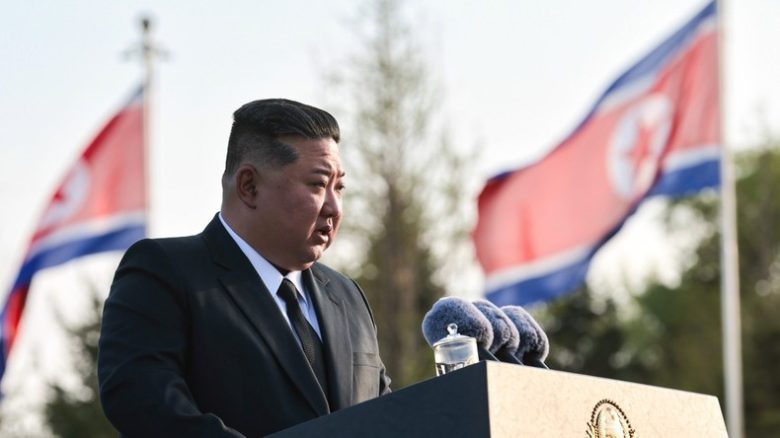
North Korea has adopted a new legal framework for its nuclear forces, notably providing for automatic retaliation if its command system is threatened. Kim Jong-un reaffirmed that Pyongyang does not intend to abandon its nuclear arsenal despite American pressure. The North Korean Constitution now envisions the possibility of a nuclear strike in case of threat against leader Kim Jong-un’s life, according to South Korean news agency Yonhap.
The Supreme People’s Assembly adopted a law specifying conditions for employing the country’s nuclear forces. The text notably provides that a strike could be triggered automatically if North Korea comes under attack. According to KCNA, North Korea’s news agency, such a strike could be launched immediately to destroy the source of a provocation if the nuclear forces’ command and control system is threatened by hostile forces.
The law also grants Kim Jong-un unified command along with all decision-making powers regarding nuclear weapons. According to Yonhap, Kim Jong-un publicly reaffirmed his determination not to abandon the country’s nuclear arsenal. He accused the United States of seeking not only North Korea’s denuclearization but also the collapse of the North Korean political system.
The North Korean leader indicated that Pyongyang does not intend to resume denuclearization negotiations. In his speech before the Supreme People’s Assembly, Kim Jong-un declared that the United States’ objective is not merely to make North Korean nuclear weapons disappear, but also to compel North Korea to renounce or weaken its self-defense means. He also criticized American sanctions and pressure policy, presented as the most significant ever conducted against Pyongyang to achieve denuclearization.
According to him, this approach stems from adversaries’ misevaluation of the situation vis-à-vis North Korea. Kim Jong-un especially emphasized that the country must continue expanding its tactical nuclear operations scope to strengthen its nuclear combat posture. The North Korean leader specified that enshrining this nuclear policy in law holds great importance, as it draws an irreversible line preventing the country’s nuclear power from being used as a negotiation object.
He added that changes in political and military conditions on the Korean peninsula, as well as the international political environment, would be necessary to consider modifying this North Korean nuclear policy. The Supreme People’s Assembly is the supreme power organ according to the North Korean Constitution. It typically holds a plenary session in March or April, mainly devoted to budget and government changes.