

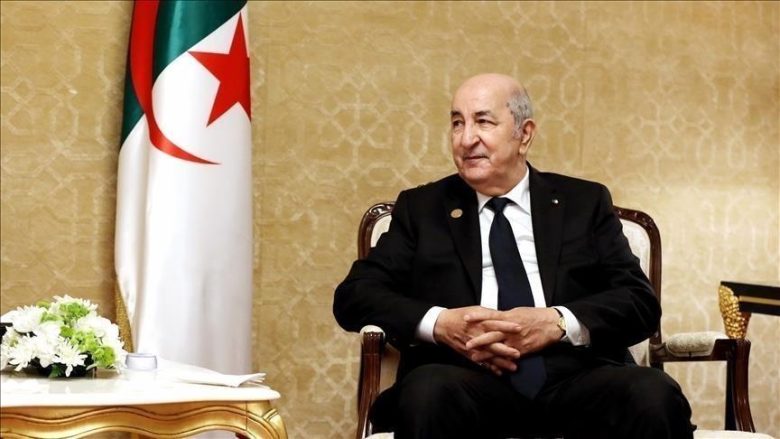
On the occasion of the 81st anniversary commemoration of the May 8, 1945 massacres, President Abdelmadjid Tebboune condemned a genocide carried out by French colonial brutality against defenseless Algerians. In his address to the nation, he also revealed plans for National Memory and History Forums, along with drafting a national memory law to safeguard and pass down history to future generations.
President Tebboune described the May 8, 1945 atrocities as “one of the most horrific massacres and crimes against humanity in modern times,” noting that Algerians mark this date as “a grim chapter steeped in colonial hatred, among the darkest in human history.” The head of state further blasted “a blatant disregard for the right to life” and “a moral collapse devoid of any civilized value,” while slamming “extremist circles” that, in his view, still peddle “the myth of colonialism as a bearer of civilization and progress.”
The president asserted that, “in stark contrast to these baseless claims, the May 8, 1945 massacres were a genocide against defenseless Algerians—including women and children—on their own soil and in their homeland.” He recalled how the victims had peacefully demanded “their right to freedom” before being “systematically wiped out under artillery barrages and the treads of military vehicles, with chilling detachment and burning hatred.”
Recounting the bloody events in Sétif, Guelma, and Kherrata, President Tebboune depicted “scenes of sheer terror” involving “entire villages torched, gruesome executions,” and “dozens of martyrs piled into mass graves for days.” He added that these “unbearable, indelible scenes from history burden their perpetrators with eternal shame and condemnation,” while also dooming “those who push for forgetting or denial.” He highlighted the massacres’ pivotal historical and political role as a key turning point in Algeria’s independence struggle.
Stressing that “the martyrs who fell in these tragic massacres ignited the spark for the glorious November 1 uprising,” the head of state noted how the echoes of colonial repression reached global audiences and elevated “Algeria’s just cause to the United Nations podium.” In this vein, President Tebboune declared these sacrifices “will forever stand as a glorious chapter in our modern history” and remain etched “in every detail within the memory dossier.”
————-Safeguarding and Passing Down National Memory
The head of state also underscored the vital need to protect this collective memory against efforts to erase or whitewash the colonial past. He argued that memory issues form “a core pillar for building ties free from the excessive glorification of a dark, unjust colonial era, or from extremist rhetoric trapped in outdated nostalgia.”
In this light, President Tebboune announced he had directed the Ministry of Mujahideen and Rights Holders to launch two key initiatives to bolster national memory preservation. He specified that “the first involves National Memory and History Forums, and the second entails preparing a national memory law,” framing these steps as “acts of loyalty to the martyrs of the May 8, 1945 massacres and all of Algeria’s martyrs.”
This announcement comes amid rising focus on memory and history matters at institutional, civil society, and academic levels. The upcoming national forums are expected to gather historians, scholars, academics, cultural figures, and representatives from national bodies and organizations for in-depth discussions on documenting, preserving, and transmitting the history of the national movement and liberation war.
The national memory law, meanwhile, could mark a major step in formalizing Algeria’s duty to remember. Though details remain under wraps, the legislation would likely outline protections for national historical memory, regulate archive preservation, and strengthen history education for younger generations.
In this context, the president praised the array of historical, intellectual, and cultural events held nationwide each year to uphold national memory. He stated, “I commend all historical, intellectual, and cultural initiatives and events organized annually on this poignant date in universities, schools, youth centers, cultural hubs, and various venues, to combat oblivion and perpetuate Algeria’s triumphs.”
Closing his message on a note of solemn reverence and fidelity to the martyrs’ legacy, the president declared: “On this National Memory Day, marking the 81st anniversary of those massacres, we gather in deep respect for their pure memory, renewing our pledge to honor their oath, serve our beloved homeland, and the valiant Algerian people—in a victorious, proud, and dignified Algeria.”