

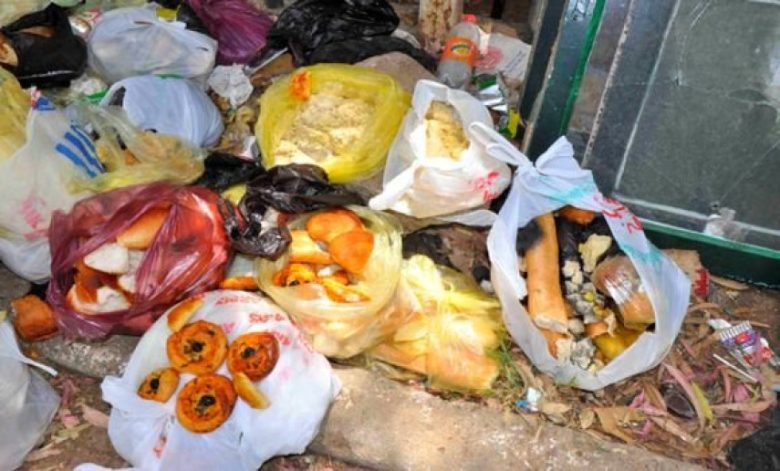
Behind the overloaded tables and overflowing garbage bags, a breathless consumption model is revealed, between food waste, pressure on landfills, and a silent economic hemorrhage. Amel Makhloufi, director of the environment for the Algiers wilaya, drew up this Wednesday a severe assessment of food waste and called for genuine citizen awareness.
Ms. Makhloufi stated, during her appearance on the waves of National Radio, that “3,200 tons of waste per day is the volume recorded during the first ten days of the month of Ramadan at the Algiers technical landfill center,” specifying that it is “a figure clearly on the rise compared to the annual average ranging between 2,600 and 2,800 tons daily.” The official added that “200 tons of bread were thrown away during the same period, according to preliminary data.” She lamented “a dry loss,” both economic, ecological, and moral, emphasizing that “behind every loaf thrown away, there is water, energy, natural gas, transportation, and human efforts mobilized uselessly.”
Ms. Makhloufi estimated that the problem is rooted in behaviors, explaining that “we cook beyond real need. We decorate our tables for the eyes more than for the body.” She added that food waste, particularly visible during the month of Ramadan, is a revealer of an unbalanced relationship with consumption.
The official also pointed out that “the consequences go beyond the simple domestic framework. A direct economic burden for local authorities and, ultimately, for the State.” She specified that “the increase in collected volumes leads to more truck rotations, higher fuel consumption, greater reliance on manpower, and additional pressure on landfill centers.”
Moreover, she highlighted the significant share of organic waste in household garbage. These materials, buried en masse, generate leachates—the liquids from decomposition—whose treatment requires costly facilities. On the contrary, if valorized upstream, they could produce compost and significantly reduce pressure on technical centers.
———-Piety, Righteousness, and Sustainability
Faced with this assessment, the Ministry of Environment and Quality of Life, led by Kaouter Krikou, has launched a national awareness campaign under the slogan “Ramadan, Righteousness, and Sustainability for Generations.” Conducted in coordination with the Ministries of Commerce and National Solidarity, this campaign relies on a religious and moral anchoring in its call for moderation. It aims to remind that the fight against waste is in line with Islam’s principles, which condemn excess and ostentation. “Sobriety is a spiritual value as much as an ecological imperative,” Ms. Makhloufi stressed.
But awareness does not stop at the holy month. The official recalled that campaigns are conducted throughout the year, notably through the introduction of environmental education in schools as well as the creation of green clubs intended to train a more conscious generation.
On the regulatory front, the director mentioned the modernization of the legal framework governing waste management. Law No. 01-19, promulgated in 2001, has been supplemented by Law No. 02-25, introducing the principles of circular economy, green economy, and extended producer responsibility, with the aim of moving away from the logic of “waste to be landfilled” toward that of a resource to be valorized.
Plastics, cans, electronic waste—so many sectors called to be structured. Implementing texts are in the process of being finalized to better regulate recovery and recycling activities, including those carried out informally. “We must organize, regulate, and secure these circuits to protect both the environment and public health,” she explained.
Questioned about the relative failure of selective sorting, Ms. Makhloufi nuanced this assessment, stating that “we cannot compare our situation to that of countries like Germany, where waste legislation dates back to the 1970s.” She assured that sorting is a progressive process that requires time, appropriate infrastructure, but above all a profound change in mindsets.
She recalled that household waste management primarily falls under the communes, which must draw up clear master plans to set collection schedules and organized routes. In Algiers, truck geolocation devices have been put in place to optimize routes and identify black spots. But for Ms. Makhloufi, no policy can bear fruit without the active involvement of the citizen. “We can multiply laws, campaigns, and infrastructure. If behavior does not change at the source, the effort will remain insufficient,” she emphasized.