

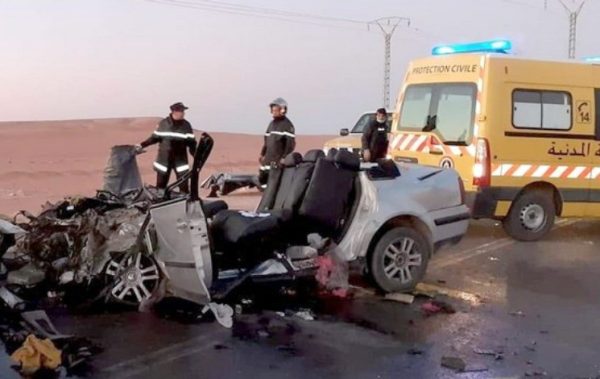
Nearly 215 traffic accidents resulting in 83 deaths were recorded during the first ten days of the month of Ramadan. Compared to last year, this toll is up and proves alarming. This is what representatives from the National Gendarmerie, the General Directorate of National Security (DGSN), and Civil Protection indicated this Monday during a forum titled “Ramadan Without Accidents: Collective Responsibility and Road Safety.”
Guest at the Dk news forum, Ms. Laib Rachida, commander in the National Gendarmerie specializing in road accident prevention, stated that “traffic accidents always have a particular impact, especially during the month of Ramadan, a period when habits and behaviors change,” specifying that the GN has put in place a special plan for this month. This plan is based on a set of measures, including strengthening territorial units and human resources to ensure the safety of citizens and roads. Prevention against this “road terrorism” involves, according to her, mobilizing all stakeholders, security services, and various partners.
Regarding the traffic accident toll, she indicated that “during the first ten days of the month of Ramadan, our units recorded 215 accidents that caused the death of 83 people and injured 342,” marking an increase compared to the first ten days of Ramadan 2025, when 198 accidents were recorded, causing 78 deaths and 342 injuries.
This increase is mainly explained by “human factors: speeding, dangerous overtaking, driver inattention, left-side driving without caution, failure to respect safety distances and signage,” she added. The wilayas with the highest number of accidents are Algiers, Chlef, El Oued, and Djelfa. The most involved categories remain young drivers and motorcyclists, which contributes to the rise in the number of victims.
Ms. Laib also announced that an awareness campaign has been launched under the slogan “Speed Kills,” emphasizing respect for speed limits, caution during overtaking maneuvers, and wearing seat belts. Particular attention is given to long-distance travel, especially to southern wilayas, as well as family trips at the end of the week, which can lead to fatigue and loss of concentration.
Finally, it was recalled that “road safety is a collective responsibility.” It “does not solely concern security services or media institutions, but requires the combined efforts of civil society, educational establishments, media, and above all the family,” which plays “a fundamental role in instilling values of discipline and responsibility.”
The three institutions took advantage of this meeting to demonstrate the extent of their constant commitment to protecting citizens. The information officer at the General Directorate of Civil Protection, Lieutenant Hakim Benaida, emphasized that the human factor remains the main cause of accidents. He specified that “Civil Protection remains fully mobilized to ensure rapid and effective interventions for the protection of citizens throughout the month of Ramadan.”
The holy month imposes particular organization on Civil Protection due to changes in habits and schedules, which “gives our interventions a specific character.”
In addition to operational work, Lieutenant Benaida stated that Civil Protection conducts significant awareness efforts through campaigns in mosques, especially during Ramadan when they see high attendance from the faithful. Others are carried out in coordination with various partners, whether at the neighborhood level or in school establishments. All this fits into a preventive and strategic approach adopted by the General Directorate of Civil Protection.
It should be noted that accidents involving collective transport are often more serious, with multiple victims, requiring significant mobilization of intervention units. Not to mention that the month of Ramadan has its particularities, including fatigue, haste as iftar approaches, and decreased concentration. According to the same official, some drivers, particularly in passenger transport, drive at high speeds to make up for delays or arrive on time before iftar. This unfortunately causes serious accidents. These collective transports are often heavier, with multiple injuries and sometimes several deaths, requiring significant mobilization of intervention units. “We finally remind that the emergency numbers 14 and 1021 are available to citizens 24/7.”
For his part, Zouaoui Rabah, divisional commissioner and head of the communication office at the General Directorate of National Security (DGSN), also insisted on “respecting the specificities of this holy month” and on “the importance of security measures taken in this context, as preventive measures,” affirming that DGSN services work “to anticipate risks and control consequences in order to preserve the value and sanctity of this blessed month.” The institution is tasked with “a major role in protecting people and property, maintaining public order, and fighting all forms of crime,” he indicated.
Among the measures adopted are strengthening security coverage of various sectors, adapting police work to the month’s requirements, increased surveillance of crowded public places, particularly markets and public squares, as well as securing mosques and cultural and religious events.