

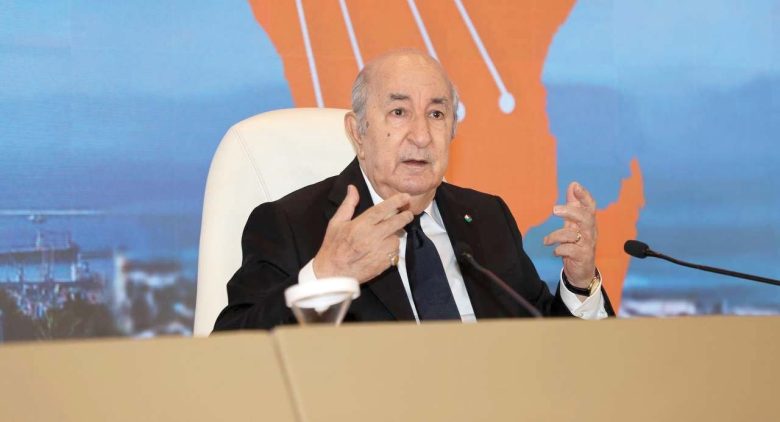
The President of the Republic, Abdelmadjid Tebboune, called this Monday on African countries to mobilize in order to have colonialism recognized as a crime against humanity and to enshrine its penalization in international law. This came during a high-level meeting held on the sidelines of the 39th ordinary session of the Conference of Heads of State and Government of the African Union, in Addis Ababa.
President Tebboune affirmed “Algeria’s full and constant support for all initiatives of the African Union Commission and its specialized legal bodies,” which work to explicitly include colonialism among “the most serious international crimes.” In a message read on his behalf by the Prime Minister, Sifi Ghrieb, he emphasized that such an approach would “consolidate the principles of accountability, put an end to impunity, and lay the foundations for equitable historical justice.” The meeting was dedicated to examining the legal implications of classifying colonialism as a crime against humanity, as well as reclassifying certain practices related to slavery, forced deportation, and colonial domination as acts that could constitute genocide against African peoples. The discussions were based on the in-depth study prepared by the African Union Commission on International Law.
The head of state praised it as “a rigorous study of high scientific quality,” seeing it as “a major qualitative contribution to building a collective African legal thought.” He stressed that this work “sheds light on the direct legal consequences of recognizing colonialism as a crime against humanity” and paves the way for “a normative reinterpretation of enslavement practices, forced displacement, and systemic domination.”
President Tebboune also called for “a clear and unequivocal international recognition” of the criminal nature of practices that marked the slave trade, deportation, ethnic cleansing, torture, and systematic oppression policies. Practices that, according to the head of state, “stand out for their scale and brutality in contemporary history.”
In this context, Algeria expressed its readiness to make available to the competent African bodies “all the archives, material evidence, and historical testimonies in its possession,” drawing on an experience of colonialism that lasted more than 132 years. The presidential message referred to “the massive crimes perpetrated to stifle the Algerian people’s resistance,” including the use of methods prohibited by international law.
———–The Algiers Appeal, Matrix of an African Front
President Tebboune also returned to the joint initiative of Algeria and the African Union Commission, which led to the holding, on November 30 and December 1, 2025, of an international colloquium under the theme: “Crimes of Colonialism in Africa: Toward the Consecration of Historical Truth and the Criminalization of Colonialism.” This meeting concluded with the adoption of the Algiers Appeal, which notably recommends the official recognition of colonial crimes, their explicit inclusion in international law, and the strengthening of mechanisms for documentation and preservation of African memory.
In the same dynamic, Algeria welcomed the adoption of its proposal to establish an African Day dedicated to the memory of the continent’s martyrs, celebrated every November 30, in order to “transmit to future generations the awareness of the sacrifices made for freedom and dignity.”
On the domestic front, President Tebboune described as a “decisive sovereign step” the adoption on December 24, 2025, by the Algerian Parliament, of a law criminalizing the colonialism suffered by Algeria. He specified that this text aims to “assign legal responsibilities, preserve national memory, and enshrine the principle of imprescriptibility for serious crimes.”
In conclusion, from his intervention, the President of the Republic declared that “the sacrifices of millions of Africans for freedom and dignity cannot be consigned to oblivion or diluted in truncated narratives.” For Algiers, “the recognition of historical truth is neither an exercise in selective memory nor a dispute from the past, but a moral and legal imperative,” a condition for an international order founded “on law and equity, rather than on power relations.”
It should be noted that the meeting dedicated to the criminalization of colonialism was marked by broad support for the declaration presented by Algeria, hailed as a concrete contribution to African efforts to have colonialism recognized as a crime and to open the way to reparations.
Participants considered that the Algerian initiative fit into a continental dynamic of reclaiming history and defending the dignity of African peoples. Several speakers emphasized that the issue of reparations no longer belongs solely to the moral register but now constitutes a political and legal demand carried collectively by African states.
A strong tribute was also paid to the President of the Republic, Abdelmadjid Tebboune. Participants expressed their gratitude for “his constant commitment to the security, stability, and development of the continent,” as well as for his affirmed attachment to preserving African memory. They highlighted Algeria’s active role in strategic African dossiers, particularly regarding peace and historical justice.
In the extension of these discussions, it was proposed to adopt November 30 as the “African Day of Remembrance for African Martyrs and Victims of the Transatlantic Slave Trade, Colonialism, and Apartheid,” in order to permanently inscribe in the continental calendar a moment of reflection and mobilization around the tragedies that marked the history of the African continent.