

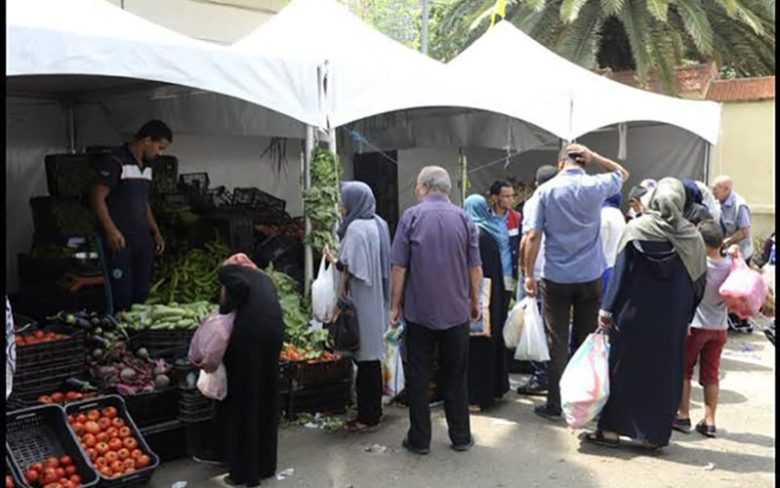
A few days before the start of the month of Ramadan, markets and large stores in certain neighborhoods of the capital are already being stormed. Tableware, fabrics, decorations, and household appliances compete for attention in an atmosphere blending tradition, anticipation, and a desire for renewal, revealing a true frenzy of consumption.
In this context, the Jeune Indépendant team toured several markets and shops in the capital to gauge the pulse of this commercial effervescence. As a quintessential popular neighborhood, Bab El Oued remains a preferred destination for many citizens, some coming from distant municipalities. Its reputation rests on a weighty argument: prices considered more affordable than in other parts of the capital.
Tableware shops are particularly in demand there. Plates, bowls, dishes, and complete sets line the stalls. Welcoming and resourceful merchants compete in ingenuity by displaying their finest models to seduce an ever-growing clientele. Prices vary according to the quality and origin of the products.
In this lively atmosphere, vendors call out to passersby at the top of their lungs: “100 dinars per plate! You’ll find what you’re looking for and have a pleasant Ramadan with new tableware!” calls one of them, smiling. The call does not go unnoticed. For these prices deemed accessible, female customers often buy without much hesitation, and the shops buzz like beehives.
Karima, visibly enthusiastic, addresses a young seller: “Brother, please, I want two kits for six people.” The promoted product is immediately packaged. The customer chooses different colors: “For this price, I’m buying the second one to give to my sister-in-law,” she confides to her friend.
Not far away, Zahia buys an air fryer offered at 15,000 dinars, as well as a complete table service and a few additional items. “For this Ramadan, I want to please my family. This is my first paycheck; I hope to have my parents’ ‘baraka’,” she explains.
Fabric stores are no exception. Halima, a young mother, inquires about the prices of curtains, kitchen valances, tablecloths, placemats, and napkins. After her purchases, she heads to a seamstress located nearby to handle these fabrics. “She’s a true artist. The result is as beautiful as ready-to-wear,” she affirms. She adds: “I’m satisfied; for only 4,500 dinars, I’ve changed the look of my living room. I’m ready to receive my loved ones during the holy month.”
Leaving Bab El Oued for Oued Romane, the commercial atmosphere shifts. Here, no popular market, but rather mini-supermarkets and more structured shops, also very crowded. The offerings are more diverse and often more modern, with more refined finishes, but prices are noticeably higher. “Two knives are offered for 500 dinars. It’s more expensive than in Bab El Oued; it’s just that the choice is wider,” estimates a customer encountered in a mini-supermarket.
Preparing for Ramadan remains a deeply rooted tradition among Algerians. Cleaning the domestic space, renewing the table, and beautifying the home are part of a family ritual passed down from generation to generation.
Through the commercial arteries of Algiers, the effervescence is palpable. Shoppers with baskets in hand and carefully prepared lists roam the neighborhoods in search of good deals. Bowls at 200 dinars, saucers at 150 dinars, table kits ranging from 750 to 1,450 dinars: everyone tries to anticipate expenses. “We prefer to buy now, before prices rise even more,” confides a mother who came to renew her tableware.
Between tradition, economic anticipation, and desire for renewal, the consumption frenzy takes hold, reminding us each year that Ramadan, beyond its spiritual dimension, remains a major moment in social and commercial life.