

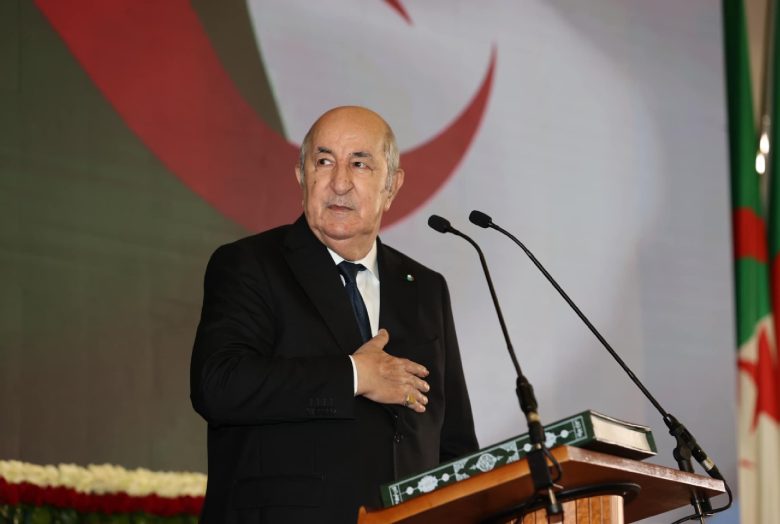
In Addis Ababa, at the 39th ordinary session of the Conference of Heads of State and Government of the African Union, the President of the Republic, Abdelmadjid Tebboune, firmly reaffirmed Algeria’s steadfast position on the security, humanitarian, and political crises shaking the continent.
In a message read on his behalf by Prime Minister Sifi Ghrieb, the head of state reiterated Algeria’s unwavering commitment to the sovereignty, territorial integrity, and stability of African states, emphasizing that “our constant position on the conflicts striking the continent remains unchanged.”
The session dedicated to the report of the AU Peace and Security Council provided the president with the opportunity to review the main hotspots of tension. Right from the start, he expressed Algeria’s “total support” for the sovereignty and integrity of the Democratic Republic of the Congo. The resurgence of violence threatening the national unity of this brother country has raised concerns in Algiers, which calls for continental mobilization to curb the escalation and preserve the cohesion of the Congolese state.
Addressing the Sahel region, which has become the epicenter of multifaceted threats, President Tebboune underscored “the importance of an integrated approach linking security and development, addressing the social and economic causes of violent radicalism.” For the head of state, the response cannot be exclusively military. It must tackle the deep roots of extremism, including marginalization, poverty, and lack of prospects for youth. This comprehensive vision, long defended by Algeria, fits into a logic of sustainable conflict prevention.
The situation in Libya, marked by multiple interferences and persistent internal fractures, also held a central place in the presidential address. “Algeria supports the intra-Libyan political process and continental and UN efforts to bring the positions of Libyan brothers closer together,” affirmed the President of the Republic. He recalled that “the only solution to the crisis lies in organizing free and transparent elections, as well as the immediate and complete withdrawal of all foreign forces and mercenaries,” an essential condition to ensure Libyan unity and sovereignty.
Regarding Sudan, plunged into unprecedented violence and a deep humanitarian crisis, the president expressed his “deep concern over the human tragedy and unprecedented violations.” Welcoming “the central role of the African Union in its efforts to resolve the crisis,” he called for “an immediate ceasefire and the launch of a sovereign and inclusive Sudanese national dialogue” to end the bloodshed and meet the legitimate aspirations of the Sudanese people.
In the Horn of Africa, a strategically vital region marked by recurrent tensions, Abdelmadjid Tebboune emphasized that “respect for the sovereignty and integrity of states and the peaceful settlement of disputes through constructive dialogue are essential,” insisting that these principles be fully integrated into the AU’s mechanisms.
On the question of Western Sahara, the president reaffirmed that “Algeria fully supports the UN’s efforts to achieve a just, lasting, and mutually accepted political solution, in line with the principles of the UN Charter and the relevant Security Council resolutions.” He underscored the importance of maintaining constructive engagement under UN auspices and the Personal Envoy of the Secretary-General, in respect of international law.
Beyond these specific crises, the head of state warned against illegitimate foreign interventions, described as “true catalysts of instability.” Declaring that “external interferences remain one of the main factors of instability and constitute a major obstacle to conflict resolution and democratic construction on the continent.” To meet these challenges, he called for the full implementation of the African peace and security architecture and the realization of the principle of “African solutions to African problems.”
————-Tightening Ranks Against UN Blockages
In another context, on the sidelines of the Addis Ababa summit, Algeria’s voice was raised during the meeting of the Committee of Ten (C10) on UN Security Council reform. In his message, President Tebboune issued a stark assessment of the international situation, marked by “the alarming escalation of conflicts” and “the proliferation of tension hotspots,” denouncing a “clear institutional dysfunction” that paralyzes the effectiveness of the multilateral system.
He pointed out that this impotence undermines confidence in international law, fuels double standards policies, and revives the logic of force at the expense of justice and equality principles. Explaining that Africa bears “a disproportionate share of intertwined crises,” whether the expansion of terrorism, organized cross-border crime, the resurgence of armed conflicts, or the proliferation of unconstitutional changes of government.
In this context, Abdelmadjid Tebboune hammered home that Africa’s place on the Security Council is “neither a favor nor a concession,” but “a historic right.” With its geopolitical weight, economic potential, and civilizational contributions, the continent deserves “fair and permanent representation” in the most powerful executive body of the UN system. “This is not a circumstantial claim, but a long-overdue justice that must now be restored,” he affirmed, denouncing a “structural anomaly” that must be corrected without delay.
In conclusion, the President of the Republic called on African states to close ranks against attempts to weaken or fragment the continent’s common position. Resisting pressures, speaking with one voice, and defending a credible and equitable reform of the multilateral system are, according to him, the indispensable condition for securing Africa’s rightful place.