

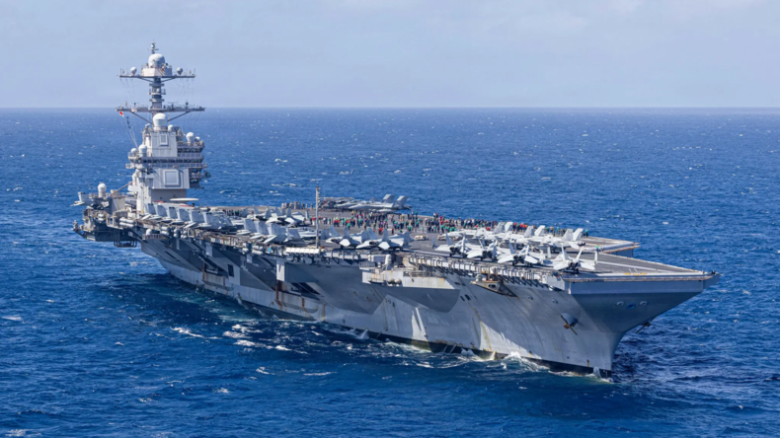
Washington is strengthening its military presence in the Middle East. The aircraft carrier Gerald R. Ford, involved in the US operation against Venezuela, is set to join the naval group of the Abraham Lincoln in the Persian Gulf. This decision comes amid tensions between the United States and Iran.
Deployment Details
The USS Gerald R. Ford, the world’s largest aircraft carrier, is preparing to leave the Caribbean Sea to head to the Middle East, according to US military officials cited by the New York Times. The ship and its escort group will integrate into the naval deployment already in place around the USS Abraham Lincoln in the Persian Gulf. Initially deployed in June 2025 for a mission in Europe, the Gerald R. Ford was later redirected to the Caribbean as part of US operations against Venezuelan President Nicolás Maduro. On January 3, aircraft from the carrier participated in the raid on Caracas that led to the illegal abduction of the Venezuelan leader and his wife. This operation drew widespread international criticism over US military interference in Latin America.
Pressure on Iran Amid Talks
The redeployment of the Gerald R. Ford extends a mission already prolonged once. According to the New York Times, the 4,000 crew members will not return to base before late April or early May, delaying scheduled maintenance on the ship. This move fits into the US strategy to pressure Iran into altering its nuclear program. President Donald Trump recently warned that failure of negotiations could lead to a “very harsh” military response. Indirect talks took place this February in Oman between US and Iranian representatives. While both sides described the dialogue as “constructive,” no concrete compromises were reached. Tehran continues to defend its right to uranium enrichment for civilian purposes. “We will not yield to excessive demands,” declared Iranian Foreign Minister Abbas Araghchi.
Regional Escalation Concerns
With the Gerald R. Ford’s arrival, the US will have two carrier strike groups in the region, and a third, the USS George H. W. Bush, could also be mobilized. This buildup adds to an existing presence of destroyers, cruise missiles, and air units. The force concentration occurs in a Middle East already weakened by recent conflicts, with some regional states fearing a direct US-Iran confrontation could spark an unprecedented regional escalation. In Iran, the domestic situation remains tense, with ongoing mourning ceremonies for victims of recent unrest drawing crowds and heightening internal political pressures.
The White House confirms a more offensive regional policy in the Middle East without specifying deployment duration. This shift highlights Washington’s growing reliance on military means to impose conditions in international negotiations.