

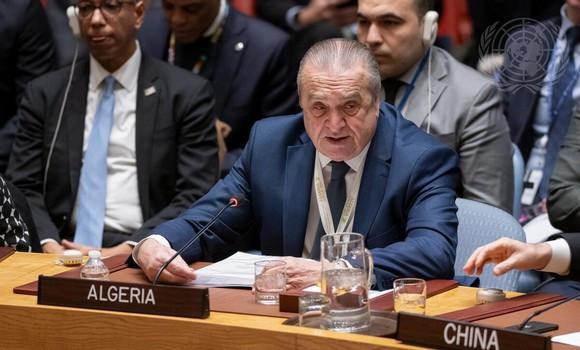
During the Security Council session dedicated to the situation in Libya, Algeria’s permanent representative to the United Nations, Amar Bendjama, speaking on behalf of the African group A3+, delivered a firm yet nuanced statement, calling on the international community to redouble efforts to support Libya on its path toward stability and regained sovereignty.
At the start of his speech, Bendjama praised the progress made by the Government of National Unity and the Libyan Presidential Council, emphasizing that “the key agreement reached helped ease tensions in the capital and create a more serene political dynamic.” According to him, this agreement represents a major step as it provides for the return of several strategic infrastructures to state institutions, a move that, he said, “reflects the total rejection of militarization in all regions of the country.”
The diplomat reaffirmed the A3+ group’s support for ongoing efforts to reform the security sector, as well as the initiative to dismantle illegal armed groups. “It is essential that the monopoly of force returns solely to the Libyan state,” he stressed, while calling on national actors to pursue inclusive and peaceful dialogue.
On the political front, Bendjama expressed the A3+ group’s hope to see “the second phase of municipal elections held in 16 constituencies starting October 18, before beginning the third phase from October 20.” He recalled that these milestones “represent a democratic test to consolidate institutional legitimacy in Libya.”
Addressing the economic dimension, Algeria’s representative voiced concern over the persistent budget crisis and the absence of unified public finances. However, he welcomed “the decision by the President of the Presidential Council to initiate a comprehensive financial audit in the oil and electricity sectors,” considering this move “aligned with transparency and good governance.”
Bendjama also condemned the mismanagement of frozen Libyan assets and the failure to comply with Security Council resolution 27/69, particularly paragraph 14, which authorizes the Libyan Investment Authority to “invest frozen reserves in order to preserve their value.” For him, “it is unacceptable that the wealth of the Libyan people remains blocked while the country faces one of its most difficult economic and social situations.”
But it was especially on the security aspect that the ambassador delivered a clear message. “Political settlement in Libya remains out of reach as long as foreign interference persists,” he warned, pointing to the continuous flow of weapons and the presence of mercenaries on Libyan soil.
In an unequivocal appeal, Bendjama demanded the immediate withdrawal of all foreign forces and mercenary fighters. “This is the primary condition to restore Libya’s full sovereignty and allow Libyans to freely decide their future,” he underlined.
Finally, the diplomat recalled Algeria’s consistent position, based on respect for Libya’s unity, territorial integrity, and sovereignty, and urged the international community to support national reconciliation efforts without interference. “Peace in Libya will be built neither under bombs nor under foreign interests. It will be born from the will of the Libyans themselves, supported but never replaced by the international community,” concluded Amar Bendjama.