

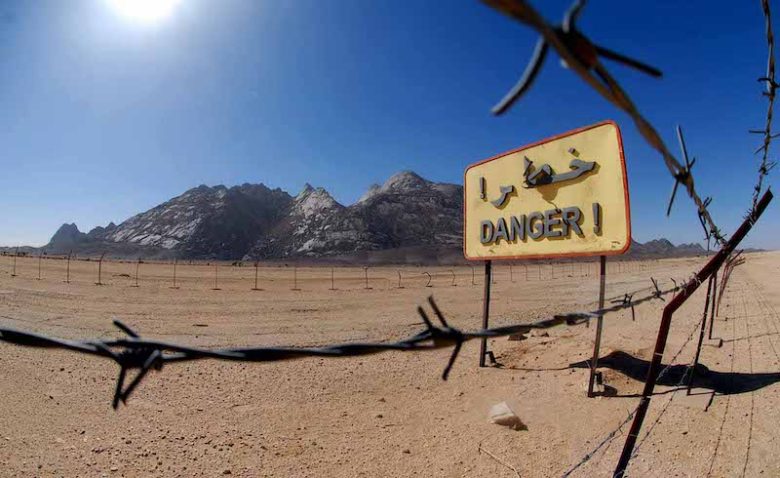
Sixty-six years after the first French nuclear explosions in southern Algeria, at In Ekker in the Tamanrasset wilaya, Algeria has launched the first partial depollution operation of the nuclear test sites, carried out exclusively by national expertise. This was announced by the Ministry of National Defense (MDN) in a documentary titled “Algerians at the Heart of the Challenges.”
The documentary, produced by the MDN’s Directorate of Information and Communication and broadcast this past Thursday evening, specifies that work has begun on the Taourirt Tan Afella site, the location of the underground “Beryl” test, considered one of the most dangerous in the entire series of experiments conducted by colonial France in Algeria. The documentary adds that this scientific and memorial project is part of a firm commitment to “restore environmental sovereignty” over lands long scarred by a toxic colonial legacy.
On May 1, 1962, at In Ekker, France carried out an underground nuclear test with an estimated yield of 150 kilotons of TNT. The operation, presented at the time as controlled, turned out to be a major technical failure. The gallery intended to contain the explosion cracked, causing a massive leak of radioactive gases, the formation of a contaminated cloud, and projections of highly irradiated lava. More than six decades later, persistent traces of cesium-137 and plutonium continue to be detected in the area. The soils, rocks, and ecosystem still bear the scars of an accident that some specialists describe as a “nuclear catastrophe in the middle of the desert.”
The extent of the contamination exceeds 40 hectares, sweeping away French claims that the tests were “clean” and the waste “permanently eliminated.” Archival images and scientific analyses presented in the documentary reveal a far darker reality: an uncontrolled radioactive cloud, flows of contaminated materials, and a lasting impact on the ecological balance of the massif.
After decades of studies, scientific surveys, and coordination between various ministerial sectors, Algeria has decided to launch a pilot partial depollution operation. Placed under the supervision of the Ministry of National Defense, it mobilizes Algerian experts, engineers, and technicians from several institutions.
————-Transforming a Toxic Past into an Act of Sovereignty
A depollution camp has been set up on the site, “the first of its kind at this level,” according to the documentary, with the aim of serving as a model for broader and deeper rehabilitation of the other contaminated sites. The operation involves identifying irradiated zones, collecting radioactive waste, and packaging it in specially designed concrete containers, in strict compliance with safety standards.
However, the task is made more complex by “the absence of French maps and archives” detailing the exact burial zones and contamination perimeters. This historical opacity complicates the mapping of hotspots and requires meticulous fieldwork based on scientific surveys and in-depth radiological analyses.
Faced with this challenge, the Algerian teams affirm their determination. The documentary emphasizes that national expertise “rises to the challenge with professionalism and commitment,” driven by the conviction that “every inch of this land must be restored.”
Addressing the history of this colonial crime, the documentary features testimony from nuclear physicist researcher Ammar Mansouri, who recalls that French nuclear tests in Algeria began on February 13, 1960, at Reggane, with the explosion named “Blue Gerbil,” followed by “White Gerbil,” “Red Gerbil,” and “Green Gerbil.” These atmospheric explosions, among the most powerful of the time—reaching five times the power of the Hiroshima bomb—dispersed radioactive fallout over vast territories. He noted that the surface explosions, particularly dangerous, drew sharp international criticism. Under pressure, France continued with underground experiments, notably at In Ekker. But the Beryl accident demonstrated the technical limits of these operations, revealing it as an “uncontrolled underground test” whose effects were far from contained.
Researcher Mansouri denounced the fact that waste from the experiments “was not buried according to rigorous technical standards,” contrary to official French statements. Studies have confirmed the persistence of contamination, particularly in the Reggane region, known for hosting one of the largest aquifers. According to Mr. Mansouri, “the dispersion of radioactive elements poses a permanent risk to ecosystems and human health.”
For his part, physicist Hassan Hussein speaks of “lingering effects still perceptible to this day,” whether chronic pathologies or lasting environmental impacts. For him, “the effects of the nuclear tests are not a thing of the past, but a present that continues to weigh on local populations.”
In the face of these poisoned legacies of French colonialism, through this depollution operation, Algeria intends to affirm that it is “capable of rising to all challenges and transforming trials into victories.” The experts mobilized on the ground are waging what the documentary calls a “war against a hidden but toxic and deadly colonial legacy.”
The stakes go beyond the purely environmental dimension. They touch on national memory, historical justice, and the dignity of a people who refuse to let their territory remain a silent witness to imposed experiments. By launching the depollution of In Ekker, Algeria asserts its will to “close, through science and sovereign action, one of the deepest wounds in its contemporary history,” committing to transform an imposed toxic past into a site of repair and a trauma into an act of sovereignty.